


“Where do your Google reviews come from?” Ask a property manager that question and the honest answer, most of the time, is “angry residents”. The people motivated enough to write about you unprompted are rarely the ones you helped move in smoothly last month. They’re the ones whose AC took nine days to fix.
That’s the structural unfairness property management and reputation management have to solve: your unhappiest audience writes for free, while your happiest one stays silent unless asked. And the stakes aren’t cosmetic. Research has found that 96% of renters find online reviews important to their decision-making, and prospective owners run the same Google search before they ever fill in your contact form.
The fix is a sequencing trick and here’s the full playbook.
Key Takeaways
- Reviews come from asking, and asking works best right after a survey confirms the person is happy. Promoters asked at the right moment convert; cold blast requests mostly don’t.
- Property management has two review audiences with different jobs: resident reviews fill vacancies, owner reviews win management contracts. Run both streams deliberately.
- Time the invite to goodwill peaks: a resolved maintenance ticket, a smooth move-in, a completed tenant placement, a renewal just signed.
- Never gate. Inviting only happy people to review after they know their score is a policy risk and, long-term, a trust risk. Invite based on moments. Let the survey handle triage before the invite goes out.
- A bad review answered quickly, specifically, and calmly does less damage than a good review left to stand alone. Prospects read your replies as a preview of your service.
The Two Review Audiences (and What Each One Sells)
Most reputation advice treats “get more reviews” as one job. In property management it’s two, and they pay differently.
Resident reviews fill vacancies. This is the multifamily reputation management half of the job. A prospective renter comparing two similar listings reads your Google and apartment-site reviews the way they’d read a menu. Volume, recency, and the tone of your replies decide whether they book the showing. Every week, a unit sits empty because your rating scared off applicants is money the owner watches you lose.
Owner reviews win doors. When an investor searches “property management company [your city]”, the map pack and its star ratings are your first sales conversation. A firm with 40 reviews at 4.6 gets the call; the firm with 9 reviews at 3.8 doesn’t get to explain itself. Reviews written by owners, mentioning owner concerns (statements, communication, vacancy handling), are the most persuasive sales collateral you can’t write yourself. Reviews are one lever for winning new doors; the full acquisition playbook lives in how to get property management clients.
The practical implication: you need review streams from both audiences, triggered by different moments, and your survey program is what tells you who’s ready to write one. (If you don’t yet have that program, start with the property management CX survey guide; the review engine bolts onto it.)
Survey First: Why the Order Matters
You could skip the survey and just ask everyone for a review. Firms do. Two problems follow.
First, you’re inviting your Detractors to the most visible microphone you own. The property management CX study found residents averaging NPS 10 across the industry, which means a blind review blast reaches a lot of people whose honest review you don’t want published this week. You want their feedback, urgently, but privately first, while it’s still fixable.
Second, cold asks convert poorly because they arrive contextless. “Please review us” in a random newsletter is an errand. The same ask, arriving the day after someone told you they’d rate their move-in five stars, is nearly frictionless: they’ve already composed the opinion; you’re just offering it a venue.
So the sequence is: survey the moment, read the score, then branch. High scores get a warm invite with a direct Google link. Low scores get a human. This is the same Promoter-routing logic we describe in turning NPS feedback into reviews and referrals, tuned for PM’s two audiences. On Retently, the branch runs automatically: the follow-up a respondent sees adapts to the score they gave, so Promoters get the review invitation while Detractors get an acknowledgment and a fast internal alert.
The Moments That Mint Reviews
Timing does most of the work. These are the goodwill peaks worth wiring an invite to, per audience:
Residents
- Move-in, around day 30. They’re settled, the boxes are gone, and the leasing experience is still fresh. A good move-in survey score is the single best review trigger you have. (What to ask at move-in is covered in the tenant survey playbook.)
- A resolved maintenance ticket. Counterintuitive but potent: a resident whose problem just got fixed fast is often more enthusiastic than one who never had a problem. Trigger from a top score on the maintenance satisfaction survey.
- A signed renewal. They just voted to stay with their wallet. If their relationship NPS is high, this is the natural “would you say that publicly?” moment.
Owners
- A completed tenant placement. The unit is filled, rent is flowing, and your value is at its most visible.
- A strong quarterly NPS response. An owner who scores you 9 or 10 and writes a warm comment has essentially drafted their review already. The invite just asks them to paste it somewhere public.
- An anniversary. “One year together” messages with a review invitation land well with owners whose trend line has been steady.
Keep the invite short, personal, and one-click: a direct link to your Google profile, a sentence acknowledging what they said, and no begging. And throttle it. One review ask per person per year is plenty. Repetition converts goodwill into irritation.
The Gating Line You Must Not Cross
A warning that saves firms real pain: review gating, meaning you ask happy people for public reviews while deliberately suppressing unhappy people’s ability to post, violates Google’s policies. Google’s prohibited content rules bar selectively soliciting positive reviews, and platforms have removed review sets from businesses caught doing it.
The clean way to stay on the right side of the line: base your invites on moments and audiences, not on a hard score filter that hides the review link from anyone unhappy. Everyone who asks for a way to review you gets one. What the survey changes is sequencing and emphasis: unhappy respondents get a human conversation first, which most of them prefer anyway. People with a fixable complaint would rather have it fixed than published. The ones determined to post publicly will do so regardless of your workflow, and your reply (next section) is where you win that exchange.
Also, never buy reviews, never review yourself, and never let staff pose as residents. Beyond the policy risk, locals can smell it, and one exposed fake costs more trust than ten honest three-star reviews.
Keeping Detractors Out of Public Threads
The defensive half of reputation is giving unhappy people a faster, better channel than Google.
Speed is the whole mechanism. A resident with a grievance escalates to a public review when they believe nothing else will work. Every hour between their low survey score and a human response raises the odds they’re right. The firms that protect their ratings run a hard SLA: Detractor alert lands, a named person calls within one business day, and the resident hears a concrete next step, not a sympathy template. The mechanics are the same Detractor recovery loop any industry runs. PM just runs it on a shorter fuse because the public venue is one tap away.
One more defensive layer: make complaining to you easy at all times, not just post-survey. A visible “something wrong? tell us first” path in the portal and in email signatures catches frustration on days your survey didn’t happen to arrive.
Responding to the Reviews You Do Get
Prospects read your replies more carefully than the reviews themselves, because the replies are the only part you wrote.
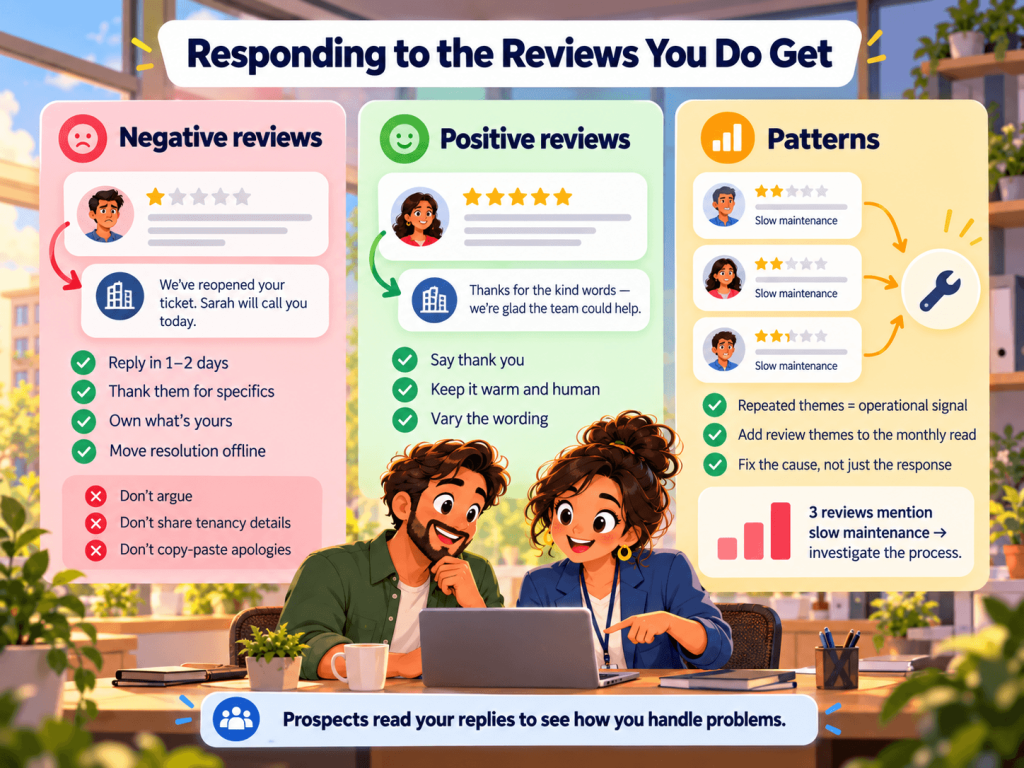
For negative reviews: respond within a day or two, thank them for the specifics, own what’s yours without litigating details in public, and move the resolution offline (“we’ve reopened your ticket and Sarah will call you today”). Never argue, never reveal tenancy details, never copy-paste the same apology. A calm, specific reply under an angry review tells every future reader how you handle problems, which is exactly what they’re trying to find out.
For positive reviews: a short, warm, varied thank-you. It signals the reviews are read by humans, which encourages the next one.
For patterns: three reviews mentioning slow maintenance isn’t a PR problem, but an operations finding wearing a PR costume. Feed review themes into the same monthly read as your survey drivers, and fix the cause rather than polishing the response.
Conclusion
Reputation management for property managers is the public shadow of your feedback program. Survey the moments that matter, hand the microphone to the people who just told you privately how good you were, and reach the unhappy ones before the review form does. Firms that run this sequence stop being hostage to their angriest residents and start compounding proof, one five-star review at a time, that they’re worth renting from and worth hiring.
Retently automates the sequence end to end: score-adaptive follow-ups that route Promoters to your Google profile, instant Detractor alerts with assignment, and separate owner and resident streams. Start a free trial or book a demo and let your happiest customers do the talking for once.
Frequently Asked Questions
How do property management companies get more Google reviews? By asking at the right moments: after a good move-in, a resolved maintenance request, a signed renewal, or a completed tenant placement. Running a survey first and inviting the people who scored the experience highly converts far better than cold requests, and keeps unhappy feedback in a private recovery channel first.
Is it legal to ask only happy tenants for reviews? Selectively soliciting positive reviews (review gating) violates Google’s review policies and can get reviews removed. Base invitations on moments rather than hiding the review option from unhappy people, and give everyone a route to review you. Use the survey to sequence the private conversation first.
Should property managers respond to negative reviews? Yes, quickly and specifically. Thank the reviewer, acknowledge the concrete issue, avoid disputing details or revealing tenancy information publicly, and move resolution offline. Prospective residents and owners read your replies as evidence of how you’ll treat them when something goes wrong.
Do reviews actually affect occupancy? Recent research has found that 96% of residents choose communities with better online reputation, and prospective owners screen management companies by star rating before making contact. Reviews function as pre-sales for both audiences: residents fill vacancies, owners bring doors.

 Christina Sol