



“How do we get more doors?” is the question every property management operator brings to every conference, and the answers on offer are always the same: buy ads, hire a BDM, cold-call landlords, sponsor the local investor meetup. All of it works a little. All of it gets more expensive every year, because every competitor in your metro has heard the same talk.
Here’s the question almost nobody asks back: where did your best current clients come from? Run that analysis at most established firms and a pattern appears. The owners with the longest tenure, the fullest portfolios, and the fewest headaches came from referrals and reputation, not from ads. Which means the highest-yield growth channel most PM companies own is the satisfaction of the clients they already have, and it’s the one channel nobody manages on purpose.
This playbook is about managing it on purpose: the leaky-bucket math, the referral engine, the review flywheel, and the proof-based pitch that wins the doors your ads can’t.
Key Takeaways
- Acquisition spend on top of unmanaged churn is negative growth: a firm winning 60 doors while losing 80 is shrinking expensively. Fix the bucket before scaling the tap.
- Referrals convert better and stay longer than any paid channel, and they can be systematized: ask at the moment an owner scores you 9 or 10, not at random.
- Reviews are your always-on BD channel. The survey-first review engine is a separate playbook worth running deliberately.
- Measured satisfaction is sales collateral competitors can’t copy: an owner NPS above the industry benchmark, shown in the pitch, answers the prospect’s real question (“what’s it like to be your client?”) with evidence.
- All three engines run on the same feedback program. Growth is a byproduct of the listening infrastructure, which is why firms with the best scores also tend to grow at the lowest cost.
First, the Bucket: Growth Math Nobody Likes
Before spending another dollar on acquisition, do the arithmetic that determines whether the acquisition even helps.
Doors in, doors out, per year. A firm that added 60 doors and lost 80 didn’t grow slowly; it shrank while paying marketing costs. And the two numbers aren’t independent: the service problems driving owners out also leak into reviews and referrals, quietly raising the cost of every new door. Marketing into churn is filling a leaking bucket with a more expensive hose.
The property owner retention playbook covers patching the bucket in full. For this article, the point is sequencing: the feedback program that fixes retention is the same infrastructure the three growth engines below run on. You’re not choosing between keeping doors and winning doors – the machinery is shared.
Engine 1: The Referral Ask, Timed by Score
Ask operators whether they get referrals, and everyone says yes. Ask whether they have a referral system, and the room goes quiet. The difference between the two is worth real money because a referred owner arrives pre-sold by someone they trust, negotiates less, and churns less.
The system has three parts:
Know who to ask. This is what your recurring owner NPS survey is for. An owner who scores you 9 or 10 has just identified themselves as a willing advocate. The survey found your referral sources for you. Asking a random owner for referrals is awkward. Asking a Promoter days after they called you excellent is nearly frictionless.
Ask at the peak, specifically. The follow-up to a Promoter score is the moment: a short, personal note. “Glad the partnership’s working. If you know another owner who’s tired of managing it themselves, we’d take great care of them, and there’s no better introduction than yours.” One sentence of context, one clear ask, zero forms to fill in. On Retently, the score-triggered follow-up automates the timing. The note itself should read like a human wrote it, because one did, or should have.
Make referring effortless and acknowledged. A simple forwarding line or intro email beats a referral portal. And every referral, whether it closes or not, gets a thank-you from a principal. Some firms add a referral credit. In our experience, the acknowledgment matters more than the incentive, and paying for referrals can even cheapen an act that owners were happy to do for standing. Test what fits your client base.
The pattern is the classic Promoter-activation play we’ve written about in advocacy marketing, pointed at the one audience where a single advocate can be worth a six-figure revenue stream: an owner who knows other owners.

Engine 2: The Review Flywheel
While referrals win you the doors, your clients know about, reviews win you the strangers. When an investor searches “property management [your city]”, star ratings decide which three firms exist and which forty don’t. A 2026 survey found that 96% of renters say online reviews are important to their decision-making process, and owner behavior looks no different: nobody hands their largest asset to a 3.6.
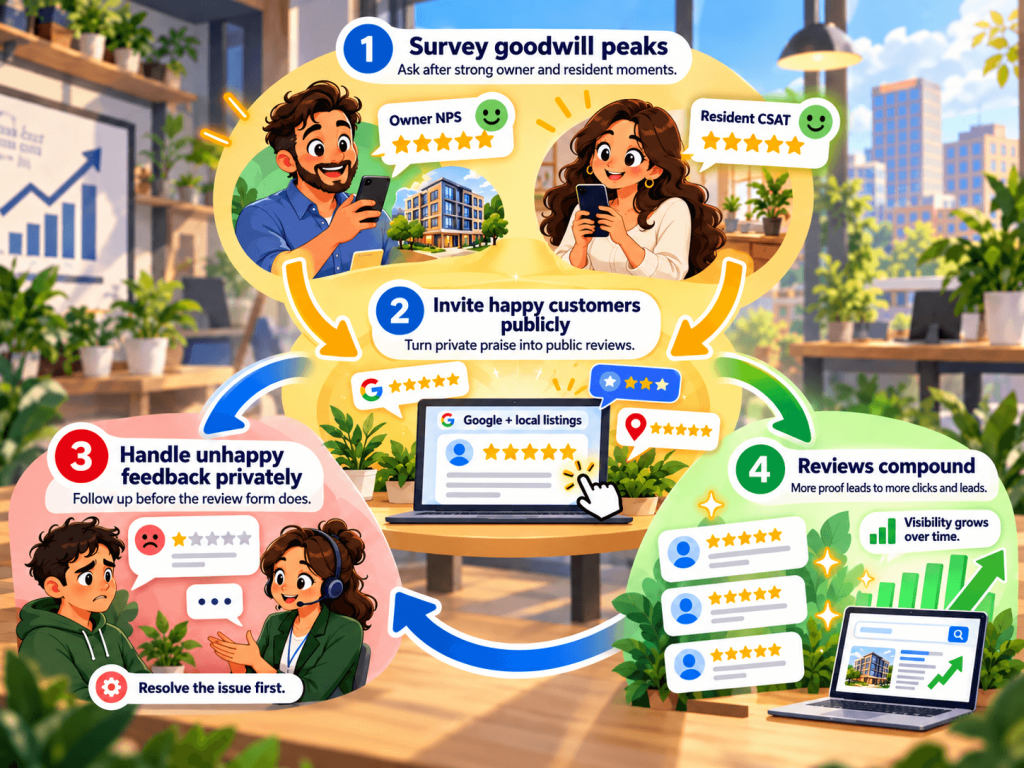
The engine, in brief: survey both audiences at their goodwill peaks, invite the delighted to say it publicly, and reach the unhappy privately before the review form does. Owner reviews mentioning statements and communication sell your BD pipeline. Resident reviews about maintenance responsiveness fill your vacancies, which is itself an owner-retention story.
We’ve written the full sequence, the timing moments, and the review-gating line you must not cross in how property managers turn feedback into Google reviews. If you build one engine from this article this quarter, build that one; it compounds daily and works while you sleep.
Engine 3: Proof-Based Selling
Now the part that changes your win rate on the deals you’re already pitching.
Every owner evaluating management companies is trying to answer one question: what will it actually be like to be your client? Most firms answer with adjectives. Responsive. Professional. Local. The prospect has no way to weigh one firm’s adjectives against another’s, so the decision collapses to fees, which is the race to the bottom you’re trying to exit.
A feedback program lets you answer with evidence instead:
- Your owner NPS, against the industry number. “Our owners rate us 48; the industry benchmark is 35” is a sentence a competitor without a program literally cannot say. That’s BlueSky Property Management’s real position, 13 points above the property management benchmark, and it turns a pitch meeting into a category of one.
- The trend, not just the level. Two years of quarterly owner scores on one slide says “we measure ourselves and improve” louder than any brochure.
- The practice itself as proof. Telling a prospect, “every quarter you’ll be asked how we’re doing, a human follows up on anything below great, and here’s the survey you’ll receive”, sells the system of accountability. Owners who’ve been burned by unresponsive managers, which is most owners shopping for a new one, buy accountability before they buy anything else.
One honesty rule: only pitch numbers you’d show a skeptic. If your scores are mid-rebuild, pitch the practice and the trend. Measured mediocrity improving beats invented excellence, and in a small market, invented excellence gets found out.

The Compounding Effect
Notice what the three engines have in common: none is a campaign. Campaigns spike and decay. These compound, because they run on relationships that renew monthly.
Every retained owner extends the referral base. Every referred owner arrives happier and refers sooner. Every review makes the next cold prospect warmer, which makes the proof-based pitch land harder, which wins doors that churn less, which improves the scores that power all of it. Eighteen months into running the loop deliberately, firms find their cost per door falling while competitors’ rise, and the gap is structural: you’re growing on infrastructure, they’re growing on spend.
The prerequisite for all of it is the measurement layer, and that’s the unglamorous truth of PM growth: the best acquisition strategy is a feedback program run well enough to brag about.
Conclusion
Door growth has a supply chain, and it starts further upstream than the marketing budget: with the owners you already serve, measured honestly, asked at the right moments, and armed with proof worth repeating. Ads rent attention, satisfaction owns it.
The infrastructure underneath all three engines is one feedback program: recurring owner NPS, score-triggered follow-ups, review routing, and benchmarks to pitch against. Retently runs it end-to-end, live within two 30-minute calls. Start a free trial or book a demo, and let your happiest owners start selling.
Frequently Asked Questions
How do property management companies get more clients? The highest-converting channels are referrals from satisfied current owners and online reputation, both of which can be systematized: use recurring owner NPS to identify Promoters and time referral asks, run a survey-first review engine, and use measured satisfaction (your NPS versus the industry’s owner benchmark) as evidence in sales pitches.
Do referral programs work for property management? Yes, when timed by satisfaction data rather than blasted broadly. Asking an owner for a referral days after they score you 9 or 10 converts far better than periodic requests to everyone. Acknowledgment from a principal matters as much as any incentive. Test whether referral credits help or cheapen the ask with your client base.
How important are reviews for winning property management clients? Decisive. Prospective owners screen firms by star rating before making contact, and 96% of renters call online reviews important to their decision-making. Reviews function as an always-on BD channel for owners and a vacancy-filling channel for residents simultaneously.
What should a property management sales pitch include? Evidence over adjectives: your owner NPS against the industry benchmark, the multi-quarter trend, and a description of the accountability system prospects will experience as clients (recurring surveys, human follow-up on low scores). Firms without a feedback program cannot make these claims, which is the point.

 Christina Sol