Mabel's Labels Turns 20,000+ Responses a Year Into a Quarterly Voice-of-Customer Engine
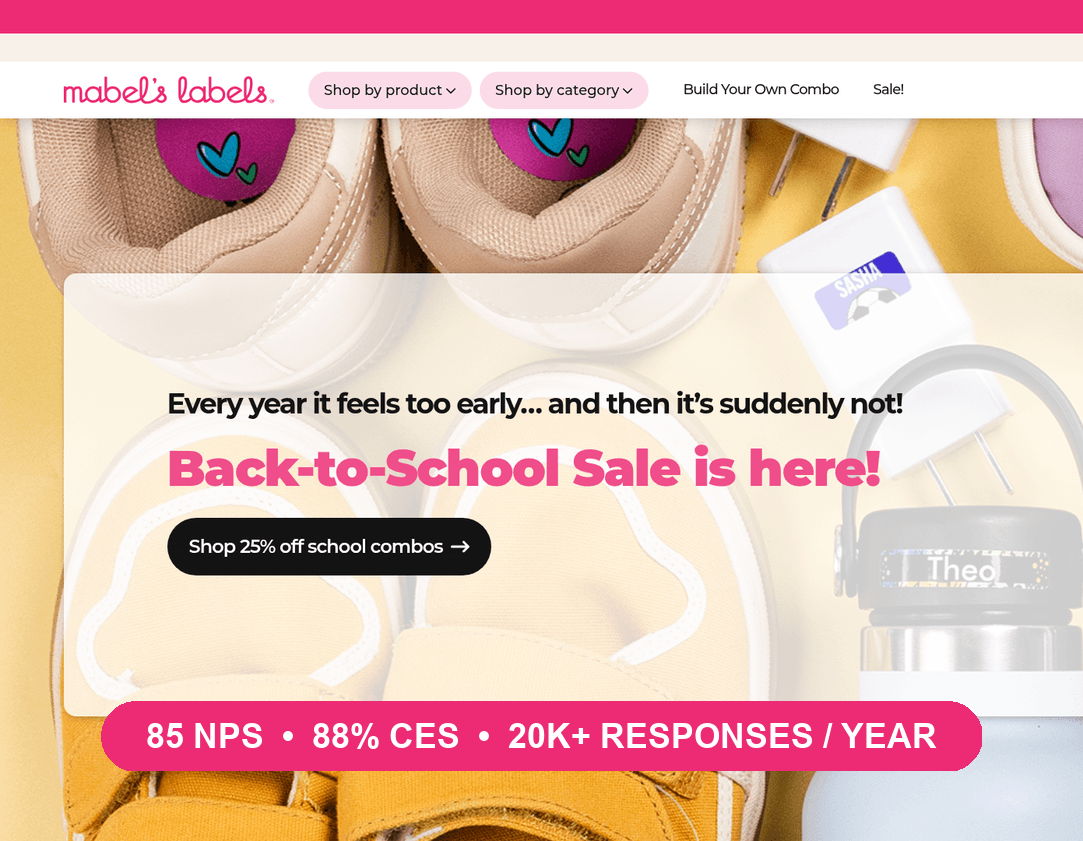
NPS Score
CES Score
Responses a Year
Mabel's Labels Overview
Mabel's Labels started in 2003 with four moms in a basement and a universal parenting problem: kids' stuff leaves home and never comes back. Daycare sweaters, camp water bottles, school lunch boxes, all vanishing into lost-and-found bins while parents fought back with masking tape and marker. Their answer was a waterproof, ultra-durable, personalized name label cute enough that kids actually wanted them on their things.
The solution stuck, in every sense. The business grew exponentially, was acquired by CCL Industries for its Avery North America division in 2016, and is today the number one personalized label company in North America, selling across the US and Canada, in both English and French.
It is also a fiercely seasonal business. Camp season and back-to-school compress a huge share of the year into one summer surge, and the customer experience team grows from five permanent members to nine to absorb it. Since 2022, that team has run its customer feedback program on Retently, and turned it into something few ecommerce brands manage: a feedback loop that reaches the leadership table every quarter and changes what the company builds.
Mabel's Labels' Challenges
When Eryn Chesney took over the CX team in 2022, the team was excellent at support, but support tickets were the company's only structured listening channel.
Tickets tell one story. Only customers with a problem worth a support email ever reached the team. The silent majority, happy, mildly disappointed, or drifting away, was invisible.
No structured feedback owned by CX. Signals about how customers felt about the brand, not just their last order, had no home and no owner.
Feedback had to live where the team works. Any new program that made reps swivel between tools would die in the summer peak. Feedback needed to land in the same inbox as everything else.



The Solution
Eryn started with NPS in Retently, then added a Customer Effort Score survey right after checkout, covering the two moments that matter most in ecommerce: how hard was it to buy, and how did the whole experience land once the order arrived.
What made Retently the fit, in her words: the dashboard was easy to read, every survey's feedback lived in one place, and it integrated painlessly with the support software the reps already live in every day.
 CES, immediately after checkout, catching friction with the buying and personalization flow while the memory is seconds old
- NPS, post-purchase, measuring the full experience: product, shipping, service
- A dedicated partner survey for the schools and camps that fundraise through Mabel's Labels, a different customer with different needs, triggered two months after signup
- Every neutral and negative response flows into the support inbox in real time and is treated like a support ticket, with an average first response around two hours
- Two languages, one program. The same surveys run in Quebec French, where generic auto-translation fails on regional nuance. Retently handles the French well, and Quebec-French-fluent team members handle the rest
Here is Eryn on why the program exists and what the team does with every response:
The team's rule for what happens next has no fine print:
That responsiveness compounds. Customers regularly answer the team's same-day follow-ups with some version of "I didn't know anybody was actually going to read this." A brand known for answering is a brand people keep talking to, which is how a five-person team ends up with one of the highest response rates we see in ecommerce.
Results With Retently
A quarterly Voice-of-Customer engine. Every quarter, Eryn convenes the entire leadership team and presents a report built from feedback across all channels, with survey data as its backbone. Leadership picks the problems, agrees on solutions and priorities, and ships the changes. Then the CX team does the part almost nobody does: it goes back to the customers who complained and tells them, "we listened, we fixed it, let us know if it's better."
- A mobile personalization rebuild, measured end to end. CES responses kept flagging how frustrating the label personalization flow was on mobile. The team took that to developers and designers and launched a brand-new, mobile-optimized product configuration experience. Within the first month, CES was already running a few points above usual, tracked daily
- Changed shipping carriers, driven by recurring shipping and delivery feedback
- Major product design improvements, based on what customers said they liked and didn't
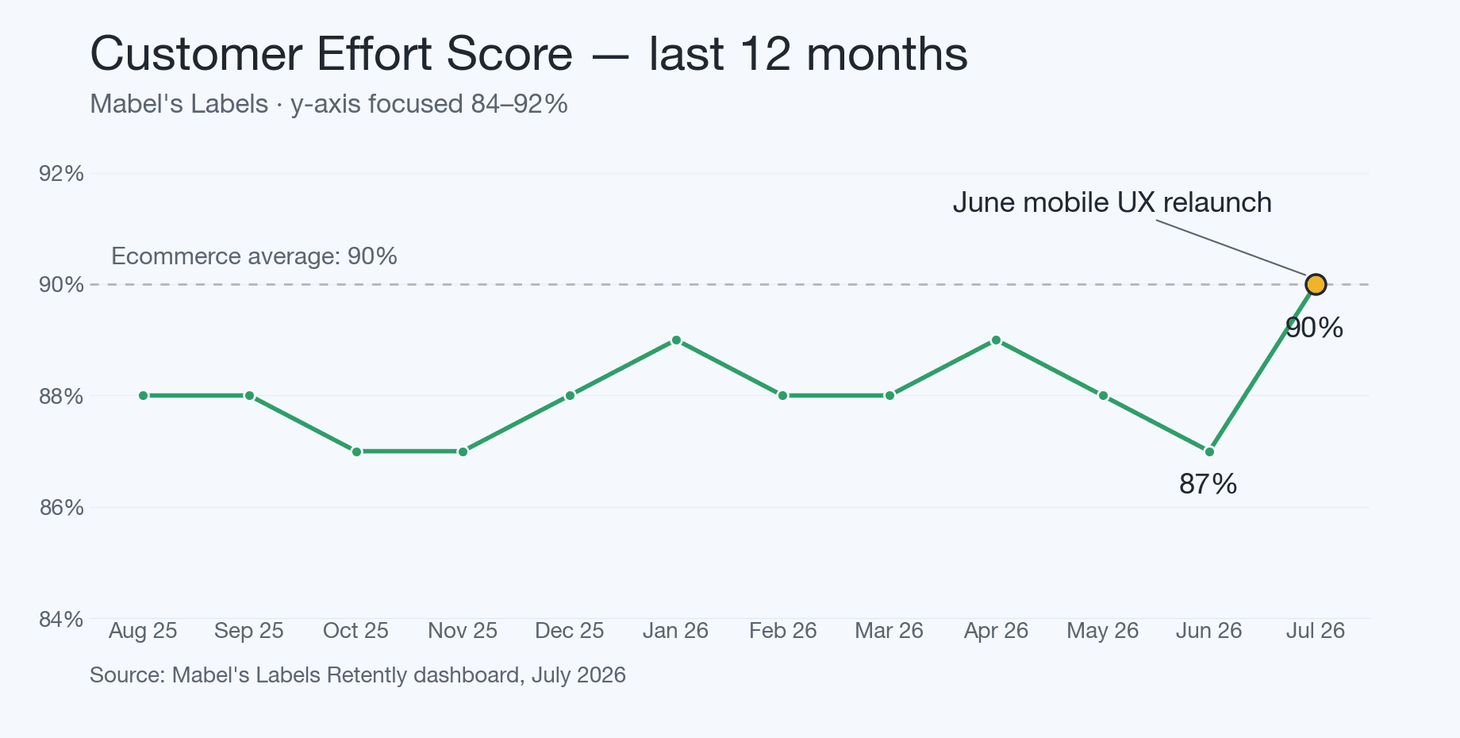 CES over the last 12 months, from the Mabel's Labels Retently dashboard. The June mobile UX relaunch is already visible.
The scores follow. An NPS of 85 against a 60 ecommerce benchmark, a CES of 88% and climbing since the redesign, and 20,000+ responses a year with nearly half of surveyed customers responding, many of them writing out what they think rather than just tapping a score.
- Put survey feedback in the inbox your team already works in. A separate tool is a separate chore
- Answer feedback like a ticket, same day if you can. Being known for answering is why people keep responding
- Treat neutrals as your retention budget. Detractors are obvious; the "it was okay" customers are the ones you quietly lose
- Give the team carte blanche to make it right: replacement, discount, whatever it takes
- Bring the feedback to leadership on a fixed cadence, with numbers attached, and assign owners
- Close the loop publicly: tell the original complainers what you changed
For a brand founded by four customers solving their own problem, the feedback program is less a new capability than a return to form at 20,000 responses a year: stay close to the customer, and let what they say guide the brand.
Start your free 14-day trial
Get started with the world’s most trusted CX software, in days, not months.