



Community association management is one of the few corners of property management where your client can vote you out at a meeting. The board hires you, evaluates you, and renews you; the homeowners experience you at the mailbox, the pool gate, and the violation notice. Those two groups want different things, judge you on different moments, and talk to each other constantly, usually about you.
This makes the standard approach to HOA survey questions, one generic questionnaire blasted to everyone every year or two, close to useless. A board president worried about reserve planning and a homeowner furious about a lawn violation cannot be measured with the same five questions, and averaging their answers produces a number that describes neither.
This guide splits the job properly: a relationship survey for the board, touchpoint surveys for homeowners, question banks for both, and the part most management companies miss, which is how the results become the strongest slide in your contract renewal presentation.
Key Takeaways
- Boards and homeowners are separate audiences with separate stakes: survey the board on the management relationship annually, and homeowners at the specific touchpoints where friction actually occurs.
- Board surveys use NPS plus service-area ratings; homeowner surveys use short CSAT or effort questions after maintenance requests, architectural reviews, violations, and amenity interactions.
- Keep homeowner surveys to one or two questions with an open comment; long community questionnaires get answered only by the angriest voices.
- Present survey trends at the annual board meeting and in renewal conversations: measured satisfaction, openly shared, is the hardest evidence of competence a management company can bring to the table.
Two Audiences, Two Different Questions
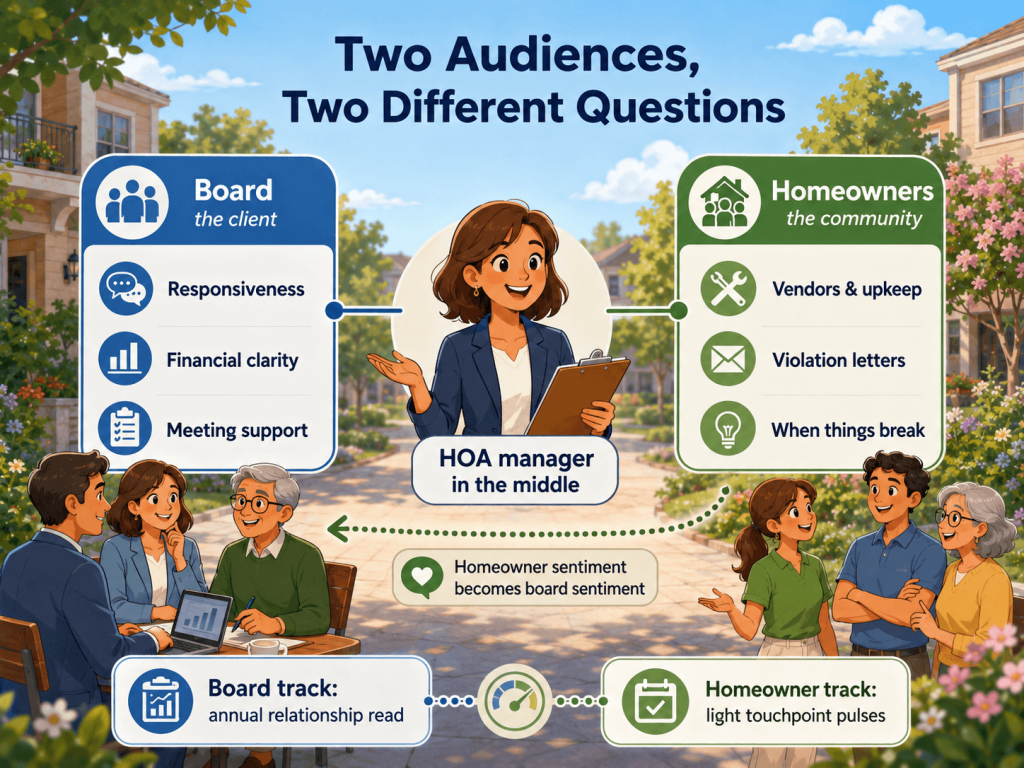
The structure of association management puts a manager in the middle of a triangle. The board is the client: they signed the management agreement, they judge responsiveness, financial stewardship, and how prepared you make them look at meetings. The homeowners are the community: they experience your vendors’ landscaping, your violation letters, and your response when the gate breaks. The board answers to the homeowners at election time, which means homeowner sentiment becomes board sentiment with a delay.
This is the same two-customer architecture we’ve mapped for rental management in how property management companies use CX surveys, with one twist: in HOA work, the “resident” audience elects your client. Homeowner dissatisfaction doesn’t just generate calls; it also drives board turnover, and new boards love rebidding management contracts.
So the measurement program needs two tracks with different rhythms: a deep annual read on the board relationship, and light, frequent pulses on homeowner experience at the moments that create it.
Surveying the Board: The Annual Relationship Read
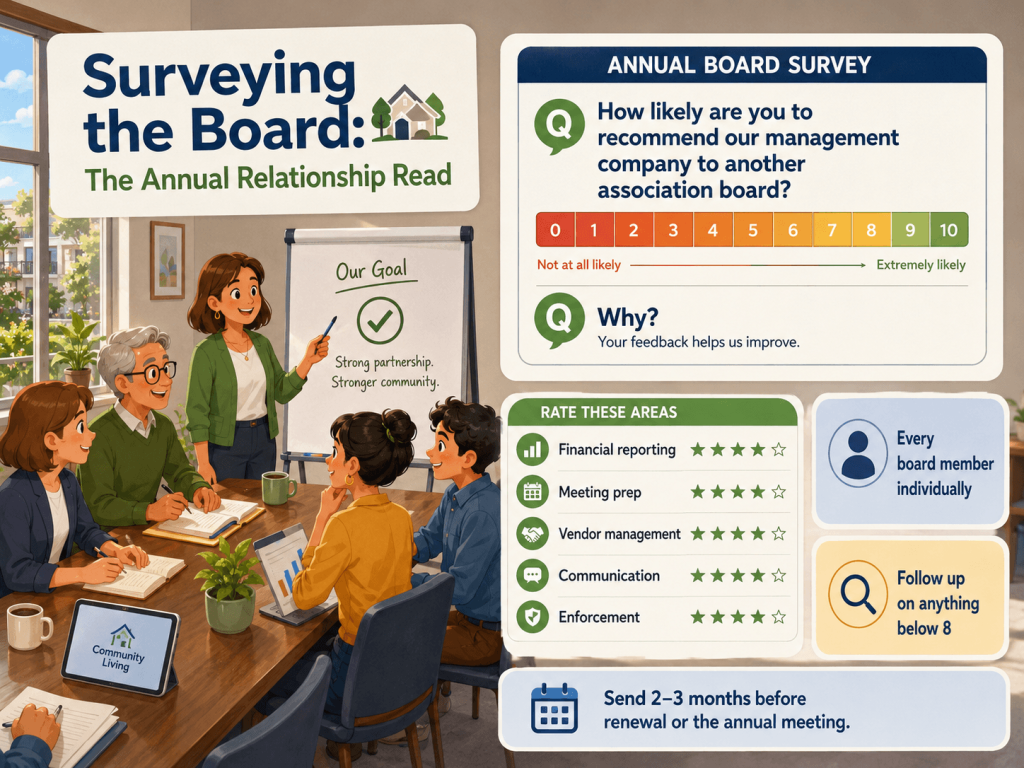
Board members are few, engaged, and opinionated: perfect survey respondents. Once a year, ideally two or three months before your contract renewal or the annual meeting, send every board member a short relationship survey.
The spine is an NPS-style question adapted to the context: “How likely are you to recommend our management company to another association board?” followed by the open “why”. Add three to five service-area ratings (1-5 scale) covering the things boards actually evaluate: financial reporting clarity, meeting support and preparation, vendor management, communication responsiveness, and enforcement handling.
Two rules make board surveys work. First, every board member individually, never one response per board; a 9 from the treasurer can coexist with a 3 from the member who’s been stewing since the paving project, and you need to see both. Second, someone senior reads every response and personally follows up on anything below an 8. With an audience of five to seven people per association, a single unhappy member is 15-20% of your client, and the Detractor recovery playbook applies at full strength.
Surveying Homeowners: Touchpoints, Not Questionnaires
The instinct with homeowners is the big annual community survey: twenty questions about everything from landscaping to holiday decorations. Resist it. Long community questionnaires get poor response rates, and the responses skew toward the loudest grievances, giving the board a distorted map.
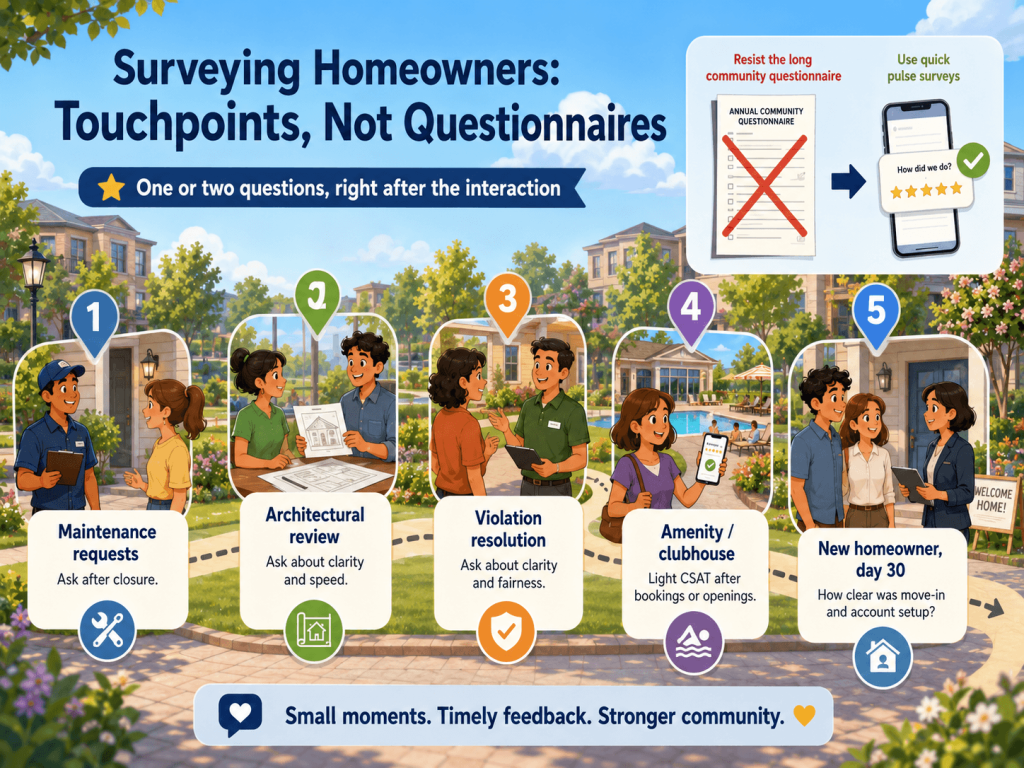
The better pattern mirrors transactional surveying everywhere: one or two questions, fired right after a specific interaction, while the memory is fresh.
The touchpoints worth instrumenting:
- Maintenance and common-area requests. “How satisfied are you with how your request was handled?” right after closure – the highest volume, the highest signal.
- Architectural review decisions. Survey after the decision letter goes out, approvals and denials alike. You’re measuring process clarity and speed, not whether people like being told no. Even denied homeowners rate a fast, well-explained process surprisingly fairly.
- Violation resolution. Wait until the matter closes, then ask about clarity and fairness of the process. Handled carefully, this is where a management company proves the rules serve the community rather than ambush it.
- Amenity and clubhouse interactions. A light CSAT pulse after bookings or seasonal openings.
- New-homeowner welcome, day 30. One question on how clear the move-in and account setup felt. First impressions in an HOA last for years, and so do first grudges.
- Resale and closing document requests. Used right after a resale certificate or closing document package goes out. This is one of the highest-friction, highest-stakes touchpoints in HOA management, since delays can hold up a homeowner’s sale.
- Special assessments and fee changes. After any assessment increase or special assessment notice goes out, ask “How clearly was this decision and its reasoning communicated to you?” This is where boards lose homeowner trust fastest, and where clean survey data can separate a communication problem from a pricing problem.
Layer one community-wide pulse on top, annually at most: a two-question survey (“How satisfied are you with the management of the community?” plus an open comment) sent to every homeowner, with results summarized for the board. Email carries it; a shareable link in the newsletter or a QR code in the clubhouse catches the households email misses.
The Question Banks
Pull directly from the surveys above: these are the exact questions to send, organized by who’s answering and when.
For board members (annual):
- How likely are you to recommend our management company to another association board? (0-10)
- What’s the main reason for your score? (open)
- Rate: clarity/timeliness of financial reporting (1-5)
- Rate: guidance on reserve funding and long-term capital planning (1-5)
- Rate: preparation/support for board meetings (1-5)
- Rate: responsiveness to board requests between meetings (1-5)
- Rate: vendor quality/vendor oversight/vendor management (1-5)
- Rate: fairness or consistency of enforcement/violation handling (1-5)
- What one thing should we do differently next year? (open)
For homeowners (transactional, pick per touchpoint):
- How satisfied are you with how your maintenance request was handled? (1-5)
- How satisfied are you with the speed of your maintenance request? (1-5)
- How satisfied are you with the quality of the work done? (1-5)
- How easy was the architectural review process to navigate? (1-7)
- Was the violation process clearly communicated from start to resolution? (1-5)
- How satisfied are you with your recent amenity/clubhouse booking? (1-5)
- How satisfied are you with your first 30 days in the community? (1-5)
- How would you rate the turnaround time of your resale certificate or closing documents? (1-5)
- How clearly was this assessment or fee change communicated to you, including the reasoning behind it? (1-5)
- What’s the main reason for your score? (open, always)
For the annual community pulse:
- Overall, how satisfied are you with how the community is managed? (1-5)
- What’s one thing that would most improve living here? (open)
Treat these banks as a copyable HOA survey template: adapt wording to your community’s vocabulary, keep any single survey under three questions, and never ask about something the board has no intention of acting on. A question implies a promise.
Running the Survey Without Drama
HOA surveys have a failure mode all their own: becoming a referendum. A few practices keep the temperature down.
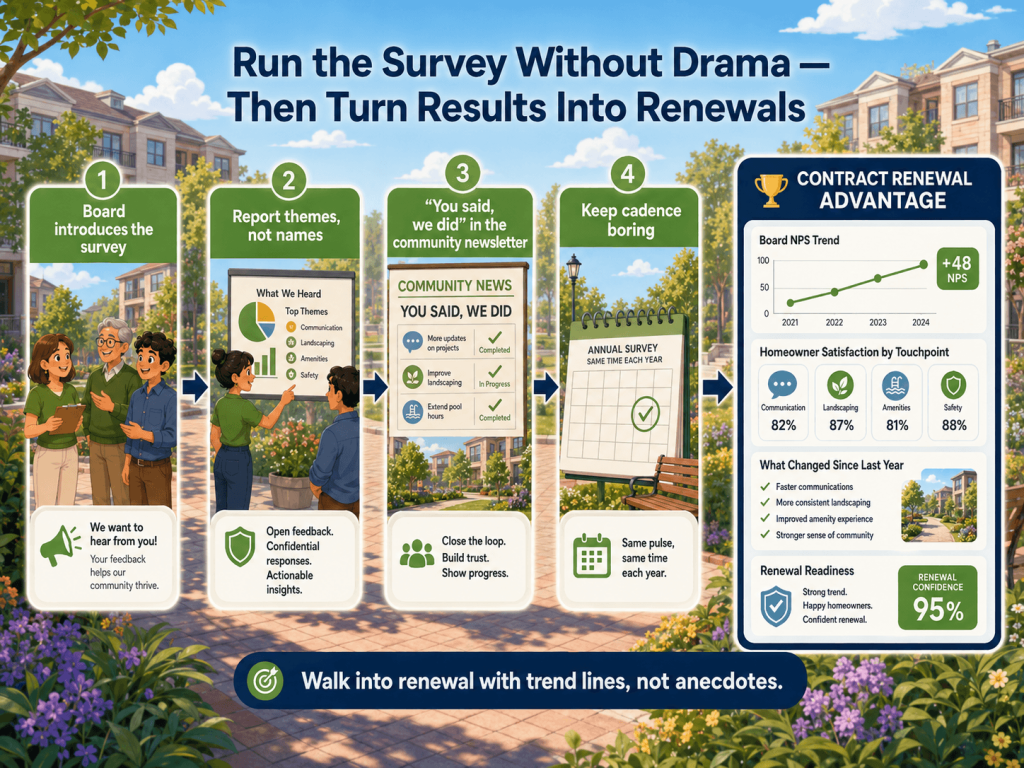
Announce it through the board. Homeowner surveys land better introduced as “your board wants to hear from you”, which is also the truth. You’re informing their community, on their behalf.
Report themes, not names, to the board. Individual responses stay with the management team for follow-up. The board sees aggregates and anonymized themes. Homeowners answer more honestly once this is known.
Make sure to close the loop in public. The single most trust-building move available: a “here’s what got fixed” item in the community newsletter after each pulse. Three fixed streetlights announced beat thirty filed responses, and it’s the same outer-loop discipline described in closing the customer feedback loop.
Keep cadence boring. Same pulse, same time each year, transactional surveys always-on. A survey that only appears after a controversy looks like damage control, because it is.
Don’t forget to cap frequency per homeowner. With seven transactional touchpoints now running, the same household can get pinged more than once in a week – a violation closing the same day as a clubhouse booking, say. Set a simple rule, like no homeowner gets more than one transactional survey in any rolling two-week window, and let the rest wait.
Turning Results Into Contract Renewals
Here’s the payoff that makes the program worth running even in a calm year. When your management contract comes up, most companies walk into the boardroom with anecdotes. You walk in with a trend line.
Board NPS over three years. Homeowner satisfaction by touchpoint, trending up since you overhauled the architectural review turnaround. The two problems that last year’s survey surfaced, and the dated record of what you changed. A new board member campaigning on “our management company doesn’t listen” runs into the inconvenient fact that listening is the most documented thing you do.
It cuts the other way too, honestly: measured decline is visible to the same board. That’s the trade a confident operator makes gladly, because the alternative, being judged on the three angriest emails a board member happened to receive, is worse. The logic is identical to the owner-side case we make in property owner retention: clients you measure are clients you keep, partly because the measuring itself is proof of professionalism.
Conclusion
An association manager serves a client who gets re-elected and the community that elects. Surveying both at the right rhythm is how you stop being surprised at annual meetings: the board’s temperature taken before renewal season, homeowner friction caught at the touchpoint instead of the open-mic session.
Retently runs both tracks from one place: separate board and homeowner campaigns, transactional triggers, alerts on low scores, and the trend lines that walk into renewal meetings with you. Setup is two 30-minute calls. Start a free trial or book a demo and know what your communities actually think.
Frequently Asked Questions
What questions should an HOA survey ask? Split by audience. Board members get an annual relationship survey: an NPS-style recommendation question plus 1-5 ratings on financial reporting, meeting support, responsiveness, and vendor oversight. Homeowners get one or two questions after specific touchpoints (maintenance requests, architectural reviews, violation resolution) plus, at most, a two-question annual community pulse.
How often should an HOA survey homeowners? Transactional surveys should run always-on, triggered by the interaction they measure. Community-wide pulses at most once a year. Frequent short surveys tied to real events get better data than long annual questionnaires, which tend to attract only the most frustrated respondents.
Should HOA survey responses be anonymous? Report to the board in aggregates and anonymized themes so homeowners answer honestly. The management team, however, benefits from identifiable transactional responses where the homeowner consents, because a low score on a maintenance request needs a follow-up call, and you can’t call a theme.
How can a management company use survey data at contract renewal? Present multi-year trends: board NPS, homeowner satisfaction by touchpoint, and a documented record of issues surfaced and fixed. Measured, openly shared satisfaction data is the strongest evidence of competence available in a renewal conversation, and it preempts anecdote-driven challenges from new board members.

 Christina Sol