



Here’s a number that shouldn’t be possible: a property management firm with a vendor NPS of 90. Not owners. Not residents. Vendors. FIG Property Management surveys the plumbers, electricians, and contractors who work its portfolio, and those vendors rate working with FIG at a level most companies can’t get from their own customers.
If your first reaction is “why would anyone survey vendors?”, you’ve identified exactly why this is worth writing about. In an industry where every firm claims to care about service, almost nobody measures the relationship that delivers the service. Your residents don’t experience your company at the moment of truth; they experience whichever technician showed up, whenever they showed up. The vendor relationship is your resident experience, subcontracted.
And that relationship runs both ways, which is the part the industry misses entirely. This piece makes the case for measuring both directions: scoring your vendors, and letting your vendors score you.
Key Takeaways
- Residents judge you by your vendors’ work, so vendor performance is customer experience wearing a tool belt. Measure it with resident ratings per vendor.
- The reverse direction matters just as much: vendors choose whose work orders to answer first in a busy season, and they choose the clients who are easy to work for.
- A vendor NPS survey is two questions twice a year: would they recommend working with you to another contractor, and why.
- The drivers of vendor loyalty are unglamorous and fixable: payment speed, work order clarity, scheduling respect, and how disputes get handled.
- Almost nobody in property management measures this, which is precisely the opportunity: preferred-client status is a competitive moat that costs mostly courtesy.
Why the Vendor Relationship Is a CX Problem
Walk through what actually happens when a resident’s water heater dies. They file the request with you. You dispatch a vendor. From that moment, everything the resident will remember (the callback speed, the scheduling window, the courtesy of the person in their home, whether it was fixed the first time) is performed by someone who doesn’t work for you.
Retently’s property management CX study found residents scoring the industry at NPS 10, with the pain concentrated in exactly these operational moments. Firms respond by tightening scripts and dashboards inside their own walls, but the moment of truth is outside the walls, in the vendor’s van. You can’t script your way around a subcontractor who deprioritizes your work orders.
So the vendor network isn’t a procurement line item; it’s the delivery arm of your customer experience. And anything that is your customer experience deserves measurement in both directions.
Direction One: Scoring Your Vendors
The first direction you may already half-run: evaluating vendors on something better than invoice size and gut feel.
The clean method uses data you should be collecting anyway. Every closed work order triggers a resident survey (the full setup is in our maintenance satisfaction survey guide); attach the vendor’s name to each response, and a scorecard assembles itself: average resident rating per vendor, resident-reported first-visit-fix rate, and the comment themes that explain both.
Review it monthly, share it with the vendors themselves, and let it govern dispatch. Sharing is the step firms skip and shouldn’t: a vendor who knows residents rate their visits, and that the ratings decide work allocation, manages their techs differently. The good ones welcome it; being measurably excellent is how they justify their rates. The ones who bristle at measurement are telling you something, too.
Direction Two: Letting Vendors Score You
Now the direction nobody runs, and the one FIG’s 90 comes from: surveying the vendors about you.
The premise takes one honest question: is your firm a client worth working for? Vendors have the same choices you do. The good ones are booked – unsurprisingly, since roughly half of plumbing and HVAC employers report they can’t find enough skilled workers, per the PHCC’s 2026 industry outlook – especially in the turn season and the first heat wave, and when a plumber with six open requests decides whose gets today, the decision runs on client quality: who pays on time, whose work orders contain the unit access details, who doesn’t blow up their schedule, who treats their people like professionals.
Most PM firms have no idea where they stand in that ranking, because they’ve never asked. A vendor NPS program asks, twice a year: “How likely are you to recommend working with us to another contractor?” plus the open “why”. The answers are operational gold, because vendor frustrations are concrete and fixable. Slow payment isn’t a mystery to solve; it’s an AP process to fix. Vague work orders are a template edit. Double-booked access is a coordination habit.
And here’s the compounding part: every fix you make for vendors flows straight through to residents. Clearer work orders mean first-visit fixes. Respected schedules mean kept appointment windows. A vendor who likes working for you sends their better techs. The vendor survey is a resident experience program that happens to be addressed to contractors.
FIG treats vendors as a first-class survey audience alongside tenants and leasing prospects, which is how a two-sided relationship becomes a two-sided asset: they know how vendors experience them, vendors know FIG is paying attention, and the 90 is the equilibrium that falls out.
What to Ask Vendors (the Short Survey)
Keep it almost insultingly short; these are tradespeople between jobs, answering on a phone.
The core, twice a year:
- “How likely are you to recommend working with [firm] to another contractor or vendor?” (0-10)
- “What’s the main reason for your score?” (open)
Optional third question, rotate one per cycle:
- “How would you rate our payment speed?” (1-5)
- “How clear are our work orders when they reach you?” (1-5)
- “What’s one thing we could change to make jobs with us run smoother?” (open)
Send it by email with a shareable link, from a named person rather than a noreply address, and have someone senior read every response. With a vendor list of a few dozen, this isn’t analytics; it’s listening with a scale attached. Low scores get a phone call, same as any Detractor, because a 4 from your best HVAC contractor in March is a staffing emergency you still have time to prevent.
Yet, weigh the number accordingly: a vendor who depends on your work orders for revenue has every reason to write down an 8 they don’t fully mean, so a comfortable-looking average isn’t proof the relationship is healthy. Read the open “why” harder than the 0-10 for exactly that reason – a vendor uncomfortable saying “4” out loud will usually still tell you what’s wrong if you ask.
Close the loop visibly: when payment terms improve or work order templates get fixed because vendors said so, tell them. “You said, we changed” works on contractors exactly as well as it works on customers.
The Payoff: Priority When It Matters
Skeptics will ask what a vendor survey buys that a good relationship doesn’t. Fair question; here’s the honest answer.
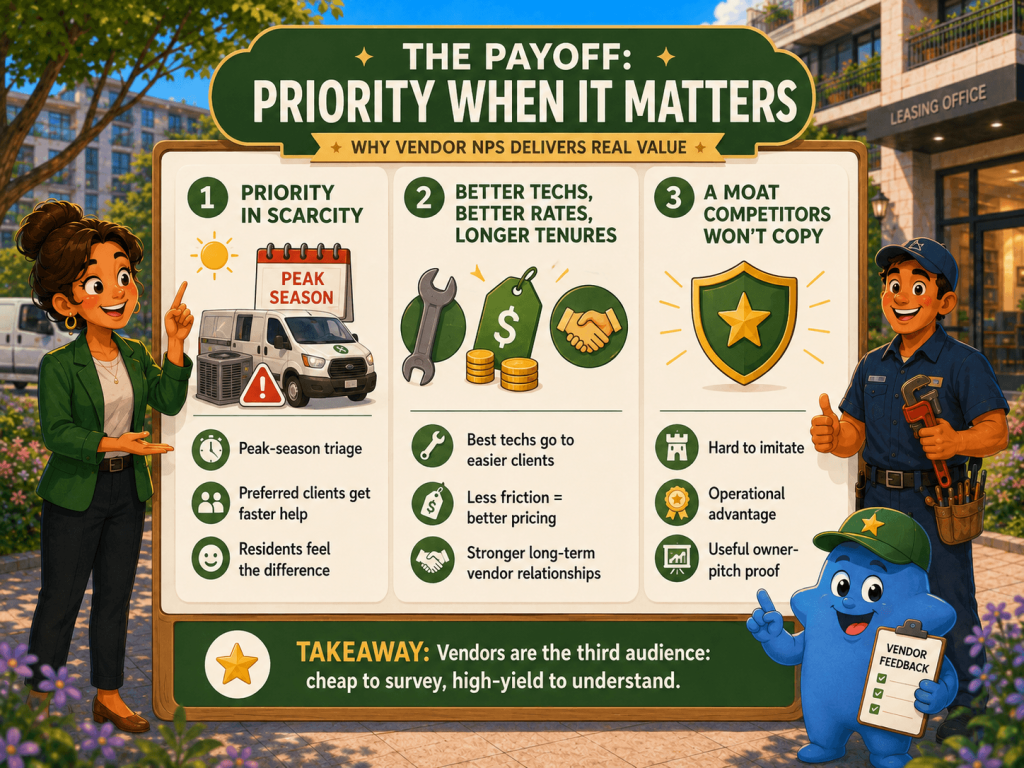
Priority in scarcity. When July hits and every AC unit in the county fails at once, vendors triage. Preferred clients get today; everyone else gets Thursday. Your residents experience that triage as your responsiveness. Vendor NPS is how you find out, before July, which side of the triage you’re on.
Better techs, better rates, longer tenures. Contractors route their strongest people to clients who don’t waste their time, and price the difficult clients’ friction into their bids. Being easy to work for is a discount you receive invisibly.
A moat competitors won’t copy. Everything in property management gets commoditized eventually: fees, portals, marketing. The firm that vendors genuinely prefer holds an advantage that takes years of consistent behavior to build and one survey program to manage. In a market where nobody else even asks, asking is differentiation. It also makes a fine line in an owner pitch: “our vendors rate working with us at 90; here’s why your maintenance gets done faster.”
The complete PM feedback architecture has owners and residents at its core, as it should. Vendors are the third audience, the cheapest to survey, and, per dollar of effort, quite possibly the highest-yield.
Conclusion
Property management spent a decade learning to measure customers. The next edge is measuring the relationship that serves them. Vendors already score you every day, in callback speed and tech assignments and quiet triage decisions; a vendor NPS program just writes the score down while there’s still time to change it.
Retently runs vendors as a full survey audience alongside owners and residents: their own campaign, their own trend line, alerts on the scores that need a call. Setup is two 30-minute calls. Start a free trial or book a demo, and find out what the people who fix your water heaters would say about you.
Frequently Asked Questions
What is vendor NPS? A Net Promoter Score survey sent to your vendors and contractors, asking how likely they’d be to recommend working with your firm to another vendor, plus an open “why”. It measures whether you’re a preferred client, which determines the priority, quality, and pricing your work orders receive.
Why would a property management company survey its vendors? Because vendors deliver the resident experience and choose whose jobs to prioritize when capacity is tight. Vendor feedback surfaces fixable friction (payment speed, work order clarity, scheduling) whose repair flows directly into faster, better maintenance for residents, and firms that measure it, like FIG Property Management with its vendor NPS of 90, hold measurable preferred-client status.
How often should vendors be surveyed? Twice a year is plenty: two questions by email, from a named person, with every response read by someone senior. Pair it with the reverse direction, scoring vendors monthly through resident ratings attached to closed work orders, so the relationship is measured both ways.
What drives vendor satisfaction with a property management client? The unglamorous basics: on-time payment, complete and clear work orders, realistic scheduling with reliable unit access, professional treatment of technicians, and fair dispute handling. All are process fixes, which is what makes vendor NPS such an actionable score.

 Christina Sol