



A survey introduction is the first thing a respondent reads, and its only job is to earn the response. It doesn’t sell, it doesn’t recap your roadmap, and it should never be longer than the survey it opens. The rule that runs this whole piece: match the intro to where the survey lands. A one-question in-app prompt and a cold link survey cannot carry the same words, because one interrupts someone mid-task and the other arrives with no context at all.
What every good survey introduction promises
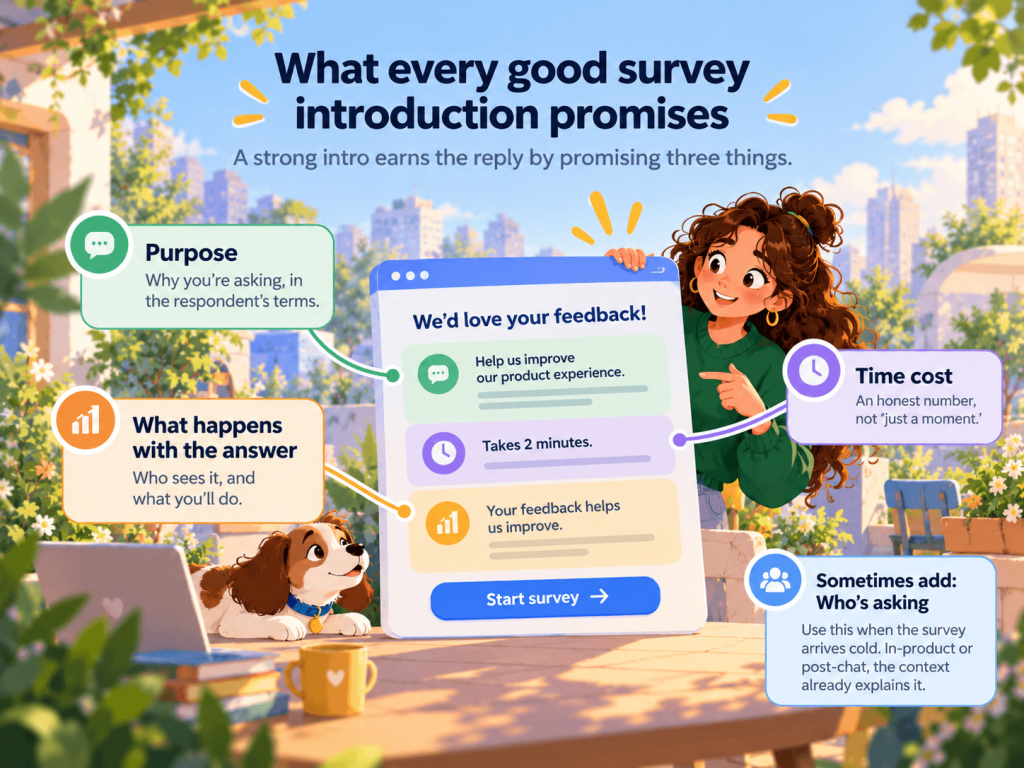
Most guides give you a long list of elements: company name, goal, anonymity, instructions, and a thank-you. Strip it to what actually earns the reply, and a strong intro promises three things:
- Purpose – why you’re asking, in the respondent’s terms.
- Time cost – an honest number, not “just a moment.” A count works too: “one question.”
- What happens with the answer – who sees it, and what you’ll do. Promise only what’s true: if the link identifies the respondent, say “confidential,” not “anonymous.”
That’s the anatomy. Purpose, time, use.
A fourth part matters only sometimes: who’s asking. When the survey arrives cold, a link sent to a list with no reason to expect it, you say who you are first. Inside your product or right after a support chat, the context already answers that, so naming yourself again burns the line. For what to ask once someone’s in, see how to avoid bad survey questions.
Everything else is padding. And context can stand in for any part the channel already answers: a widget inside your product doesn’t need to say who’s asking, and a prompt that arrives right after a chat doesn’t need to explain why. Write only the promises the channel can’t make for you.
Copy-and-paste survey introductions by channel
The typical template bank offers one email-shaped paragraph for every situation, when the same four sentences don’t belong above a one-tap in-app prompt or in a cold outreach email. Here’s an intro for each channel we ship surveys through, rendered the way the respondent sees it, with a note on how the anatomy applies. Copy the one that fits where your survey lands.
NPS email intro
Warm, two lines above the scale, one clear reason.
Hi [First name], you’ve been using [Product] for a couple of months now, and your honest read helps us get the next release right. One tap, about ten seconds.
How likely are you to recommend us to a friend or colleague? 0 1 2 3 4 5 6 7 8 9 10
Anatomy: purpose (your honest read), time (ten seconds), use (shapes the next release). The from-name carries who’s asking. Adjust or drop “a couple of months” if tenure varies, and set a fallback (“Hi there”) so a blank merge tag never reaches the respondent.
CSAT post-ticket intro
Rides the conversation that just ended, so it’s the shortest full intro here.
Thanks for chatting with us just now. One quick question before you go so we know what to fix/ so we follow up on the bad ones:
How would you rate the support you got today? 1 · 2 · 3 · 4 · 5
Anatomy: purpose and use fold together (rate it, so we follow up on the bad ones); “one quick question” is the time cost, stated as a count. “Before you go” assumes live chat. For an emailed ticket close, use: “Your ticket is closed. One question, about ten seconds, so we know whether we got it right.”
In-app microsurvey intro
No room for a paragraph in a widget, and no need; the person is already inside your product. The intro is one line.
Quick one: how easy was it to set up your first campaign? Very hard · 1 2 3 4 5 · Very easy
Anatomy: one line does purpose and time at once; who’s-asking and data-use are implied by the session.
Link survey to a contact list
The cold case is the only intro that needs all four parts. It arrives with no context, so it says who’s asking first.
Hi [First name], this is [Your name] from [Company]. We’re asking a handful of customers what’s working and what isn’t, so we can fix the right things first. It takes about two minutes, and your answers go straight to our product team, not a marketing list.
Start the survey
Anatomy: all four, in order, who, purpose (fix the right things), time (two minutes), use (product team, not marketing).
Post-purchase (ecommerce) survey intro
Ride the order. Name the product, and make the use a two-way deal.
Hi [First name], hope the [product name] is working out. A quick rating helps us and the next shopper trying to decide. Thirty seconds, that’s all.
How would you rate your purchase? ★ ★ ★ ★ ★
Anatomy: purpose (a quick rating), time (thirty seconds), use (helps us and future shoppers); the named product makes the ask feel real.
SMS survey intro
A text has no room for a paragraph, and it arrives from a number the reader may not recognize, so the sender is the one part you can’t drop.
[Company]: Hi [First name], one question, 10 seconds: how likely are you to recommend [Product] to a colleague, 0 to 10? Reply STOP to opt out.
Anatomy: who’s asking (the company name leads), time (one question, 10 seconds), purpose (carried by the question). Use is dropped for space, and context covers it.
Website pop-up or feedback tab intro
The reader is mid-task and didn’t ask to be surveyed, so the intro’s real job is to be easy to dismiss. Show a visible close button, and wait until the reader has had time to look around before it appears.
Help us improve this page: did you find what you were looking for? Yes · No
Anatomy: purpose and use in one clause (“help us improve this page”), time implied by the two-option answer, who’s asking implied by the site. Unlike the in-app widget, the visitor is usually unidentified, so the line can refer to the page but not to their account or usage. Add a follow-up open question only after they answer.
Variants: same anatomy, nearby situations
The templates above adapt to most other cases with a swap or two:
- B2B NPS email: swap “a friend or colleague” for “another [role] at a company like yours.”
- Onboarding check-in: swap “a couple of months” for “your first two weeks,” and swap the purpose line for “so we can make getting started easier.”
- QR code or in-person: the sign is the intro, so keep it to about eight words: “Rate your visit: one question, 10 seconds.” Put it where the experience happens, not at the exit.
- Long relationship survey (more than five questions): say the number of questions and the time, and add a progress indicator so “about five minutes” stays true.
Why does the intro change by channel
One template can’t cover this because responses are scarce, and scarce in different ways by channel.
Each starting point gives the intro a different job. The cold link earns attention from nothing, so it names who’s asking. The in-app one-liner interrupts someone already engaged, so it says the least. An SMS arrives from a number nobody saved, so the sender comes first. A website pop-up interrupts like the widget but wasn’t asked for, so it has to be easy to dismiss. The subject line is the envelope and the intro is the letter inside, two crafts, and getting more envelopes opened is covered in survey subject lines. To move the response number itself, improving response rate goes deeper than an intro can, and the honest time estimate you give is part of how you avoid survey fatigue.
Five rules for any survey introduction
The channel changes the shape; the discipline stays the same.
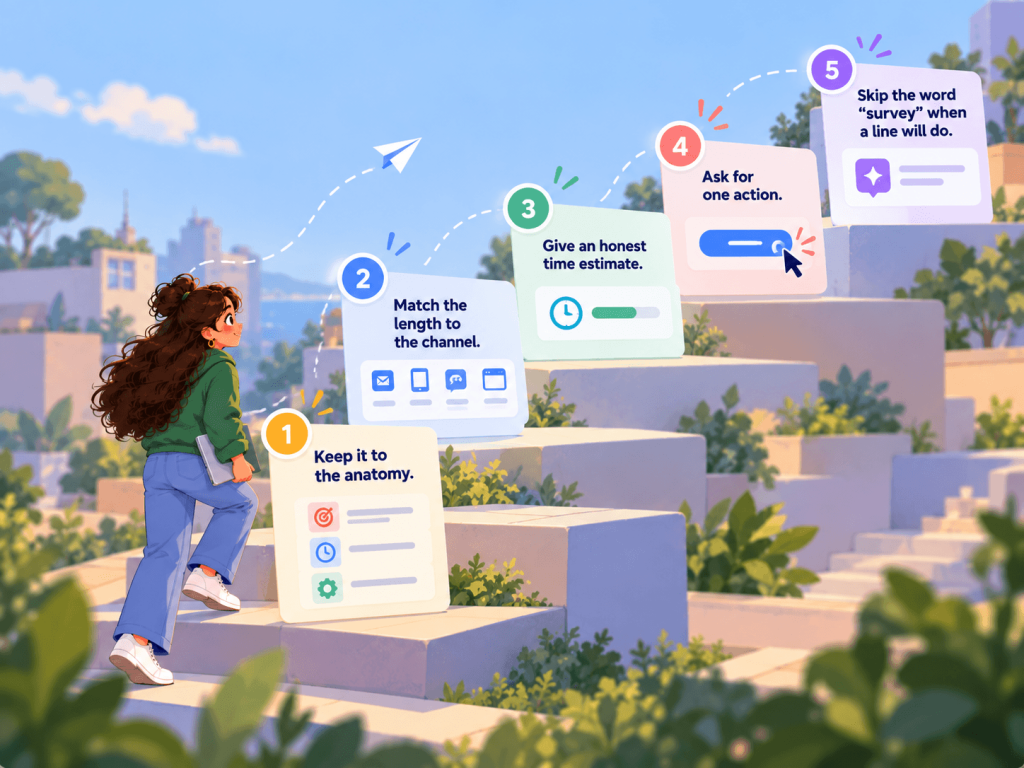
- Keep it to the anatomy. If a sentence isn’t purpose, time, or use, cut it. Mission statements and apologies for interrupting are the usual offenders.
- Match the length to the channel. A widget gets one line; a cold link earns four; email and post-purchase sit between. Never longer than the survey takes to answer.
- Give an honest time estimate. “Two minutes” that turns into eight teaches people to ignore your next survey. Pull the median completion time from your past surveys, round up, and have a colleague time the draft before you send it.
- Ask for one action. One link, one tap, one scale. A second ask splits attention.
- Skip the word “survey” when a line will do. Inside a product, “quick one” beats “please take our survey.” Save the formal framing for the cold cases.
Once the intro has done its job, the survey question types decide what comes next.
Match the intro to the moment
A survey introduction has one specific job: tell someone why you’re asking, how long it takes, and what you’ll do with the answer, in whatever space the channel gives you. Get those three right (four when you’re cold), fit them to where the survey lands, and the intro earns the response instead of getting in its way.
Retently ships surveys across email, in-app widgets, links, and post-purchase flows, so one feedback program can meet customers in whichever channel fits, each with an intro shaped for it. Start a free trial to build one on your own list, or browse the survey templates to see the intros and questions matched by channel.
Frequently Asked Questions
What should a survey introduction include? Three things: purpose (why you’re asking, in the respondent’s terms), an honest time cost (how long it takes), and what happens with the answer (who sees it, what you’ll do). When the survey is cold, a link to a list that isn’t expecting it, add a fourth: who’s asking. Anything past those four is usually padding.
How long should a survey introduction be? It depends on the channel. Inside your product, one line. A post-support or post-purchase prompt can be a sentence or two, since it rides on the context the reader already has. A cold link survey needs the full setup, two to four sentences. The rule of thumb: never longer than the survey it opens.
How do you write an introduction for an NPS survey? Name the reason in one line, promise the effort honestly (“one tap, about ten seconds”), and put the 0-to-10 question right underneath. In an email, you can add a warm opener and your brand; in an in-app widget, collapse it to a single line, like the copy-ready examples above.
Does the survey introduction affect response rate? We don’t have a measured lift number, and neither does anyone selling you one. What a good intro does is remove uncertainty: it says why you’re asking, how long it takes, and what you’ll do with the answer. That lowers the friction which makes someone close the tab and cuts the mid-survey drop-off caused by surprises.
Should you use the word “survey” in the introduction? Usually, skip it when the intro is a single line. “Quick one” reads lighter than “please take our survey” and gets out of the way. The word earns its place in the cold cases, a link survey to a contact list, where naming it sets a clear expectation.

 Christina Sol