



Search “client satisfaction survey” and look at what actually comes back. Near the top there’s a clinical scale built for therapists, a legal-aid PDF, and a run of pages that are ordinary customer-satisfaction guides with the word “client” dropped into the title. Put “customer” back in and most of them read the same, word for word.
That’s the tell. A client is not a customer. You have fewer of them; each one is worth far more. The relationship runs on a retainer or a project rather than a one-off purchase, and more than one person at the account has a say in whether you get renewed. A survey built for a high-frequency transaction doesn’t measure any of that.
This page is for firms whose customers are clients: agencies, consultancies, and law, accounting, financial, or real estate practices. It covers when to ask across an engagement, who to ask at each account, and a client survey template you can copy. For how to word and score the questions, it points you to the guides that already own that ground.
Key Takeaways
- A client relationship is a handful of high-value, retainer-based accounts, so each response is a named client you act on individually, not a number to average.
- Time the survey to the engagement, not the calendar: at kickoff, after a deliverable, as a quarterly pulse, and before renewal.
- Survey two people at each account: the day-to-day contact and the economic buyer who signs the renewal. They often score you differently.
- Ask about the working relationship, communication, deliverable quality, and strategic value, not “how was your purchase.”
A client survey isn’t a customer survey
Start with the shape of the relationship, because it decides everything else about the survey.
A consumer brand sells to a hundred thousand people and reads satisfaction as a statistic: the average moved, one segment dipped, act on the trend. A service firm works the other way. You might have twenty clients, or forty. Each response carries a name, a contract value, and a renewal date. When one account rates you a 6, that’s not a number to average away, it’s a conversation to have this week, about an account you can’t afford to lose.
So the thing you’re measuring is the relationship, not the transaction. That changes which metric you reach for. Relationship NPS (Net Promoter Score) reads loyalty at the account level, the renew-and-refer signal. CSAT (Customer Satisfaction Score) scores a specific deliverable right after it lands. CES (Customer Effort Score) tells you how easy you are to work with.
Which one fits which touchpoint is its own decision, and our guide to NPS, CSAT and CES walks through the choice. If you need to score and benchmark NPS and CSAT, our guides have the math. This page stays on what to ask a client, and when.
When to survey across the engagement lifecycle
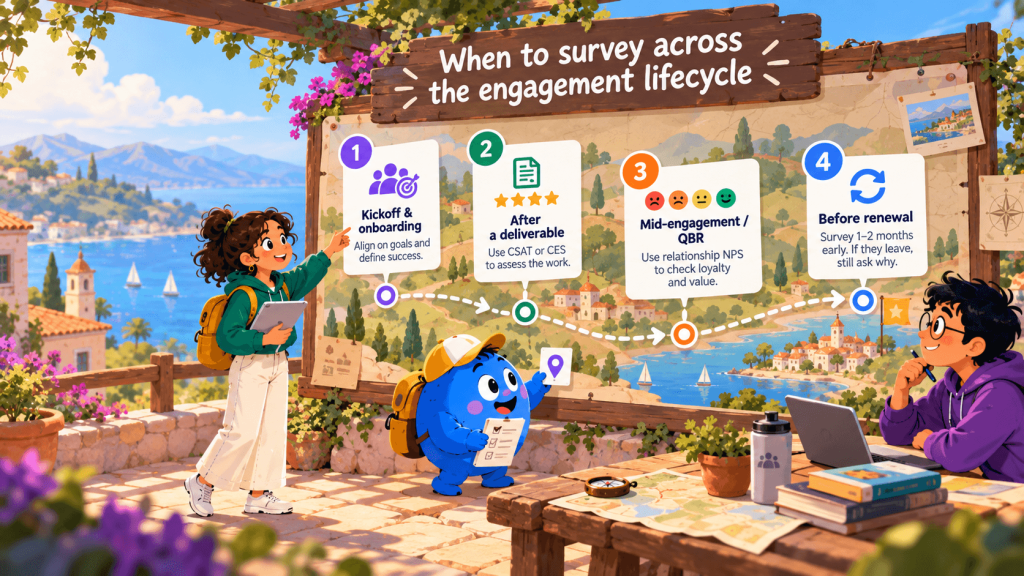
Most satisfaction programs run on the calendar: an annual or quarterly blast to the whole list. For a client relationship, that’s the wrong clock. What you actually need to know shifts depending on where the engagement is, so the survey should fire against the work, not the date. Four moments carry most of the signal, and each maps onto the wider B2B client journey viewed through the survey lens.
Kickoff and onboarding
The goal here isn’t a satisfaction score, but a baseline. Before you’ve delivered anything, you want the client’s own definition of a win and their read on whether you understand it. Capture that now and you have something to measure against later, plus an early flag if expectations are already off.
After a milestone or major deliverable
Right after you ship the thing, the rebrand, the audit, the quarter’s campaign, memory of the work is at its sharpest. This is a CSAT or CES moment: did the deliverable match the brief, and was it easy on the client’s side to get it over the line? Score the work while it’s fresh, not three months later in a round-up.
The mid-engagement pulse or QBR
Between deliverables, the question moves from the work to the relationship. A short pulse tied to your quarterly business review reads loyalty and strategic value: are we still worth the retainer, and are we adding anything beyond execution? This is the relationship-NPS moment, and it’s the one most firms skip.
Before renewal, or at offboarding
The retention read has to come ahead of the renewal conversation, not during it. Ask a month or two out, while there’s still time to fix whatever surfaces. If a client is leaving anyway, the offboarding version of the same survey is some of the most honest feedback you’ll ever get, worth running even when the outcome is settled.
Who to survey at the client
Here’s where client surveying quietly goes wrong. You send it to the person you talk to every day, the marketing manager, the in-house counsel, the operations lead, a warm score comes back, and you relax. But the person you Slack daily usually isn’t the person who signs the renewal.
Those two often see you very differently. Gainsight’s Customer Success Index found day-to-day users sitting at a median NPS of 36, while the executive buyers and decision-makers who control the budget averaged 46. In practice the gap runs both ways: sometimes the champion loves you and the economic buyer barely registers the value, sometimes the reverse. Survey only your friendly contact and you’re blind to half the renewal risk.
The fix is to survey both and tag responses by role, so the working relationship and the buying decision read as two separate signals instead of one blended average. We get into the trade-offs of each audience in who to survey in B2B. For a client account, the short version is to survey the contact and the buyer, and never assume they agree.
Client satisfaction survey questions by engagement moment
The questions below are grouped by the four moments and rendered the way a client sees them. They’re deliberately specific to a service relationship, so a QBR set doesn’t read like a generic post-purchase form. What they don’t do is re-teach question craft: for the general CSAT bank, see CSAT survey questions, and for support-style touchpoints, service survey questions. Pick one or two per moment, not the whole list.
Kickoff questions
Set the baseline before you’ve delivered anything. You want the client’s own definition of success and an early read on alignment.
- Coming into this engagement, what does a clear win look like six months from now? [ your answer ]
- How confident are you that we understand your goals/constraints? 1 · 2 · 3 · 4 · 5 (1 = not at all, 5 = completely)
- What worried you most about bringing in an outside partner for this? [ your answer ]
Post-deliverable questions
Fire these right after a specific piece of work lands, measured against the brief you agreed on.
- How well did this deliverable match the brief we set? 1 · 2 · 3 · 4 · 5 (1 = missed it, 5 = nailed it)
- Getting this piece of work over the line was easy on your side. Strongly disagree · 1 2 3 4 5 6 7 · Strongly agree
- What would have made this deliverable land better for your team? [ your answer ]
Relationship and QBR questions
Between deliverables, read loyalty and strategic value at the account level.
- How likely are you to recommend our firm to a peer running a similar team? 0 1 2 3 4 5 6 7 8 9 10 (0 = not at all likely, 10 = extremely likely)
- This quarter, how much value did we add beyond just delivering the work? 1 · 2 · 3 · 4 · 5 (1 = none, 5 = a great deal)
- At kickoff, you told us a clear win would look like [their kickoff answer]. How close are we to that today? 1 · 2 · 3 · 4 · 5 (1 = not close, 5 = fully there)
- How responsive/easy to reach has your account team been? 1 · 2 · 3 · 4 · 5
- What’s one thing that would make us a more valuable partner next quarter? [ your answer ]
Renewal-intent questions
Ahead of the renewal, measure intent honestly instead of manufacturing a yes.
- When your contract comes up for renewal, how likely are you to continue with us? 0 1 2 3 4 5 6 7 8 9 10 (0 = not at all likely, 10 = extremely likely)
- If you were re-evaluating partners today, would we make your shortlist? Why or why not? [ your answer ]
- Is there anything unresolved that would give you pause about renewing? [ your answer ]
A client satisfaction survey template
The part of the template worth copying isn’t a list of questions, it’s the order they go in. A client pulse is really five slots:
- Intro line: One sentence naming the review + how long it takes.
- Anchor metric: Relationship NPS, asked FIRST, before anything primes it.
- Relationship Q: One or two from the QBR set.
- Open question: The “voice” question. One box.
- Role tag: Day-to-day contact or decision-maker. Last, so you can segment.
Filled in for a quarterly pulse, it renders like this:
A two-minute pulse ahead of our quarterly review. Three questions, one of them open.
- How likely are you to recommend our firm to a peer running a similar team? 0 1 2 3 4 5 6 7 8 9 10
- This quarter, how much value did we add beyond delivering the work? 1 · 2 · 3 · 4 · 5
- What’s the one thing that would make us a more valuable partner next quarter? [ your answer ]
- Your role with us: ◯ Day-to-day contact ◯ Budget holder / decision-maker
Keep it to three or four questions. A client’s attention is scarcer than a consumer’s, the relationship is personal, and a bloated survey from a partner they’re paying reads worse than one from a brand they barely know. The role tag at the end splits the contact from the buyer without a second survey. For starting points across metrics, our ready survey templates give you a base to trim.
Best practices for client satisfaction surveys
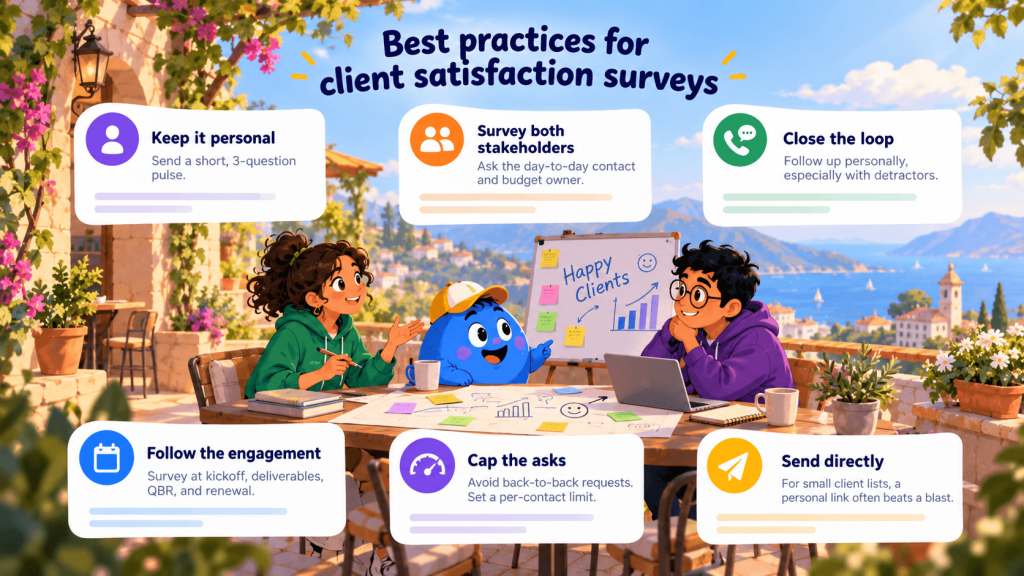
Most survey advice is generic. A few things matter more, or differently, when the respondent is a client paying you a retainer.
- Keep it short and personal. A three-question pulse addressed to the client by name beats a long form that feels like it went to a list.
- Survey both stakeholders and segment by role. The day-to-day contact and the budget holder answer different questions in their heads. Send to both, tag the responses, read them apart.
- Close the loop yourself. Agency relationships are high-touch, so the account manager or founder follows up, not an automated sequence. A Detractor who gets a personal call back is often a save.
- Run it as a program, not an annual event. One survey a year tells you where the relationship was, not where it’s heading. The kickoff, deliverable, QBR, and pre-renewal rhythm keep a pulse on it throughout.
- Cap the asks. Set a limit per contact (one request a month is a sensible start), and let the QBR pulse stand in for a deliverable survey that would land within a fortnight of it.
- Consider a personal send over an email blast. For a small, named client list, a link you send directly often lands better than a bulk send. In our own data, once someone opens a shared survey link they finish it over 90% of the time, which suits a list you can address by hand.
Turn client feedback into a renewal signal
A client survey only pays off when the answer reaches the person who can act on it, fast. On a book of twenty or forty accounts, a single quiet Detractor is a real slice of revenue, not a rounding error. That means asking the right question at the right moment, surveying both the contact and the buyer, and routing every response to an owner who follows up personally.
Retently runs NPS, CSAT and CES for service businesses, segments respondents by role so you can survey the day-to-day contact and the decision-maker separately, and sends each response to an owner instead of a dashboard nobody checks. Start a free trial and send one of the sets above to your own client list.
Frequently Asked Questions
What is a client satisfaction survey? A client satisfaction survey measures how a professional-services client rates the working relationship, not a one-off purchase. Agencies, consultancies, and firms run it across an engagement, at kickoff, after deliverables, at quarterly reviews, and before renewal. Because these accounts are few and high-value, each response maps to a named client you can act on individually.
What questions should an agency ask on a client satisfaction survey? Ask about the working relationship rather than a transaction: communication and responsiveness, how well deliverables matched the brief, the strategic value you add beyond execution, and likelihood to renew or refer. Anchor the account-level survey with a relationship NPS question, then add one or two tied to the moment, whether that’s kickoff, a deliverable, a QBR, or renewal.
How often should you survey clients? Tie the cadence to the engagement, not the calendar. Survey at kickoff to set a baseline, after each major deliverable, with a light quarterly pulse around your business review, and a month or two before renewal. That rhythm beats a single annual blast, which tends to arrive with no context and miss the moments where the relationship actually turns.
CSAT or NPS for client satisfaction? Use both, for different jobs. Relationship NPS reads loyalty at the account level, will this client renew and refer, and fits the quarterly pulse. CSAT scores a specific deliverable or milestone right after it lands. A client program usually runs relationship NPS as the anchor and drops in CSAT or CES at the transactional moments.

 Christina Sol