



The termination email always reads the same way. Polite, brief, past tense. “We’ve decided to go a different direction with the property at 114 Maple.” By the time it lands, the owner has already interviewed your competitor, compared fee structures, and mentally moved out. Whatever you say next is negotiating with a decision that was made weeks ago.
Here’s the uncomfortable part: that decision almost never comes out of nowhere. It builds through a late statement, a maintenance bill that arrived without warning, a question that took four days to answer. Owners rarely complain along the way. They’re businesspeople with other options, so instead of complaining, they quietly shop.
Which means owner retention is really a detection problem. The firms that keep their doors aren’t the ones with charming account managers; they’re the ones who find out an owner is unhappy while there’s still time to fix it. This playbook covers how.
Key Takeaways
- Owner churn is silent by default. Owners are commercially minded clients who shop for alternatives instead of complaining, so the absence of complaints tells you nothing.
- A lost door isn’t one lost sale, but recurring fee revenue gone, often in bundles, plus the referral stream that the owner would have generated.
- Recurring owner NPS is your early-warning radar. A declining trend or an unanswered Detractor comment predicts termination months out.
- The retention conversation works best before the owner starts shopping, armed with their own feedback history rather than generic reassurance.
- Retention compounds: the same program that saves at-risk owners turns happy ones into the referral engine that grows doors.
The Economics: What a Lost Door Actually Costs
Worth stating plainly, because most operators underestimate their own number: NARPM’s benchmarking guide puts average annual door churn at 20-25%, while most PM leaders asked to guess their own churn rate say something closer to 5%. That gap between what operators think is happening and what’s actually happening is the real cost of not measuring this.
Property management is a recurring-revenue business wearing a real estate costume. Every door is a small subscription: a monthly management fee that runs for as long as the owner stays. Lose the door and you don’t lose a transaction; you lose the whole future stream, plus leasing fees, plus maintenance coordination margins.
And doors rarely leave alone. Owners with multiple properties move them as a block. An investor who pulls one duplex because of a bad experience is telling you what happens to the other six when their leases with you come up. Worse, the small-portfolio owners you lose talk to the same local investor groups your marketing is trying to reach.
Now run the comparison every operator should have taped to their monitor: what does it cost to win a door? Marketing spend, sales calls, onboarding effort, the discounted first-year fee you offered to close. Most PM firms spend multiples more acquiring a door than they would spend keeping one. That asymmetry is the entire business case for taking owner retention seriously as a system, not a vibe.
Why Owners Churn Silently
Residents complain loudly. They live in the product, so friction shows up in calls, portal messages, and one-star reviews. Owners are different in three ways that matter.
They’re evaluating you against alternatives constantly. Every self-managing landlord forum, every “we’ll manage your property for 6%” mailer, every conversation at a real estate meetup is a quiet competitive pitch. Your owner doesn’t need to be furious to leave; they need to be merely unimpressed while someone else looks slightly better.
Their pain arrives on a statement, not in person. An owner experiences you mostly through documents: the monthly statement, the maintenance invoice, the vacancy report. When something on those documents confuses or surprises them, the natural response isn’t a phone call. It’s a raised eyebrow, filed away. Enough raised eyebrows become a decision.
Nobody asks them how it’s going. The property management CX study Retently published found that many firms survey neither audience systematically, and those that do usually start with residents. The paying client, the one whose departure actually shrinks revenue, is often the last to be asked anything.
That’s the silence. It isn’t satisfaction; it’s unmeasured drift.
The Early-Warning System: Owner Feedback Signals
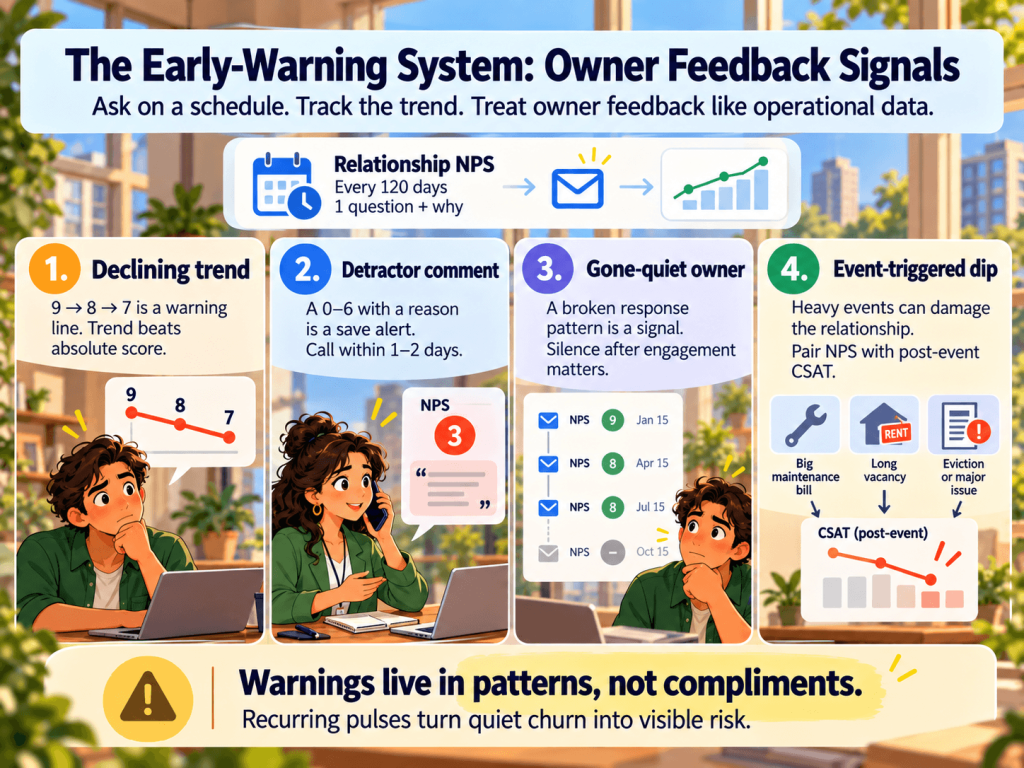
The fix is structurally simple: ask owners how it’s going, on a schedule, and treat the answers as operational data rather than a compliment box.
The core instrument is recurring relationship NPS. One question, “how likely are you to recommend us to another property owner?”, plus an open “why”. Sent quarterly or roughly every 120 days, per owner, forever. The cadence matters: a single annual survey gives you one stale data point; a recurring pulse gives you a trend line, and trends are where the warnings live.
You’re watching for four signals, in escalating order of urgency:
1. The declining trend
An owner who scored 9 last year, 8 in spring, and 7 this quarter hasn’t “given you three passing grades.” They’ve drawn you a line pointing at the exit. Trend beats absolute score every time, which is the same reason we tell every industry that NPS is an ongoing process, not a one-time reading.
2. The Detractor comment
A score of 0 to 6 with a written reason is the most valuable email your firm will receive that week. The owner just told you exactly what would have shown up in a termination letter six months from now, while it’s still fixable. Every one of these needs a response from a human within a day or two. Our guide to handling Detractors covers the mechanics; in PM, the short version is: call them, don’t email.
3. The gone-quiet owner
An owner who used to respond to surveys and stopped is a signal most firms never notice because their tooling doesn’t show non-response. Silence after engagement is how commercial clients disengage. Flag owners whose response pattern breaks, and have their account manager make an unprompted check-in call.
4. The event-triggered dip
Some churn risk is situational: a big unexpected maintenance bill, a long vacancy, an eviction. Pair your relationship pulse with transactional CSAT after these heavy events, and you’ll see immediately whether the event damaged the relationship or was handled well enough to survive.
The benchmark to calibrate against: across property management firms surveying through Retently, owners average NPS 35. BlueSky Property Management runs at 48, thirteen points above it, and, tellingly, they tag every score to a driver so a dip is never a mystery.
The Owner Touchpoints Worth Measuring
Relationship NPS is the radar. Transactional surveys are the close-up cameras. The owner lifecycle has a handful of moments worth instrumenting:
| Touchpoint | Metric | What it catches |
|---|---|---|
| Onboarding, ~30-90 days in | CSAT | Expectation gaps before they calcify (statement confusion, communication cadence) |
| Tenant placement | CSAT | Satisfaction with marketing, screening speed, and lease-up |
| After significant maintenance events | CSAT | Bill shock, approval process friction |
| Renewal of the management agreement | CES | How effortful staying with you feels |
| Recurring, every ~120 days | NPS | The overall relationship trend |
Two notes on this table. First, onboarding deserves its own playbook, because the first 90 days set the trust budget everything else spends – we cover it in onboarding new property owners.
Second, don’t run all of these on day one. Start with recurring NPS plus one transactional touchpoint (tenant placement is a good first pick, since it’s where owner satisfaction is most fragile), then expand. Colorado Realty and Property Management surveys owners and residents separately across 8 lifecycle touchpoints, but they built up to that architecture; they didn’t launch it whole.
Running the Retention Conversation
Sooner or later, a signal fires and someone has to pick up the phone. A few rules make that conversation work.
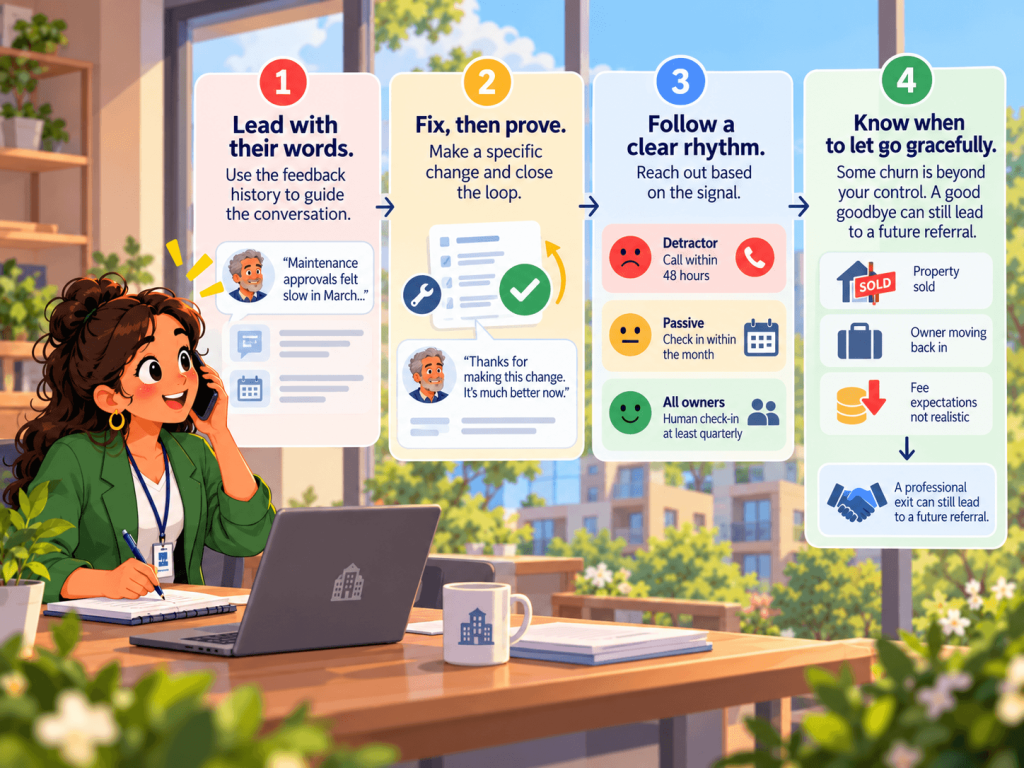
Lead with their words, not your talking points. “You mentioned in March that maintenance approvals felt slow, and I want to walk you through what we changed” lands entirely differently than a generic “checking in!” call. The feedback history is the script.
Fix, then prove. Owners have heard promises before. The credible move is to make one specific change, then close the loop: tell the owner what changed because of what they said. This is the outer half of closing the feedback loop, and it’s the single behavior that converts a survey program from paperwork into retention.
Don’t wait for the score to trigger it. The best firms run a standing rhythm: every Detractor gets a call within 48 hours, every passive gets a check-in within the month, and every owner, happy or not, hears from a human at least quarterly with something other than an invoice.
Know when the save isn’t worth it. Some owners churn for reasons no service level fixes: they sold the property, moved back in, or want a fee no sustainable operator can match. A good feedback program also tells you which goodbyes to accept gracefully, and a graceful goodbye protects the referral even when it loses the door.
What the Firms That Keep Their Owners Do
Pull it together and the pattern is consistent across the firms with above-benchmark owner scores:
- They measure owners separately from residents. Blended scores hide owner drift behind resident noise (or vice versa). Separate campaigns, separate trend lines.
- They survey on a cadence, not on a whim. Quarterly-ish recurring NPS, transactional CSAT on the heavy moments, delivered by email with the occasional link in a statement.
- They respond faster than they report. The Detractor call happens this week; the board-level dashboard can wait for month-end.
- They close the loop in public too, not just one-on-one. A “here’s what changed” note in the owner newsletter turns the fix-then-prove habit above into visible proof for owners who weren’t the ones who complained.
- They convert satisfaction into growth. Promoter owners get asked, at the right moment, for a referral or a public review. That’s a separate playbook, covered in how to get more property management clients, but it runs on the same rails.
None of this requires headcount. It requires wiring: surveys triggered on schedule, alerts routed to the right person, and a habit of treating an owner’s written comment as a work order for the relationship.
Conclusion
Owner churn feels sudden because the deciding happens where you can’t see it. A feedback program moves the deciding into view: the trend that dips, the comment that names the problem, the silence that breaks pattern.
Run the system against 114 Maple, and the story from the top of this piece plays out differently. The late statement shows up as a passive score two quarters before the termination email. The maintenance bill that arrived without warning triggers an event-based CSAT dip a month later. Someone calls in month four, not in month nine, and the polite, past-tense email never gets written. Every one of those is a door you still have time to keep.
The mechanics are not exotic. Separate owner campaigns, a steady NPS cadence, CSAT on the heavy moments, and a human who calls when the signal fires. Firms running exactly this on Retently hold owner scores well above the industry’s 35 benchmark, and setup takes two 30-minute calls, not a quarter. Start a free trial or book a demo, and put a radar on the revenue you already have.
Frequently Asked Questions
How do you measure property owner satisfaction? Run a recurring NPS survey to every owner (quarterly or every 120 days works well), asking how likely they’d be to recommend your firm to another property owner, plus an open-text “why”. Add transactional CSAT after heavy events like tenant placement or major maintenance. Track the trend per owner, not just the aggregate.
What is a good NPS for a property management company with owners? Across property management firms surveying through Retently, owner NPS averages 35. Treat that as the reference point: above it you’re outperforming the field, and a firm like BlueSky Property Management reaches 48. The trend matters more than the number, though. A falling 45 is more alarming than a stable 30.
Why do property owners leave management companies? The common causes cluster around communication (slow responses, surprise costs), performance (long vacancies, maintenance handling), and price shopping. Most exits build silently over months, which is why regularly collected feedback catches the majority of departures while there’s still time to act, before the termination notice is written.
How often should you survey property owners? A relationship NPS pulse every 90 to 120 days per owner, plus event-triggered CSAT surveys after tenant placement and significant maintenance. Throttle so no owner receives two surveys in quick succession. Consistency over years beats intensity in any one quarter.

 Christina Sol