



The best maintenance coordinator your company ever had gave notice on a Friday in March. By June, you could see her absence in the numbers: response times drifting, first-visit fixes down, two residents in her buildings posting reviews about “the new person who never calls back.” Nobody connected the dots in a meeting, because the dots lived in different dashboards. Hers was an HR event. The reviews were a marketing problem. The scores were a CX problem.
They were all the same event.
Property management is a relationship business staffed by people doing one of the industry’s most burnout-prone jobs: absorbing complaints all day, mediating between owners who want costs down and residents who want service up, with turn season stacked on top. When those people leave, they take relationships with them, and every departure quietly resets trust across an entire portfolio. Resident experience and employee experience aren’t adjacent topics in this industry. They’re the same topic, measured from opposite ends.
Which is why the feedback program you run for owners and residents should have a third audience: your own team. Here’s how employee NPS works when the employees manage properties.
Key Takeaways
- Frontline departures in PM are resident-experience events: relationships are person-mediated, and a quit resets trust across every unit that the person served.
- Run eNPS quarterly with the same seriousness as customer NPS: two questions, honest anonymity, and a leadership habit of acting on what comes back.
- In small teams, the open comments matter more than the score; protect anonymity by reporting only above a minimum group size.
- The payoff cut is putting team eNPS trends next to resident score trends per portfolio: employee sentiment usually moves first, making eNPS a leading indicator for the scores your owners see.
- Treat flight-risk roles to stay interviews before the notice letter, not exit interviews after it.
Why Frontline Turnover Is a CX Problem
Think about what a resident’s relationship with your company physically consists of. It’s Maria, who answers the maintenance line and remembers their dog’s name. It’s the property manager who handled last year’s lease renewal like a human being. Residents don’t have a relationship with your brand; they have a relationship with three or four people, and your brand borrows it.
Now run the staff turnover tape. Maria leaves. Her replacement doesn’t know the building’s quirks, the vendors’ habits, or which resident needs a call rather than an email. Service quality dips for a quarter, exactly the kind of dip that shows up in maintenance survey scores and, industry-wide, feeds the bruising resident NPS of 10 documented in the property management CX gap study. The resident doesn’t experience “normal staff transition.” They experience your company getting worse.
The financial framing of employee turnover in property management usually stops at recruiting and training costs – $5,475 per nonexecutive hire on average, per SHRM’s 2025 Benchmarking Report. The bigger line is invisible: the renewal that doesn’t happen because the renewal-window relationship left in March, the review written about the rough quarter, the owner who notices their buildings feel less looked-after. Staff churn converts into door churn with a delay, which is exactly why it hides.
And door churn has its own price tag: turning over a single apartment unit – marketing, repairs, concessions, lost rent – runs close to $4,000 on average. One avoidable resignation that costs a portfolio two or three renewals isn’t a rounding error next to a recruiting line item, it’s several times the size of it.
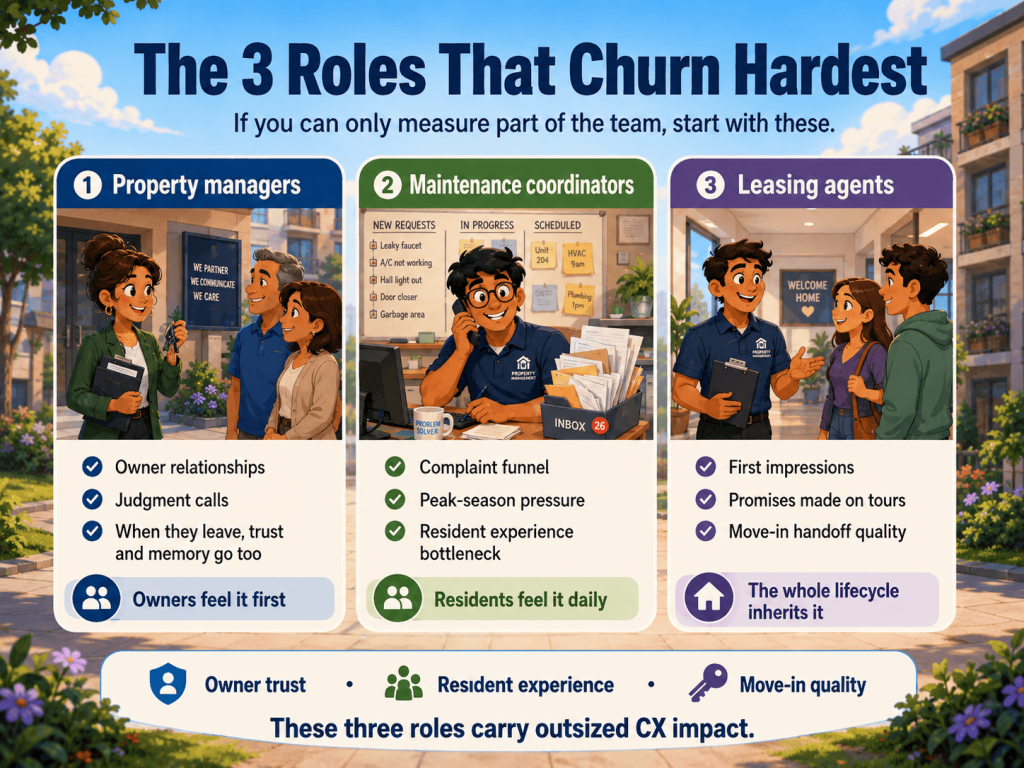
The Three Roles That Churn Hardest
Not all seats carry equal CX weight. Three do most of the damage when they empty.
Property managers hold the owner relationships and the judgment calls. The job description is professional conflict absorption, and the burnout pattern is predictable: the best ones care the most, and caring is what wears out. When one leaves, owners feel it personally; the portfolio’s institutional memory walks out in a single afternoon.
Maintenance coordinators sit at the bottom of the complaint funnel. Every frustrated resident in the portfolio flows through their inbox, at peak volume during exactly the seasons when vendors are hardest to book. It’s the most consequential seat in resident experience and typically the least recognized, a combination that writes its own resignation letters.
Leasing agents run a seasonal sprint with commission pressure and endless no-shows. Their churn resets the first impression machine: the tone of tours, the accuracy of what gets promised, the quality of the move-in handoff that the rest of the resident lifecycle has to live with.
If you can only measure part of the team, measure these three roles first.
eNPS: The Mechanics, PM Edition
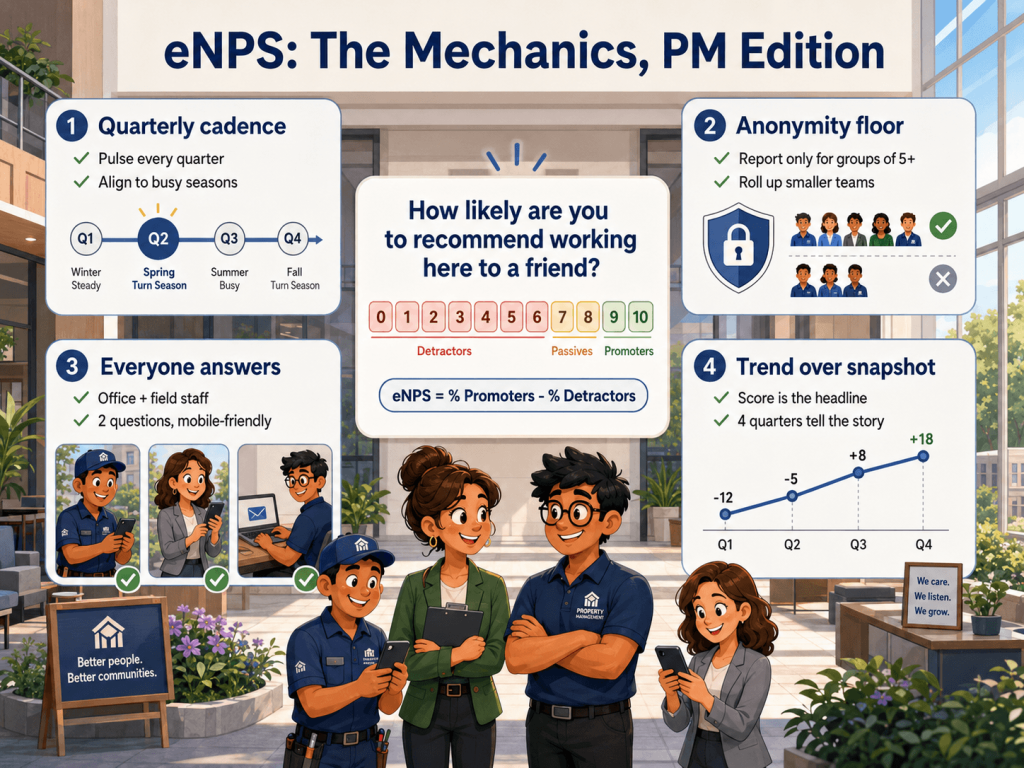
Employee NPS borrows the customer framework: “How likely are you to recommend working at [company] to a friend?”, scored 0-10, Promoters minus Detractors, tracked as a trend. Our generic eNPS guide covers the foundations; here’s what changes in a property management context.
Quarterly, aligned to your seasons. Annual engagement surveys are archaeology. Quarterly pulses catch the post-turn-season exhaustion while there’s still time to respond to it, and a fixed rhythm (say, the month after each quarter closes) makes the trend readable year over year.
Anonymity with a floor. Small teams make anonymity fragile, and fragile anonymity produces polite fiction. Only report results for groups of five or more; below that, roll teams up until the floor is met. Say the rule out loud to the team. The first honest Detractor comment you receive is proof the promise landed.
Everyone answers, wherever they work. Field staff without desks answer on their phones; email with a link works, and the survey is two questions, so it takes ninety seconds. If your techs and agents are excluded, you’re surveying the people with the least CX exposure about a job the others do.
The score is the headline; the trend is the story. A single eNPS reading tells you little (and small-team scores swing hard). Four quarters of readings tell you whether the March policy change helped, whether turn season broke something, whether the new manager’s team is recovering.
What to Ask Beyond the Score
Two questions every quarter: the 0-10, and “What’s the main reason for your score?”. In teams of fifteen, the open comments are the entire program; read every one.
Then rotate a single third question per quarter, one driver at a time:
- “Do you have the tools/vendor support you need to do your job well?” (1-5)
- “How manageable was your workload this quarter?” (1-5)
- “When residents or owners escalate, do you feel backed by management?” (1-5)
- “What’s one thing that would make your job noticeably better?” (open)
That last one deserves a warning: it’s the highest-value question on the list and the most dangerous, because answers create obligations. Ask it only in the quarters when leadership has bandwidth to visibly act on the top theme. An ignored suggestion box costs more trust than no suggestion box, with employees exactly as with customers.
Connecting Employee Scores to Resident Scores
Here’s where the program earns its keep, and where PM firms have an advantage most industries don’t: your operation is naturally segmented into portfolios and teams, and both your employees and your customers are already being scored.
Put the two trend lines next to each other. Team eNPS by quarter, resident NPS and maintenance CSAT for that team’s portfolio by quarter. You’re looking for the lead-lag pattern: employee sentiment usually moves first, because the people doing the work feel the understaffing, the vendor problems, and the process breakdowns a quarter or two before residents experience the consequences. A sagging eNPS in a stable portfolio is tomorrow’s resident-score dip filing an early warning.
Some firms in Retently’s property management dataset run exactly this architecture, with employee NPS as a standing campaign alongside their owner and resident programs, which makes the comparison a dashboard view rather than a spreadsheet project. The complete PM survey architecture treats every audience the same way: same NPS discipline, same cadence thinking, same close-the-loop obligation. Employees are the audience that predicts the other two.
One honesty note: with team-sized samples, treat the correlation as directional insight, not statistics. You’re not publishing a study; you’re noticing that Building C’s numbers started slipping two quarters after its coordinator’s did, and acting on the noticing.
Acting on It: The Retention Loop for Staff
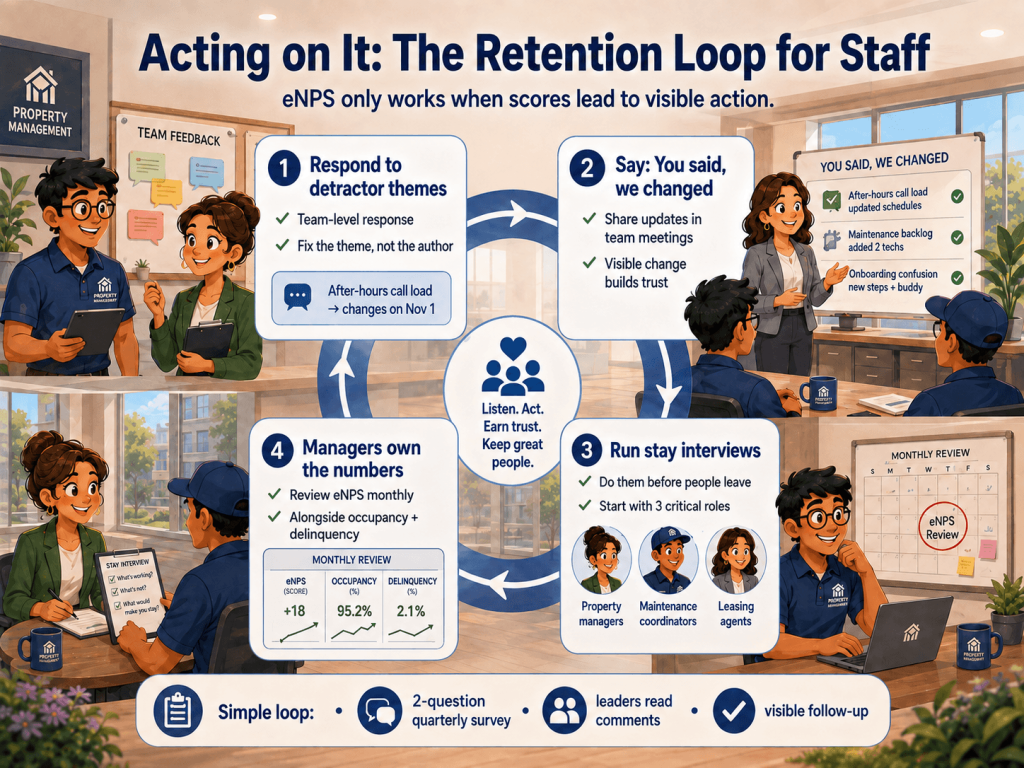
An eNPS program that collects scores and shelves them is worse than none; it teaches the team that being asked is theater. The loop that works is the same one you run for customers, translated:
- Detractor comments get a response. Not a hunt for the author; a visible, team-level response to the theme. “Several of you flagged after-hours call load; here’s what changes on November 1st.”
- “You said, we changed” gets said explicitly. Close the loop in the team meeting with the same discipline you’d use in an owner newsletter. Credibility compounds, so does its absence.
- Flight-risk roles get stay interviews. For the three critical roles, don’t wait for the eNPS dip. A stay interview, a structured conversation about what keeps someone and what would make them leave, run while they’re still happy, is the single cheapest retention tool in management. The exit interview is the same meeting held too late.
- Managers own their numbers. Team-level eNPS belongs in the same monthly review as occupancy and delinquency. What leadership inspects, the organization believes matters.
None of this requires an HR department. A two-question quarterly survey, a leadership team that reads the comments, and a habit of answering them beats most enterprise engagement programs on effect per dollar.
Conclusion
Property management firms spend heavily learning what residents and owners think, then staff the entire experience with people nobody asks. The quit that blindsides you in March was measurable in November; the resident-score dip in June was predictable in March. eNPS is how the prediction gets made, and the loop you close with your own team is the one that keeps every other loop staffed.
Retently runs employees as a first-class survey audience next to your owners and residents: quarterly pulses, anonymity built in, trends per team, alongside the customer scores they predict. Setup is two 30-minute calls. Start a free trial or book a demo, and hear about the next resignation while it’s still a conversation.
Frequently Asked Questions
What is a good eNPS for a property management company? There’s no published PM-specific eNPS benchmark, and small-team scores swing too much to chase a number. Treat any positive score as workable and focus on the trend: a team moving from -10 to +15 over a year is the success story, regardless of where competitors sit.
How often should property management companies survey employees? Quarterly, on a fixed rhythm aligned to your operational seasons. Annual surveys miss the turn-season stress cycle entirely. Keep each pulse to two questions (the 0-10 recommendation question plus an open “why”), with at most one rotating driver question added.
How does employee turnover affect resident satisfaction? Resident relationships in property management are person-mediated, so a departure resets trust across every unit that employee served: response times slip, institutional knowledge disappears, and service consistency drops for a quarter or more. Employee sentiment typically declines before resident scores do, which makes eNPS a leading indicator for resident NPS and CSAT.
Can you run eNPS anonymously in a small team? Yes, with a reporting floor: only show results for groups of five or more respondents, rolling small teams together until the threshold is met, and tell the team the rule. Anonymity that employees don’t trust produces polite scores and empty comments, which defeats the program.

 Christina Sol