



Residents at the average property management firm score their managers a bruising NPS of 10, against 35 from owners, and when you read the open-text comments behind those low scores, maintenance dominates. That’s the core finding of Retently’s property management CX study: residents tip negative at the hard operational moments, and no moment recurs more often than the work order. A maintenance satisfaction survey puts a score on that moment.
Think about what a maintenance request actually is from the resident’s side. Something in their home is broken. They’ve reported it, and now they’re waiting, with no visibility, for strangers to fix it. Every hour of that wait is your brand being formed. Handle it well and you’ve banked loyalty a rent increase can’t easily spend; handle it badly and you’ve written the first draft of a non-renewal.
Most firms track maintenance operationally (time-to-close, cost per ticket) and never measure the only outcome the resident cares about: how it felt. Closing that blind spot takes one question, sent at exactly the right moment. Here’s how to build it.
Key Takeaways
- Survey every closed work order with a single-effort or satisfaction question, fired automatically within 24 hours of close, while the repair is still fresh.
- Use CES (“how easy was it to get this resolved?”) as the default. The resident’s real complaint is almost never the wrench work, it’s the effort and the silence around it.
- Slice results three ways: by property (systemic issues), by coordinator (process issues), and by vendor (who keeps getting your work orders).
- A closed ticket is not a closed loop. Low scores need a human follow-up within a day or two, because an unresolved maintenance grievance is the most common seed of a non-renewal and a one-star review.
One Question, Sent at Ticket Close
The design principle for maintenance surveys is restraint. The resident just spent days dealing with a broken thing. The last gift you should hand them is a questionnaire.
So the survey is one scored question plus an optional open comment, and it fires automatically when the work order status flips to closed. Not weekly, not in a monthly digest: per ticket, within about 24 hours of completion. Two things make that timing right. The experience is fresh, so the answer is accurate. And the repair is recent enough that if the answer is “it’s not actually fixed,” you can reopen the ticket before frustration compounds.
One throttle rule: if the same resident has multiple tickets closing within a short window, survey the last one only. Nobody should get three surveys about one bad week of plumbing. The broader cadence rules for resident surveys are covered in our tenant satisfaction survey guide, which maps all six journey touchpoints. This article zooms into the one that fires most often.
CES or CSAT: Picking the Metric
Both work; they answer different questions.
Customer Effort Score is the better default. “How easy did we make it to get your issue resolved?” targets the thing residents actually resent, which is rarely the repair itself. It’s the follow-up calls, the missed appointment windows, the re-explaining, the not knowing. Effort is also the more predictive signal: research on CES has long shown that high-effort service experiences drive disloyalty more reliably than low satisfaction does.
CSAT fits when you want to grade the outcome. “How satisfied are you with how we handled your maintenance request?” reads naturally to residents and produces a clean 1-to-5 number you can put on a vendor scorecard.
A reasonable pattern many firms land on: CES as the scored question, with the open comment catching outcome problems. If you’d rather ask CSAT, that’s fine too. Just pick one and keep it consistent, because the value is in the trend, and a trend needs a stable ruler.
The Maintenance Satisfaction Survey Question Bank
The scored question, in the two flavors:
- “How easy was it to get your maintenance issue resolved?” (CES, 1-7 scale)
- “How satisfied are you with how we handled your recent maintenance request?” (CSAT, 1-5 scale)
The follow-up open question, one of:
- “What’s the main reason for your score?”
- “What could we have done to make this easier?”
And when you have room for one more scored item (use sparingly, and never all of these at once):
- “Was the issue fully resolved on the first visit?” (yes/no, the hidden gold: first-time-fix rate as reported by residents, not vendors)
- “How would you rate the communication about your request?” (1-5)
- “How would you rate the technician who completed the work?” (1-5, feeds the vendor scorecard)
- “How would you rate the quality of the repair itself?” (1-5, feeds the vendor scorecard)
- “Did the technician treat your home with care – shoe covers, cleanup, no damage?” (1-5, a separate signal from repair quality, and just as scorecard-worthy)
- “Did the technician arrive within the scheduled window?” (yes/no)
One more thing worth keeping on hand: when a ticket closes after being reopened from the recovery loop, don’t resend the first-attempt survey as if nothing happened. Swap in “Is the issue resolved now, after our follow-up?” so the question acknowledges the history instead of asking a resident who already complained once to answer as if this were their first time.
That’s the whole bank. Resist the committee’s urge to add “just one more question.” Response rates on one-question surveys are dramatically better, and in maintenance, you’ll be sending these often. Our data on survey response rates shows brevity is the single cheapest lever you have.
Wiring It to Your Work Order System
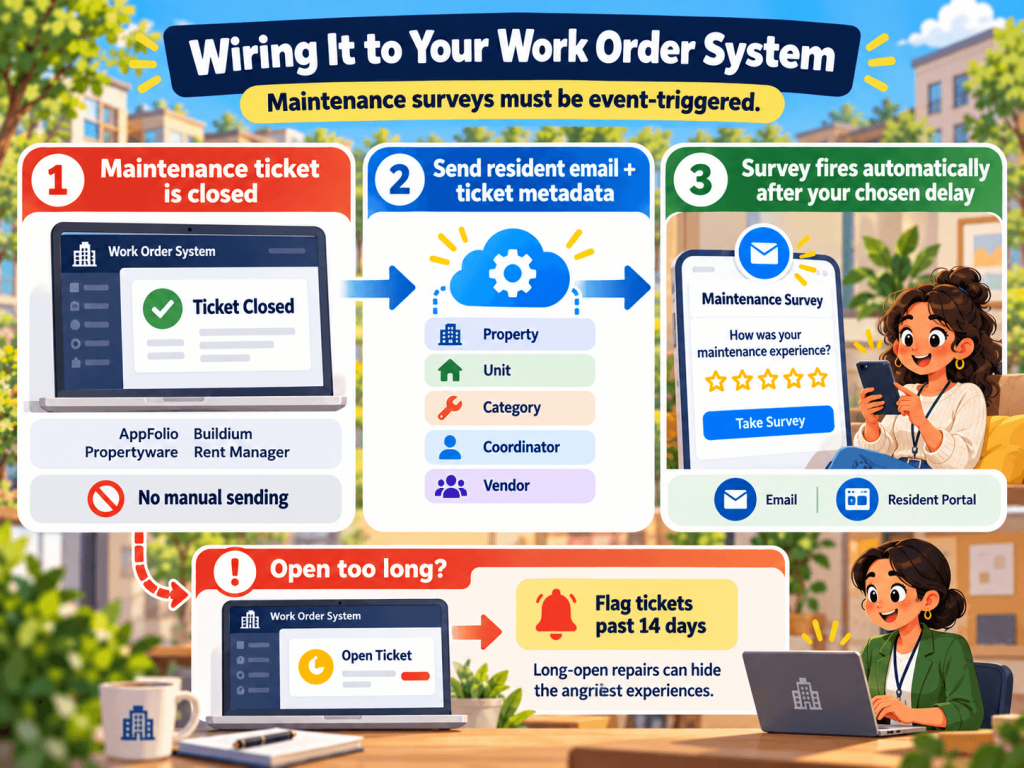
Manual sending kills maintenance surveys within a month, because the volume is steady and nobody’s calendar survives it. The survey has to be event-triggered.
The wiring is simpler than most operators expect. Whatever runs your work orders (AppFolio, Buildium, Propertyware, Rent Manager, or a maintenance platform), the pattern is the same: when a ticket closes, push the resident’s email and the ticket metadata to your survey platform, which fires the survey after your chosen delay. On Retently, that’s a webhook or a Zapier step. Firms like Colorado Realty run CSAT after every heavy process this way, as part of a program spanning 8 lifecycle touchpoints. No native integration required, and no one has to remember anything.
Carry the metadata with the survey response: property, unit, ticket category (plumbing, HVAC, electrical), coordinator, and vendor. Those five fields are what turn a pile of scores into the diagnostics in the next section. Delivery is email by default, with the survey link equally at home in a resident portal message.
Pair the survey trigger with a second alert, for tickets that stay open too long. The survey only fires when a ticket closes, so a repair stuck for weeks waiting on a part, or a vendor who no-shows twice, never triggers a score at all – often the angriest experience a resident has goes invisible simply because the ticket stayed open. Flag tickets past a set age, say 14 days, so those cases don’t hide from you.
Reading the Results: Property, Person, Vendor
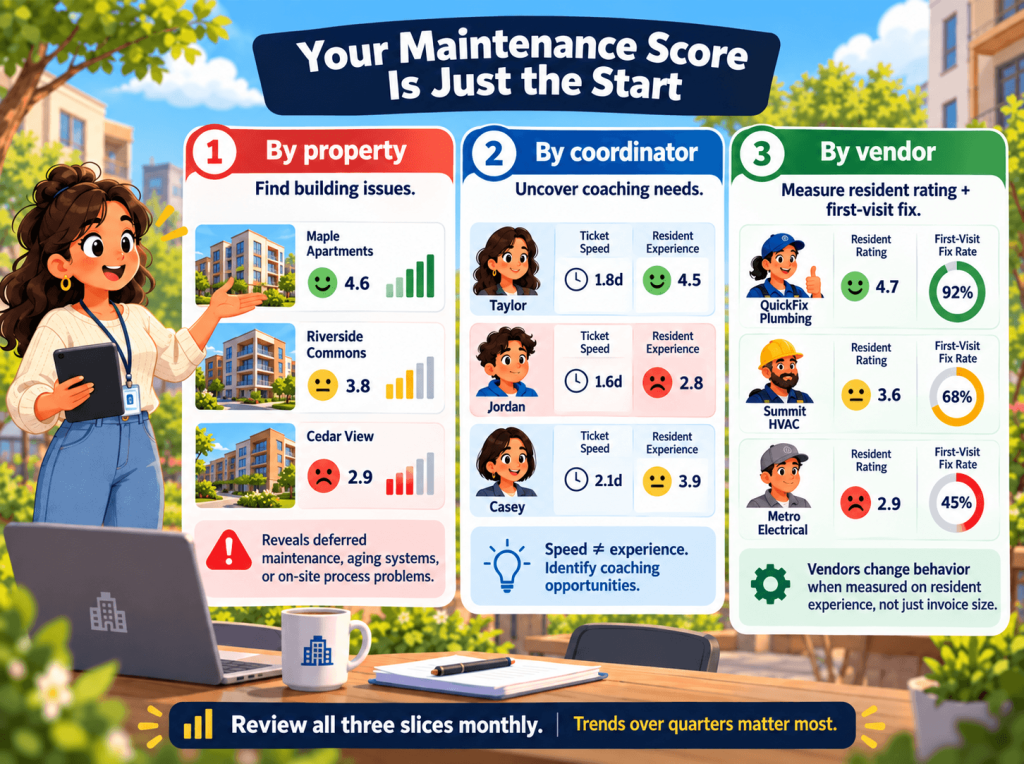
A single overall maintenance score is nice for a slide. The operational value appears when you cut it three ways.
By property. One building scoring consistently below the rest isn’t a survey artifact; it’s deferred maintenance, an aging system, or an on-site process problem making itself known. This slice tells you where the capital conversation with the owner needs to happen, with resident data to back it up.
By coordinator. If tickets routed through one coordinator run half a point below the others, you’ve found a coaching opportunity that no time-to-close report would surface, because speed and experience aren’t the same thing.
By vendor. This is the slice almost nobody runs, and it’s the sharpest. Score every vendor by the resident ratings on their completed tickets and the first-visit-fix rate, and you have an evidence-based answer to “who keeps getting our work orders?” Vendors respond to it, too: being measured on resident experience, not just invoice size, changes behavior. FIG Property Management takes this a step further and surveys the vendors themselves, holding a vendor NPS of 90. We look at that flip side in vendor NPS for property management.
Review the three slices monthly. The trend per slice, over quarters, is where the program pays for itself.
The Recovery Loop for Bad Repairs
Here’s the rule that separates programs that build trust from programs that quietly burn it: a closed ticket is not a closed loop.
When a maintenance survey comes back at the bottom of the scale, three things should happen, fast:
- An alert reaches a named human immediately. Not a shared inbox. The property manager or coordinator who owns that building sees the score and the comment the moment it lands. A bad score on a ticket already flagged as an emergency or priority – the no-heat call, not the squeaky hinge – should jump that queue ahead of a routine one.
- Someone calls within one business day. Not to defend the process; to find out what’s still wrong. About half the time, the honest answer is “it isn’t actually fixed,” and the correct response is a reopened ticket with priority, not an apology template.
- The resident hears the outcome. “We’ve scheduled the plumber back for Thursday, and I’ve flagged the missed window with the vendor” converts a Detractor moment into evidence that reporting problems works. That’s the service recovery paradox doing its thing: a problem handled visibly well can leave more loyalty behind than no problem at all.
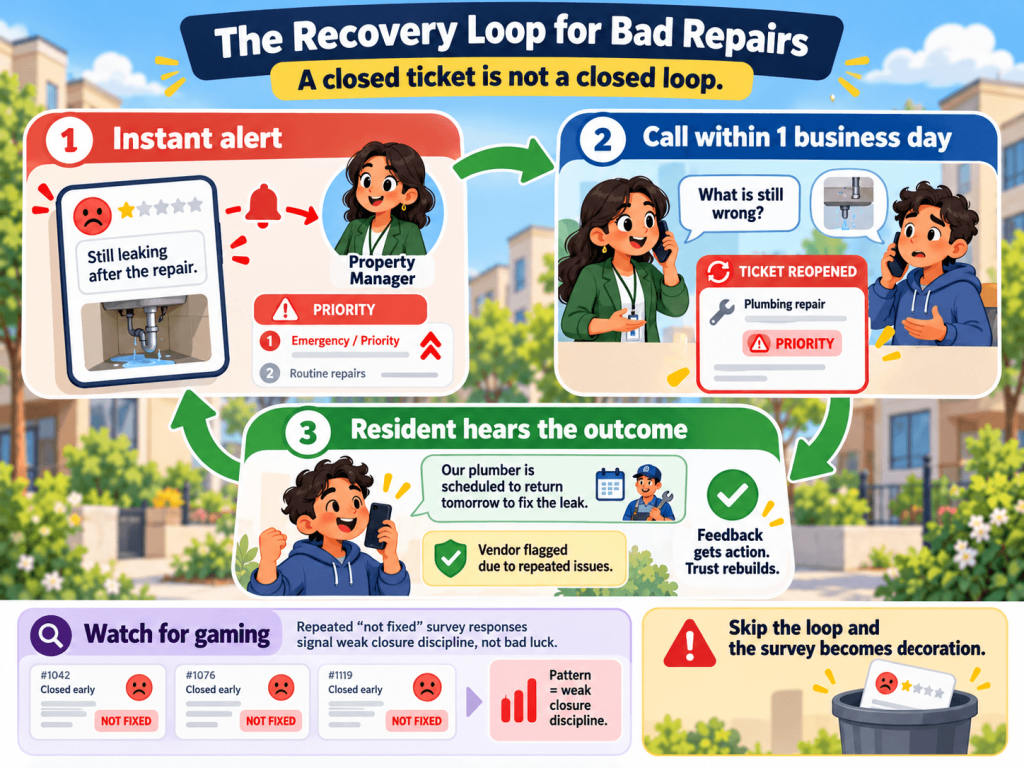
The trigger itself can be gamed, too, and it’s worth watching for. If coordinators know their numbers are tracked, closing tickets early to hit a response-time target gets tempting – and the survey is exactly what catches it. Track how often a coordinator’s closed tickets come back scored as “not fixed,” and read a pattern there as a signal about closure discipline, not bad luck.
Skip the loop, and the survey becomes actively harmful. A resident who scored you a 2 and heard nothing has learned that your surveys are decoration, and their next channel is Google reviews. Respond consistently and something better happens: residents learn that feedback gets action, which is precisely the reputation you want ahead of the renewal conversation.
Conclusion
Maintenance is where property management gets judged, one work order at a time, and it’s the touchpoint where resident goodwill is won or lost long before the renewal notice goes out. Measuring it takes one question, one trigger, and a team that treats a low score as a reopened ticket rather than a filed statistic.
Retently runs this pattern out of the box: CES or CSAT fired from your work order system through webhooks or Zapier, alerts routed to the right coordinator, and results sliced by property, person, and vendor. Setup is two 30-minute calls. Start a free trial or book a demo and put a score on the moment your residents remember most.
Frequently Asked Questions
What questions should a maintenance satisfaction survey ask? Keep it to one scored question plus an open comment. Either “How easy was it to get your maintenance issue resolved?” (CES) or “How satisfied are you with how we handled your request?” (CSAT), followed by “What’s the main reason for your score?”. Optionally add a yes/no first-visit-fix question.
When should the survey be sent? Automatically, within about 24 hours of the work order closing. That’s fresh enough for accurate answers and early enough to reopen the ticket if the repair didn’t hold. Trigger it from your work order system via webhook or Zapier rather than sending manually.
Should maintenance surveys use CES or CSAT? CES is the better default because effort, not the repair itself, is what residents usually resent: the chasing, the waiting, the re-explaining. Use CSAT if you specifically want an outcome grade for vendor scorecards. Pick one and stay consistent so the trend stays comparable.
How do you evaluate maintenance vendors with survey data? Attach vendor, property, and ticket category to every survey response. Then rank vendors by average resident rating and resident-reported first-visit-fix rate. Review monthly, share scores with the vendors, and let the data decide who keeps receiving work orders.

 Christina Sol