



Table of Contents
- Key Takeaways
- The Data Behind This Study
- The Headline: A 25-Point Gap Between Owners and Residents
- The Gap Is Structural, Not an Outlier
- Where Residents Actually Turn Negative
- Why Owners Score Higher
- What the Gap Costs in Resident Retention and Reputation
- What the Best Firms Do Differently
- How to Measure the Gap in Your Own Portfolio
- Methodology
Property management is the rare business with two customers who never see the same service. Owners get the statements, the placement updates, and the quarterly calls. Residents get the application portal, the maintenance visits, and the renewal letter. Same company, two completely different experiences.
We finally put a number on how different.
Retently analyzed tens of thousands of owner and resident surveys sent by property management and real estate companies through our platform between 2020 and mid-2026, along with thousands of NPS, CSAT, CES, and star-rating responses they generated. The headline finding is blunt:
Property managers score an NPS of 35 with the owners who pay them and an NPS of 10 with the residents who live in their units. A 25-point gap, inside the same companies, at the same time.
And it isn’t a quirk of a few struggling portfolios. In every firm in our dataset that surveys both audiences, owners out-score residents. Every single one. The gap ranges from single digits at the best-run firms to more than 40 points at the widest.
This study breaks down where that gap comes from, which moments in the resident journey create it, what it costs in turnover and reputation, and what the firms with the narrowest gaps do differently.
Key Takeaways
- The CX gap is real and it’s wide. Across our dataset, owner NPS sits at 35 while resident NPS sits at 10: a 25-point gap between the audience that pays the management fee and the audience that generates the work, the reviews, and the renewals.
- It’s universal. In every firm we studied that surveys both owners and residents, owners score higher. The gap is structural to the business model, not a symptom of a few bad operators.
- Residents turn negative at the two moments that decide retention. Move-in scores average just 3.7 out of 5, and renewal-window satisfaction drops as low as 3.0 out of 5, the weakest reading in the entire resident journey.
- The gap is expensive. Resident retention already sits below target across the industry, and every lost resident costs roughly $4,000 to replace. A resident NPS of 10 is the leading indicator of both numbers.
- The gap is closable. The firms at the narrow end of the range run the same playbook: survey both audiences separately, trigger surveys at lifecycle moments instead of annually, and treat a low score as an alert, not a statistic.
The Data Behind This Study
Most property management benchmarks are built on stated-preference research: someone asks residents how they feel about renting in general. This study is built on something different, namely revealed feedback, collected by actual property management companies from their actual owners and residents at real moments in the relationship: after a move-in, after a maintenance visit, in the renewal window, on a quarterly relationship pulse.
The dataset covers surveys sent between January 2020 and June 2026 by residential property management and real estate firms running their feedback programs on Retently, primarily across the United States. It spans single-family and multifamily portfolios, plus adjacent real estate services like brokerage and title work. Tens of thousands of surveys sent, thousands of responses across several metrics: NPS for the ongoing relationship, CSAT for individual touchpoints, CES for effort-heavy moments like renewal, and star ratings at leasing and move-in.
Because these firms run separate owner and resident campaigns (a structure we covered in depth in our guide to how property management companies use CX surveys), we can do something no general-purpose benchmark can: put the two audiences side by side inside the same companies. Full methodology notes are at the end of this study.
The Headline: A 25-Point Gap Between Owners and Residents
On the surface, the industry looks healthy. Blend every NPS response in the dataset together and property management lands in the high 30s, a respectable score for a services business (here’s what counts as a good NPS if you want the cross-industry context).
Split the same responses by audience and the picture changes completely:
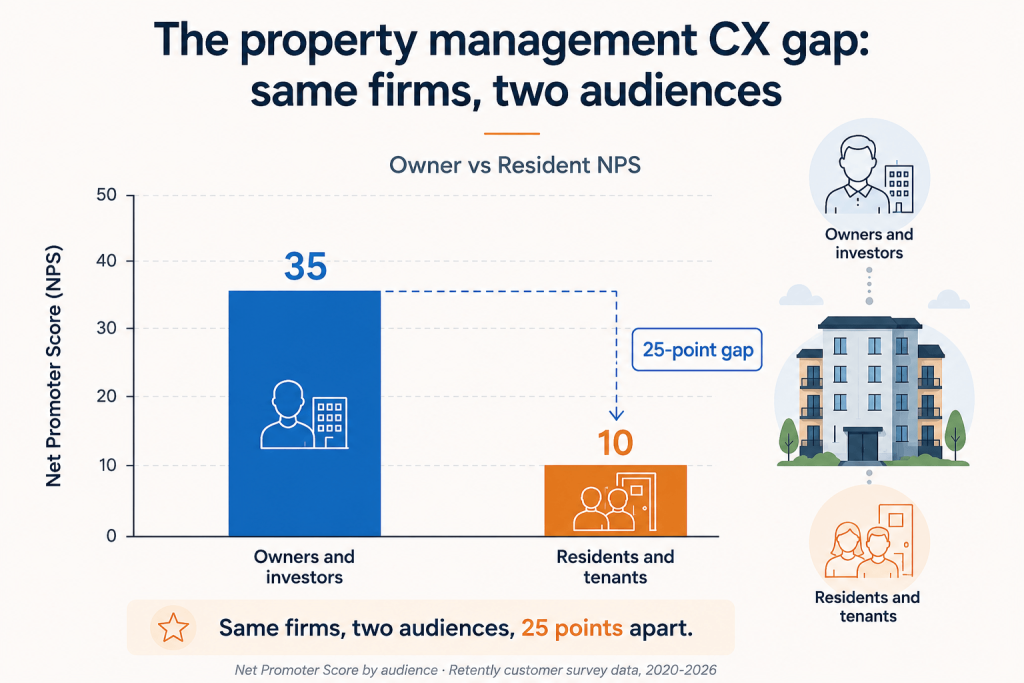
An NPS of 35 means Promoters comfortably outnumber Detractors: owners, on the whole, would recommend their property manager. An NPS of 10 means the Promoter and Detractor camps are nearly the same size. For every resident enthusiastic enough to recommend their management company, there’s almost one actively warning people away.
Two more reference points put the resident number in perspective:
Residents answer more, and less happily. Resident campaigns generate nearly twice the response volume of owner campaigns in our dataset. The audience property managers hear from most is the one who likes them least.
The contrast with adjacent real estate services is stark. The brokerage and title-services firms in our dataset post account-wide NPS scores in the low-to-mid 80s. Those are transactional businesses where the customer chose the purchase and the relationship ends at closing. Property management’s resident relationship is the opposite: ongoing, involuntary in parts (the resident picked the unit, rarely the manager), and full of friction moments. That structural difference is exactly why resident experience has to be managed deliberately rather than assumed.
The Gap Is Structural, Not an Outlier
The obvious objection to the headline number: maybe a couple of firms with unhappy residents are dragging the average down.
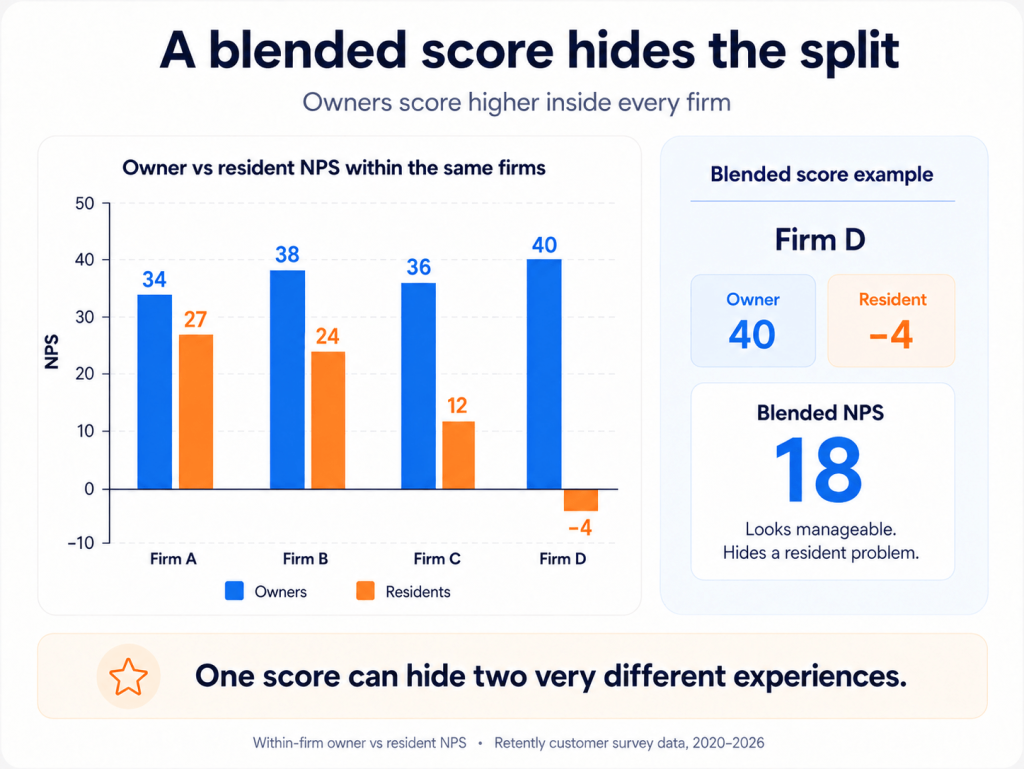
They aren’t. We checked the gap inside each company that runs both owner and resident programs, and the direction never flips:
- Owners out-score residents in every single firm. No exceptions in the dataset.
- At the narrow end, the best-run programs hold the gap to single digits, with both audiences scoring well above the industry blend.
- At the wide end, the gap exceeds 40 points. The most dramatic profiles look like this: owner NPS of 40, resident NPS of minus 4. The people paying the fees are Promoters, while the people living in the units are net Detractors, and the firm would never see it in a blended score.
That last pattern is worth dwelling on. A combined feedback program, one survey list, one score, would report these firms at a comfortable-looking NPS in the 20s. The blended number actively hides the problem. This is the strongest argument we know for running owner and resident surveys as separate programs with separate baselines, which is exactly how the experienced firms in our dataset structure it.
The within-firm consistency also tells you the gap isn’t about any individual company’s competence. It’s the physics of the business: owners experience property management as a financial service, residents experience it as their home. The same firm, with the same staff and the same processes, will score 20 points apart with the two audiences by default. Closing the gap takes deliberate work on the resident side; it doesn’t happen on its own.
Where Residents Actually Turn Negative
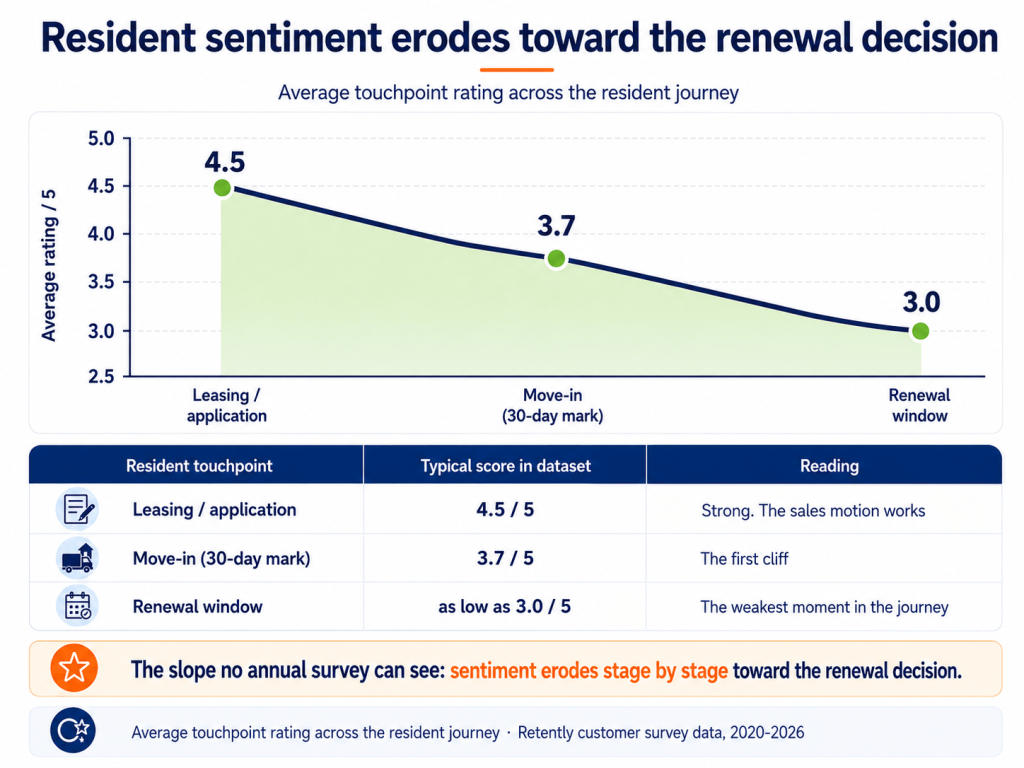
NPS tells you the size of the problem. The touchpoint surveys tell you where it lives. Across the resident lifecycle, the transactional surveys in our dataset (star ratings, CSAT, and CES at specific moments) consistently rank the journey’s stages from best to worst:
| Resident touchpoint | Typical score in dataset | Reading |
| Leasing / application | 4.5 / 5 | Strong. The sales motion works |
| Move-in (30-day mark) | 3.7 / 5 | The first cliff |
| Renewal window | as low as 3.0 / 5 | The weakest moment in the journey |
- Leasing scores high. At 4.5 out of 5, the application and lease-signing experience is the best-rated moment in the resident journey. This makes sense: it’s the stage that gets sales attention, the resident is excited, and nothing has gone wrong yet.
- Move-in is the first cliff. Thirty days in, ratings drop to 3.7 out of 5. The unit has been lived in, the punch-list items have surfaced, and the gap between what was toured and what was delivered is now the resident’s daily reality. The 30-day move-in survey is where expectations meet experience, and in our data, experience loses almost a full star.
- The renewal window is the bottom. Renewal-stage satisfaction readings sink as low as 3.0 out of 5, the weakest figure at any resident touchpoint we measure. Residents hit the renewal decision carrying every unresolved annoyance of the past year, often alongside a rent increase. Effort scores in the renewal window average 5.6 out of 7, decent on paper, but satisfaction with the renewal itself is where the accumulated relationship debt comes due.
The sequence matters because of what it implies: resident sentiment doesn’t fail at a single broken touchpoint, it erodes. The journey starts at 4.5 and grinds down to 3.0 at exactly the moment the resident decides whether to stay. Firms that only survey annually never see the slope. Firms that put a survey at each stage (the full playbook, with the exact questions, is in our tenant satisfaction survey guide) watch it happen in real time and can intervene mid-slide.
The owner journey has its own weak spot, for the record: marketing and tenant placement is the lowest-scoring owner touchpoint in our data, at 2.5 out of 5. Owners judge their manager hardest on how fast and how well a vacancy gets filled. But owner scores recover everywhere else, which is why the audience-level gap stays so wide.
Why Owners Score Higher
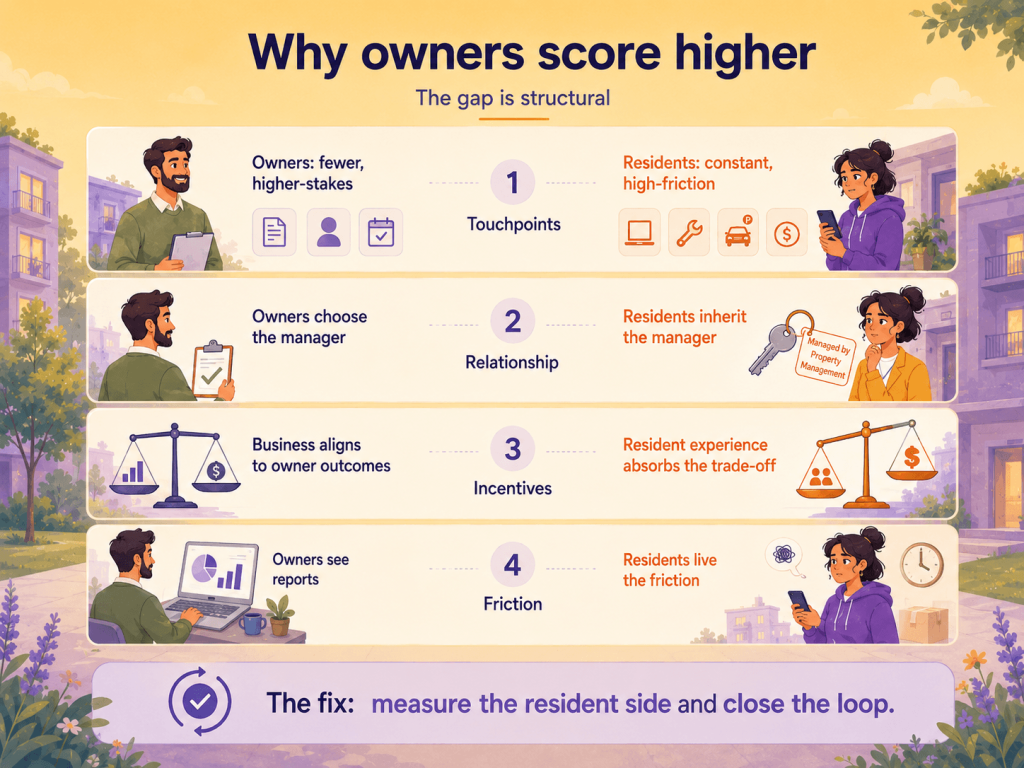
Nothing in the data suggests property managers serve owners brilliantly and residents carelessly. The asymmetry is built into the relationships.
- Owners have fewer, higher-stakes touchpoints. An owner interacts with their manager a handful of times a year: statements, a placement, maybe a renewal conversation. Each interaction is staffed by someone whose job is owner relations. Residents interact constantly (portal, maintenance, parking, neighbors, rent) and mostly through systems rather than people.
- Owners chose the relationship; residents inherited it. An owner evaluated managers and picked one. A resident picked a unit, and the management company came with it. Chosen relationships start with goodwill. Inherited ones start at zero.
- Incentives align with owners by default. The owner pays the fee, so the business is organized around owner outcomes: occupancy, rent collection, low expenses. Some of those outcomes (aggressive rent increases, minimal turn spend) directly trade against resident experience. Without a deliberate counterweight, every operational decision tilts toward the audience that signs the checks.
- Residents absorb the friction. Most of what goes wrong in property management (the late vendor, the lost work order, the deposit dispute) lands on the resident first and hardest. The owner reads about it in a report, if at all.
None of this is fixable by caring more. It’s fixable by measuring the resident side as seriously as the owner side and wiring the response loop accordingly, which is what the narrow-gap firms in the next section actually do.
What the Gap Costs in Resident Retention and Reputation
A 25-point gap would be an interesting curiosity if resident sentiment didn’t convert directly into money. It does, through three channels.
Resident retention and turnover. The average cost of a resident turn (marketing, repairs, concessions, vacancy loss) runs about $4,000 per move-out, with public references placing the cost around $3,872-$3,976 depending on the report year. Zego’s 2026 Resident Experience Management Report puts average resident retention at 57%, down from 60% in 2024. It also finds that renters begin reconsidering renewal at an average 8% rent increase, which makes the renewal window a price-sensitivity test and a relationship test at the same time. A resident NPS of 10 and a renewal-window satisfaction of 3.0 are the leading indicators behind those retention numbers. The undecided are precisely the residents a renewal-stage survey catches while the decision is still open.
Reputation. Residents write the reviews; owners don’t. J Turner Research finds that 70% of residents choose communities with a better online reputation. A resident base at NPS 10 produces a near-even stream of public praise and public warnings, and prospective renters read both – especially younger renters, who tend to be more review-sensitive and less forgiving of inconsistent service. The firms that route their happiest residents toward public reviews at the high points (a five-star move-in, a 9 on the relationship pulse) compound the good half of that stream into faster lease-ups.
Owner churn, eventually. Here’s the irony of the gap: the owner side of the business ultimately depends on the resident side. Vacancy, turnover cost, and a property’s review profile all flow from resident experience straight into owner returns. An owner NPS of 35 built on a resident NPS of 10 is borrowed satisfaction. The resident problems are already on their way to the owner’s statement; they just haven’t arrived yet.
The external data points in the same direction: renters cite controllable experience issues like rent pressure, maintenance response, safety, property upkeep, and management responsiveness among the reasons they do not renew. That is why the resident gap is not a soft CX issue. It is an operating-cost issue.
What the Best Firms Do Differently
The range in our data (gaps of single digits at one end, 40-plus points at the other) is the encouraging part of this study. The narrow-gap firms aren’t lucky; they run a recognizably different program. Four practices separate them:
- They survey both audiences, separately, on separate baselines. Owner and resident programs with their own campaigns, their own cadences, and their own score targets. Nobody averages the two into a single vanity number, so resident problems stay visible.
- They survey moments, not years. Instead of an annual blast, surveys fire on lifecycle events: a star rating after leasing, a 30-day move-in check, an effort score when a work order closes, a renewal-window pulse 60 to 90 days before expiry, an exit survey at move-out. These transactional surveys sit on top of a recurring relationship NPS every 90 to 120 days. The slope from 4.5 to 3.0 only shows up if you’re measuring at each stage.
- They treat Detractors as alerts, not data points. In the strongest programs, a low score triggers an immediate notification to the property manager, and someone calls while the Detractor is still recoverable. A resident contacted within days of a bad maintenance score renews. The same resident contacted at the renewal letter doesn’t. That discipline of closing the feedback loop is the single clearest behavioral difference between the narrow-gap and wide-gap firms. The best firms also match the response channel to the issue. Payments and maintenance status can stay digital. But noise complaints, neighbor issues, safety concerns, and renewal frustration need a human path, because those are the moments where a portal response can feel like avoidance.
- They harvest Promoters at the peaks. The high points in the journey (leasing at 4.5 stars, a great move-in) are when residents are most willing to say so publicly. Narrow-gap firms ask for the review right then, and their properties’ online reputation, the thing 70% of future residents decide on, reflects their best moments instead of their angriest ones.
None of this requires a big team. It requires the program to exist and the alerts to reach a human who acts. The wide-gap firms in our dataset mostly aren’t doing anything wrong; they’re measuring one audience and flying blind on the other.
How to Measure the Gap in Your Own Portfolio
You can replicate this study’s core measurement on your own portfolio in an afternoon:
- Run two relationship NPS campaigns, one to owners, one to residents, on a 90-to-120-day cycle. Same question, separate lists, separate dashboards.
- Subtract. Owner NPS minus resident NPS is your gap. Based on our data, expect something in the 20s if you’ve never actively managed the resident side; single digits means you’re already ahead of the field.
- Add the two cliff surveys: a 30-day move-in survey and a renewal-window survey 60 to 90 days before lease expiry. Those are the two moments where our data says resident sentiment breaks, where resident retention is actually decided, and where an early answer still changes the outcome. (Watch your response rates; a gap measured on a 5% sample isn’t a measurement.)
- Wire the alerts. Every Detractor response should land in front of a human within the hour, not in next month’s report.
The gap will not close because a property manager “cares more.” Most already do. It closes when the resident side gets its own measurement system, its own targets, and its own escalation rules. Owners may pay the management fee, but residents create the renewal, reputation, and operating reality that owners eventually judge. The firms that understand that are the ones with the narrowest gap.
Surveys trigger off your existing property management software (AppFolio, Buildium, Yardi, Rent Manager, Propertyware, DoorLoop) through webhooks or Zapier, no native plugin needed; the setup pattern is covered in our property management CX guide.
If you want the same measurement this study is built on running against your own owners and residents, start a free trial or book a demo and we’ll set up the owner and resident baseline with you.
Methodology
Source. Owner and resident surveys sent through Retently by residential property management and real estate companies between January 2020 and June 2026. Tens of thousands of surveys sent; thousands of scored responses analyzed across NPS (0-10), CSAT (1-5), CES (1-7), and star ratings (1-5).
Audience classification. Campaigns were classified as owner-facing or resident-facing based on the audience each campaign is configured to survey (owner/investor/client lists vs resident/tenant lists, and lifecycle campaigns such as move-in, maintenance, and renewal). NPS figures reported per audience aggregate all responses to that audience’s campaigns.
Within-firm comparison. The owner-vs-resident gap was additionally computed inside each company that runs both program types with a meaningful response base on each side. The direction of the gap (owners higher) held in all of them.
Sample profile. Primarily US-based firms; a mix of single-family and multifamily portfolios, plus adjacent real estate services (brokerage, title). Firms self-selected by being CX-measurement adopters, which likely biases scores upward relative to the industry at large; the true industry-wide resident figures may be lower.
Limitations. Touchpoint-level samples (move-in, renewal, placement) are smaller than the relationship NPS base and should be read as directional. Response volume is concentrated among the larger programs in the dataset, as is typical of survey panels. External figures (turnover cost, retention rates, reputation impact) come from the cited third-party sources, not from Retently data.

 Christina Sol