



Here’s a real response one of our customers got back on an NPS survey. The score was an 8. The comment read, more or less:
“I don’t generally recommend places that do loans, but if someone asks, I’d say you guys are good at what you do and easy to deal with.”
Read that again. The person basically recommended the company in the same sentence they used to say they don’t recommend. And because they parked themselves at an 8 instead of a 9 or 10, the math files them as a Passive, not a Promoter.
It’s not a one-off. We see versions of it constantly, and they’re oddly consistent in tone. People sound a little annoyed, as if the survey asked something faintly ridiculous. One respondent didn’t hide it: “It’s a stupid question. Why would I go around recommending that someone read a newspaper?” Another, after calling the service “exceptional,” scored it a 5 and explained: “I just don’t usually recommend services unless I’m asked.”
That last one is worth sitting with. A customer told a company its service was exceptional and, with the same breath, dropped it into the Detractor pile. Nothing was wrong with the product. Something was off with how the question landed.
That is where the NPS question gets more interesting than it looks. On paper, it is simple. In practice, some customers answer a slightly different question than the one companies think they are asking.
Key Takeaways
- Some customers read “How likely are you to recommend us?” literally and push back, saying they don’t go around recommending products, even when they’re perfectly happy.
- The NPS question is conditional. It asks what you’d do if the subject came up, not whether you proactively evangelize. Plenty of respondents miss that.
- This shows up most in categories people don’t naturally talk about: banking, lending, insurance, pensions, utilities, and a lot of B2B infrastructure.
- The damage is real. A satisfied customer who “doesn’t recommend things as a rule” can score you a 5 and land in your Detractor bucket.
- Two fixes: add a line of context to the question so the conditional is explicit, or switch low-advocacy touchpoints to a CSAT survey that asks what people are actually answering.
What the NPS question is actually asking
The standard Net Promoter Score question has barely changed since Fred Reichheld introduced it in the Harvard Business Review back in 2003: “How likely are you to recommend [company] to a friend or colleague?”, answered on a 0 to 10 scale. Score 9 or 10 and you’re a Promoter, 7 or 8 a Passive, anything 6 or below a Detractor.
The wording is doing something subtle that’s easy to miss. It isn’t asking, “Do you make a habit of recommending things?” It’s hypothetical and conditional. The real meaning is closer to: if the topic ever came up, and a friend or colleague was weighing this kind of product, how likely is it that you’d point them our way?
Most people answer the spirit of it without thinking. They like the product, so they say 9. They’re indifferent, so they say 7. The trouble starts with the literal readers, the ones who answer the words on the page instead of the intent behind them. If you’ve ever wondered what the question is really measuring, our guide to how NPS works walks through the mechanics, but the short version is this: it’s a proxy for loyalty, framed as a hypothetical recommendation.
Why some people read it literally (and get annoyed)
Whether a customer reads the question generously or literally has a lot to do with what you sell.
Some products live in conversation. People genuinely do tell their friends about a coffee shop they love, a pair of running shoes, or a piece of software that saved their week. Advocacy is natural, so “how likely are you to recommend us” feels like a fair question and gets a fair answer.
Other categories don’t work that way. Nobody comes home and tells their partner about a great experience renewing their car insurance. People don’t swap pension providers over dinner. The same goes for a lot of banking, lending, utilities, telecom, and the unglamorous B2B infrastructure that runs quietly in the background. The product can be excellent and still never come up in casual conversation, because the category itself is private, boring, or just not the kind of thing people volunteer.
You can see it in the comments. “I just don’t go about recommending pensions to people.” “I just don’t really recommend financial services.” These aren’t unhappy customers. They’re telling you, accurately, that their life doesn’t contain many moments where recommending a pension would be natural.
It also shows up in the benchmarks. Financial services and insurance tend to post lower NPS than categories people love to talk about, and part of that gap is structural rather than a sign of worse service. Our NPS benchmark breakdown has the by-industry numbers if you want to see where your category sits.
The cost here is quiet but real. Every “I don’t recommend things as a rule” from a happy customer drags your score down for a reason that has nothing to do with their experience. You end up reading a satisfaction problem into data that’s really a phrasing problem. That’s a close cousin of the other ways scores get distorted, which we covered in our piece on bias in NPS.
So what do you do about it? You have several good options, and they’re not mutually exclusive.
Fix 1: Give the question a little context
If your product sits in a low-advocacy category, make the conditional explicit instead of hoping respondents infer it.
A standard prompt reads: “How likely are you to recommend us to a friend or colleague?” A reframed version adds the missing clause:
“If a friend or colleague were ever looking for a service like ours, how likely would you be to recommend us?”
Or, even more directly:
“If you were ever asked about companies in our space, how likely would you be to recommend us?”
It’s a small change, and it does real work. It gives the literal reader permission to answer the hypothetical, which is what you wanted all along. The person who “doesn’t recommend things unless asked” suddenly has a question that matches how they think. Our NPS survey templates include wording you can adapt for this.
One honest trade-off to keep in mind. The canonical question exists in its exact form partly so scores stay comparable across companies and time. Reword it, and you drift slightly from that standard, which matters if benchmarking against the broader market is a priority for you. For most teams whose real goal is cleaner internal data and less annoyed customers, that’s a trade worth making. Just make the call deliberately, and keep the wording stable once you pick it, so your own trend line stays consistent.
If you want to keep the canonical NPS question unchanged, you can also add a short helper line before it instead of rewriting the question itself: “Think of this as: if someone asked you for a provider like us, would you point them our way?” That keeps the familiar NPS format in place while making the intent clearer.
Fix 2: Match the wording to the audience
Sometimes the problem is not the recommendation idea itself. It is the social context inside the question. “Friend or colleague” works well in many cases, but not all customers think about recommendations through those exact relationships.
In B2B, “colleague” may be more natural than “friend.” For professional buyers, “peer” or “another company like yours” may work better. In financial services, “if someone asked you about providers like us” may land better than a broad recommendation prompt. For internal tools, the better audience might be “another team” rather than a friend, family member, or public referral.
The goal is not to make the question easier to score highly. It is to make the imagined recommendation scenario realistic enough that people can answer the question you actually meant to ask.
Just don’t rewrite the question so far that it becomes something else while you still calculate it as NPS. “How satisfied are you with us?” is a valid question, but it is not an NPS question. If the wording changes the construct, the score should not be treated as comparable to your old NPS data.
Fix 3: When recommendation isn’t the right yardstick, measure satisfaction instead
Sometimes context isn’t enough, because the problem isn’t the framing. It’s that “would you recommend” is simply the wrong thing to ask about your product. For those touchpoints, stop forcing it and ask what you actually want to know.
One respondent made the case better than I can. After scoring a survey a 6, they wrote: “The question is ‘how likely am I to recommend’, not ‘how satisfied am I’. I’m pretty satisfied, but I’m not the type to recommend things unless they blow me away.” They told you they’re satisfied and told you the question was a poor fit, all in one comment. Take the hint and ask about satisfaction directly.
That’s what CSAT does. “How satisfied are you with our service?” carries none of the social baggage of recommendation. It works for a bank, a utility, an internal tool, anything where the value is real but the word-of-mouth just isn’t there. If your support and product journeys are effort-heavy, Customer Effort Score is another clean fit. We compared all three in our rundown of NPS, CSAT, and CES so you can match the metric to the moment.
None of this means abandoning NPS. It’s a strong metric where advocacy is genuine, and many businesses run it perfectly well alongside CSAT, sending the recommendation question for relationship check-ins and a satisfaction question after specific interactions. If you’re mapping which question belongs where, our take on transactional vs relationship NPS is a useful companion. The point isn’t to pick a side. It’s to ask each customer a question they can actually answer.
Fix 4: Treat score-comment mismatches differently
The score still matters, but the comment tells you how to interpret it. A low or neutral score with a positive comment is not the same thing as a true complaint.
Look for phrases like “I don’t recommend,” “unless someone asks,” “not something I talk about,” “not relevant to friends,” or “I’m satisfied, but…” These comments usually point to a recommendation-framing issue, not necessarily a broken experience. Separating them from actual product, support, pricing, or delivery complaints keeps your follow-up cleaner and your reporting more honest.
That does not mean you should manually “fix” the score or move the customer into another NPS bucket. The score is the score. But your internal workflow can be smarter than the bucket. A satisfied low-scorer might need better segmentation or a different survey question next time. A genuinely unhappy low-scorer needs follow-up. Treating both the same is where the data starts to mislead you.

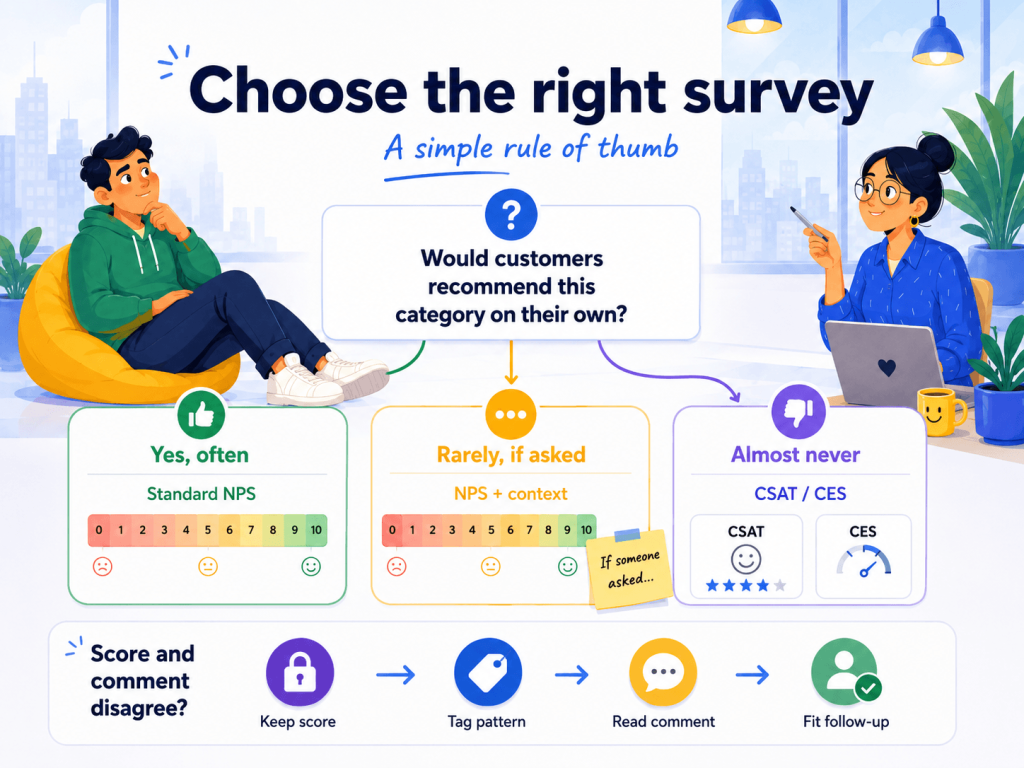
A simple rule of thumb
When you’re deciding how to survey a given audience, ask yourself one question first: Would your customers ever recommend a product in this category on their own initiative?
- Yes, often. Use the standard NPS question. Advocacy is natural, and the data will be clean.
- Rarely, only if asked. Keep NPS, but add the conditional framing so literal readers know it’s hypothetical.
- Almost never. Drop the recommendation framing for those touchpoints and measure satisfaction with CSAT, or effort with CES.
The one-question NPS format is elegant, but it was never meant to be the only tool in the box. We made that argument at length in our look at the confidence question and where NPS falls short. Knowing when a different question serves you better is a sign you’re paying attention to your customers, not a failure of the method.
Already collected responses where the score and comment disagree? Do not rewrite history. Keep the score, but tag the pattern, read the comment, and make sure the follow-up fits the actual issue.
The bottom line
When a customer tells you they don’t go around recommending products, they’re not being difficult and they’re not telling you your product is bad. They’re telling you the question doesn’t fit the way they think about your category. Often, if you read to the end of their comment, they recommend you anyway.
The fix is rarely a better product. It’s a better question. Add the context that makes the conditional clear, or ask about satisfaction directly when recommendation was never the right measure. Either way, you stop punishing yourself for happy customers who simply don’t evangelize.
Retently lets you run NPS, CSAT, and CES under one roof, so you can reframe a question or switch metrics for a specific audience without losing your history or rebuilding from scratch. Start a free trial or book a demo to see how it fits your customer journey.
Frequently Asked Questions
What is the official NPS question? “How likely are you to recommend [company or product] to a friend or colleague?” rated on a 0 to 10 scale. Responses of 9 to 10 are Promoters, 7 to 8 are Passives, and 0 to 6 are Detractors.
Can you change the NPS question wording? Yes, and many teams do, especially to add conditional framing like “if you were ever asked.” The trade-off is a small loss of comparability against the standard benchmark. If you reword it, keep the new wording consistent over time so your own trend stays meaningful.
Is NPS a good fit for banks and financial services? It can work, but these are low-advocacy categories where customers rarely recommend providers unprompted, so unframed NPS often understates satisfaction. Adding conditional context or running CSAT alongside NPS usually produces cleaner, fairer data.
Should I use NPS or CSAT? Use NPS when your customers would naturally recommend your product and you want a loyalty signal. Use CSAT when you mainly want to know whether a specific experience met expectations, particularly in categories people don’t talk about socially. Plenty of businesses run both at different touchpoints.

 Christina Sol