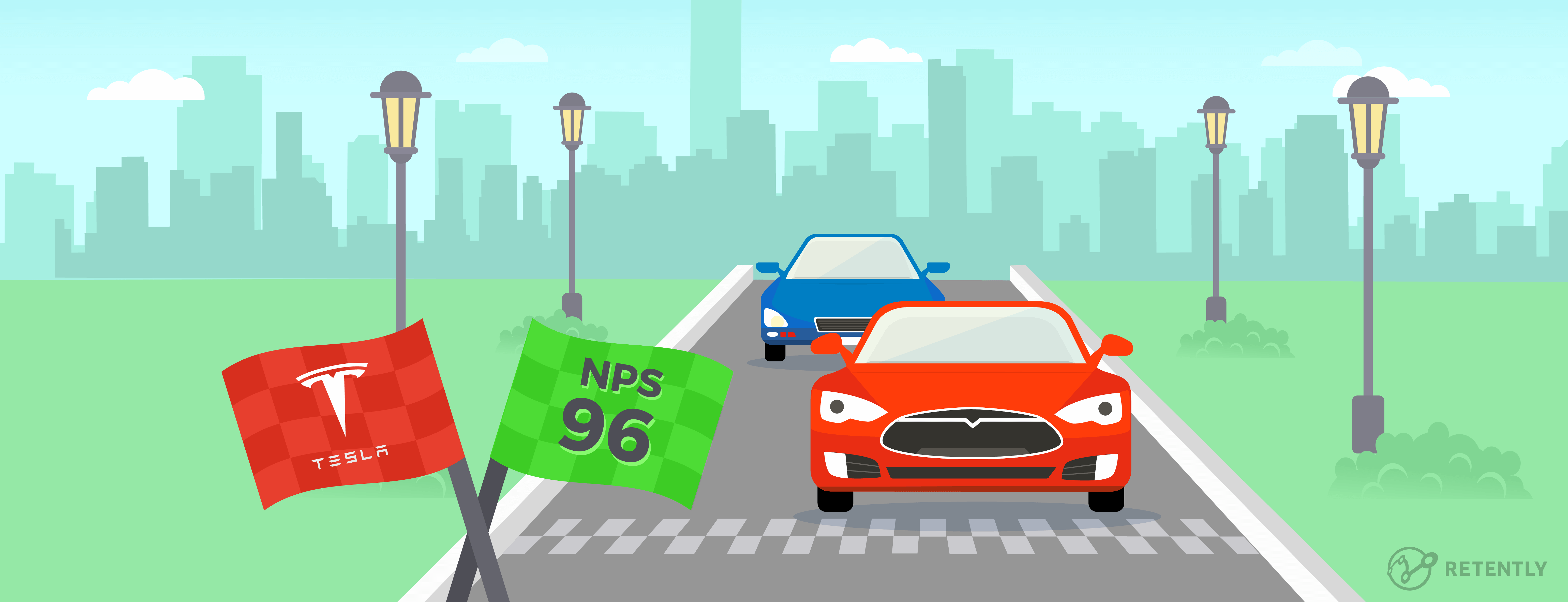



Tesla currently holds a satisfaction rating of 96, outscoring every other car manufacturer company in Net Promoter Score® ratings.
Recent data supports that broader view. S&P Global Mobility named Tesla the winner of “Overall Loyalty to Make” for the fourth consecutive year. The Consumer Reports’ annual owner satisfaction survey points in a similar direction: after years of topping the ranking, Tesla now places fourth, with 69% of owners saying they would buy again. So, the stronger point is not that one NPS number tells the whole story, but that Tesla continues to generate unusually strong loyalty signals across sources.
Total pre-orders for the Tesla Model 3 surpassed many expectations at more than a quarter of a million in less than three days. To show you the bigger picture, this is more than 70 percent of annual sales for the leader in this market segment – Mercedes-Benz C-Class. At the same time, the Model S received the highest-ever satisfaction score of 98%, while Model Y and 3 remain at the top of the best-selling electric car chart to date. The Model Y went further still – in 2023, it became the world’s best-selling car of any kind, claiming a title no electric vehicle had ever held.
You cannot argue with the fact that these results are incredible. Tesla is a definite leader in NPS® benchmarks, taking into account that anything above 40 is still considered a very good score in the auto industry.
This huge success actually shows us the big picture of how markets work. So how does the world’s NPS leader achieve such a high level of customer satisfaction?
From implementing innovative features to perfecting the customer experience, today we’ll share the secret ingredients that make Tesla so special.
Key Takeaways
- Product first. Tesla built something genuinely different – fast, practical, electric, and loaded with features no competitor had. A great NPS starts with a product worth recommending, and Tesla had that from day one.
- Mission as marketing. By anchoring the brand to a cause people care about (clean energy, the future of transport), Tesla turned customers into believers. Shared values drive loyalty far more reliably than ad spend.
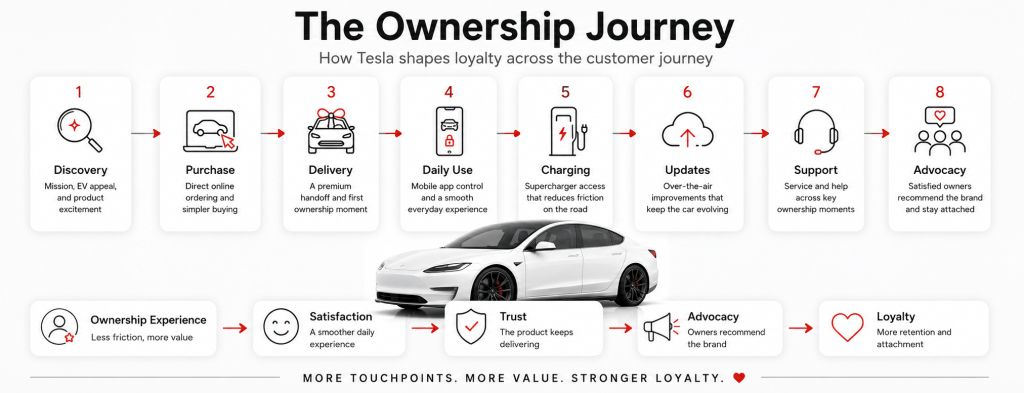
- Ownership experience, not just the car. Tesla treats the entire journey – buying, delivery, maintenance, software updates – as part of the product. That’s rare in automotive and a huge differentiator.
- Feedback loops that actually close. Whether it’s Musk responding on social media or engineers pushing an OTA fix overnight, Tesla demonstrates that customer input leads to real change. That’s what earns trust and Promoters.
- Tesla’s NPS isn’t a marketing achievement, it’s an operational one. You can’t survey your way to a 96 NPS score – you have to earn it at every touchpoint.
Tesla developed a truly unique selling proposition
A lot of economic textbooks teach you about the role of competition in the market. But they are often skeptical of the free market, concluding that some industries associated with huge entry costs alter the competitive process from its usual path.
The automotive industry is often cited as a relevant example. The need for massive investments and substantial exit fees work as a huge entry barrier.
And then comes Elon Musk with the Tesla team, creating something different, something we thought couldn’t happen – an automotive startup company.
Just like Steve Jobs, Elon Musk told a story that was aspirational and resonated with people. He said that electric cars are the future of sustainable transportation. In his blog post, he wrote:
“So, in short, the master plan is:
- Build a sport car
- Use that money to build an affordable car
- Use that money to build an even more affordable car
- While doing above, also provide zero emission electric power generation options”
The company had a vision and a long-term goal from the start. They were going to create an electric car that was fast, sexy and efficient, then use that capital to create even more desirable products – and people liked that.
A good product that appeals to the consumer is the deepest core of marketing, which is very hard to achieve. The best way to show value is to start by making something incredibly valuable to a significant market, just like Tesla did.
What makes this master plan remarkable in hindsight is that Tesla has followed it almost to the letter. The latest chapter: in June 2025, Tesla launched its first autonomous robotaxi service in Austin, Texas – a fleet of driverless Model 3s and Model Ys carrying paying passengers with no human behind the wheel. For a company that started by selling a $100,000 roadster in 2008, arriving at fully autonomous transport in under two decades is a testament to how seriously Tesla takes its own roadmap – and a powerful reason why customers continue to believe in the brand.
Tesla brings innovation
When you drive a Tesla, your concept of what a car should be is irrevocably shaken. It gives the feeling that you’ve got a taste of the future. And it’s not just that they are electric; there are many other reasons why Tesla is innovative:
- Direct sales with no dealer network. Tesla allows customers to buy a car on the Internet, and this B2C model saves a lot of time and money by skipping the middleman. It reduces distribution costs and provides customers with greater convenience and control over the process. That makes the journey feel more consistent and closer to buying a tech product than negotiating for a traditional car.
- Sporty yet practical vehicle. Tesla cars have the character and design of a sports car, but at the same time reach a level of practicality that has never been achieved before. The brand discovered a way to introduce a powerful battery pack into the auto market at an affordable price point, particularly for the luxury cars sector. Moreover, Tesla made electric vehicles feel desirable, not just responsible. Performance, range, minimalist design, storage space, and software features helped shift the perception of EVs from compromise products to aspirational products.
- Battery charging. Returning to the fact that it’s an electric car, it means you can plug it in and charge it anywhere. You can use a simple outlet or find a Tesla charging station that will charge it even faster – in about 30 minutes. The charging time would only improve in later updates. With 805 Supercharger stations in 2017, Tesla’s interactive map illustrated its plan to expand them over the next few years. According to the 2026 data, there are 80, 000 + global superchargers, so they seem to have stuck to their promises. Tesla also extended that infrastructure beyond its own customers: starting 2023, it opened the Supercharger network to other EV brands, with Ford and GM among the first to follow. Tesla’s NACS connector has since become the North American industry standard – meaning Tesla didn’t just build its own advantage, it built the infrastructure the entire industry now depends on.
- Interaction with the car via a smartphone. You can see where your car is parked or how much longer it will be until the battery is fully charged, directly in the mobile application. You can also honk the horn, flash the lights and turn on the air conditioning before returning to the car.
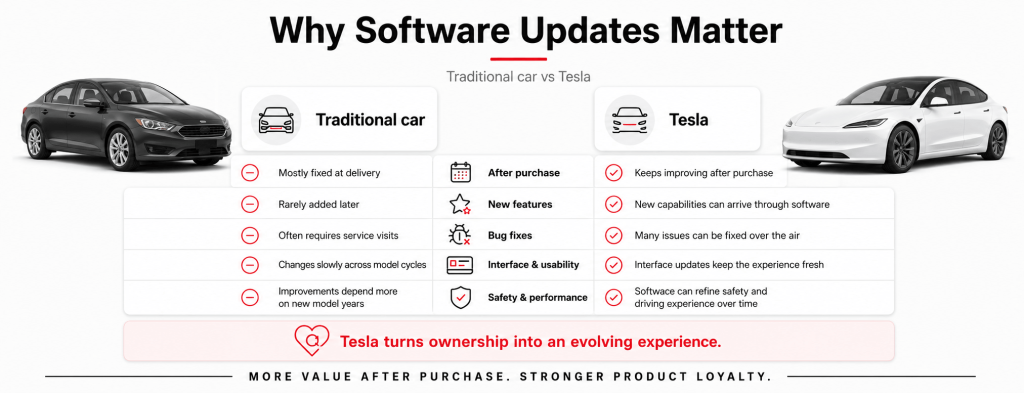
- Over-the-air updates. One of Tesla’s biggest loyalty drivers is the feeling that the car does not stay frozen at the moment of purchase. Software updates can add features, refine the interface, improve performance, and fix some software-related issues without a dealership visit. Tesla has used OTA updates to unlock faster acceleration, add new UI features, improve braking performance and introduce capabilities like Apple Watch integration on cars already sold and delivered. That means a Tesla bought years ago can have capabilities that didn’t exist at purchase. No other mainstream automaker does this at scale. That changes the ownership experience: customers are not just buying a vehicle, they are buying into a product that can evolve.
- The same mechanism works in reverse: when a software issue arises, Tesla can fix it fleet-wide without owners lifting a finger. In a 2026 rearview camera recall affecting nearly 219,000 vehicles, Tesla pushed the fix over the air and by the time NHTSA posted the formal recall notice, over 99% of affected cars had already been updated. Traditional automakers still mail letters asking owners to book a dealer appointment; Tesla often resolves the problem before most owners know it existed.
- Driver-assistance system: From mid-February 2022, all North American Tesla vehicles have Tesla Vision – 8 cameras and a neural net processing system that provides Autopilot features. It enables the vehicle to detect and respond to the environment, providing passengers with situational awareness and making driving safer and more comfortable. Tesla’s autopilot technology is a significant selling point for its vehicles. The system can automatically steer, accelerate and brake the vehicle. For example, drivers can summon their car to come to them, even if it is not in their line of sight. The technology has received positive customer reviews and helped differentiate Tesla from other automobile manufacturers. That said, Autopilot and Full Self-Driving (FSD) have also drawn significant regulatory scrutiny – NHTSA opened a formal investigation into FSD across approximately 2.4 million vehicles in 2024 following crashes in low-visibility conditions, a reminder that the technology, while impressive, is still maturing.
- Remarkably safe. Tesla Model S achieved a perfect 5-star rating across all tested categories from the National Highway Traffic Safety Administration (NHTSA) – the highest safety rating awarded to any car. It doesn’t have an engine, so the entire front end of the car becomes a crumple zone to absorb a high-speed impact. Its roof is so strong that it broke a machine intended to crush the car. Note: Tesla claimed a figure of 5.4 star safety rating, a number NHTSA publicly rebuked, clarifying that its official scale does not extend beyond 5 stars.
If your company plans to take over the future, this is the way to do it. This car feels like the future for more reasons than just being all-electric.
Tesla cultivates brand loyalty
For most of its history, Tesla operated with no traditional advertising budget – a stark contrast to competitors like Ford and General Motors. Tesla broke with this approach in 2023, running paid ads for the first time, but the brand’s extraordinary growth was built almost entirely on its advocates and word-of-mouth marketing.
In Tesla’s earlier years, product launches often looked more like tech events than traditional car releases. Hundreds of Tesla fans lined up outside dealerships before the cars were even officially unveiled, and they even had to wait a few years before getting their dream car. These incredible pre-order numbers got Tesla even more attention.
Today, that loyalty is more complex, but still powerful, and the reasons go beyond hype. So, I researched how exactly Tesla builds such incredible customer loyalty, and here’s what I found:
1. Establishes an emotional connection with the customer
Tesla fans are crazy advocates. They attach a deep emotional connection to the brand. One of the easiest ways for a company to do this is by standing for something important.
In fact, a study by marketing research firm CEB published by the Harvard Business Review found that loyalty to brands is hard to achieve without one key element – shared values. People become loyal customers when they share the same vision and beliefs which that company represents.
Tesla passionately promotes its vision that adopting electric vehicles will one day solve our planet’s energy problem. Its electric cars are environmentally friendly, which appeals to customers concerned about their impact on the planet. As a result, people feel good about driving a Tesla. They don’t need to buy gas, AND they’re helping the environment.
This sort of advertising is earned, not bought.
But emotional connection can cut both ways. Reuters reported that Tesla’s U.S. brand loyalty fell from a peak of 73% in June 2024 to 49.9% in March 2025, before rebounding to 57.4% by May. European sales dropped 33% in the first half of 2025, and the brand lost an estimated $15.4 billion in value that year. The drop was linked not only to stronger EV competition, but also to Elon Musk’s increasingly polarizing public role. That makes the Tesla case more useful, not less: it shows how powerful shared values can be in building loyalty, but also how vulnerable that loyalty becomes when the face of the brand starts to divide customers.
2. Delivers one of the best customer experience in the auto industry
Tesla has come to a realization that gave them a huge competitive advantage in the world of customer experience: make the process of owning one better than that of owning any other car.
As Tesla’s then-VP of Sales, Cristiano Carlutti, puts it:
“In the other companies, customers are customers, basically. They pay, they get a product or a service. In the case of Tesla, the customers are partners.”
The process of owning a car includes many touch points, from choosing a car to providing regular service and maintenance to keep it running.
And while many automotive companies offer great products, Tesla goes above and beyond in order to create a well-rounded user experience.
Their whole buying and maintaining process is very personal and, in some cases, unique to the car market:
- After you place your order, you have one week to modify it before the Tesla factory begins to work on it.
- Then the car will be delivered to you, or you could pick it up at the factory and at the same time get a free tour of the factory.
- If the issue is related to its software, engineers can often update the car at a distance. So, they can work on it at night and have it ready to go the following morning.
These are just some of the ways Tesla makes their customers feel special. Tesla goes beyond offering a great product; they are changing how the auto industry perceives customer experience for the better.
3. Builds loyalty through an ecosystem, not just a car
Another reason Tesla loyalty stays strong is that the product is not only the vehicle. Owners also buy into a broader ecosystem: the mobile app, Supercharger network, route planning, software updates, service experience, energy products, and, for some buyers, driver-assistance subscriptions.
That ecosystem matters because it makes Tesla harder to compare feature by feature with a traditional car brand. A customer may like the acceleration, but stay because charging is familiar. They may buy for the design, but become attached to the app experience. They may choose the car for sustainability, but value the software updates later. This is one of the most important reasons Tesla’s loyalty story is different from a normal automotive satisfaction story: the brand creates multiple points of attachment after the sale.
There is one further layer worth noting: every Tesla on the road contributes real-world driving data that helps improve Autopilot and Full Self-Driving for the entire fleet. Owners are not just users of the product – they are, in a small sense, contributors to it. The more Teslas on the road, the better the system gets for everyone. That creates a compounding loyalty dynamic with no direct parallel in traditional automotive.
4. Leverages a structured referral program
An often-overlooked pillar is its referral program. Existing owners receive credits – like $1,000 per successful referral – redeemable toward Supercharging, merchandise, software upgrades, or a new vehicle purchase, while the referred buyer also benefits at checkout.
The program turns satisfied customers into active salespeople, amplifying word-of-mouth organically and rewarding the very advocates who drive it. Tesla has relaunched and refined the program multiple times, reflecting a willingness to invest in loyalty mechanics where other brands spend on traditional advertising.
5. Takes customer feedback seriously
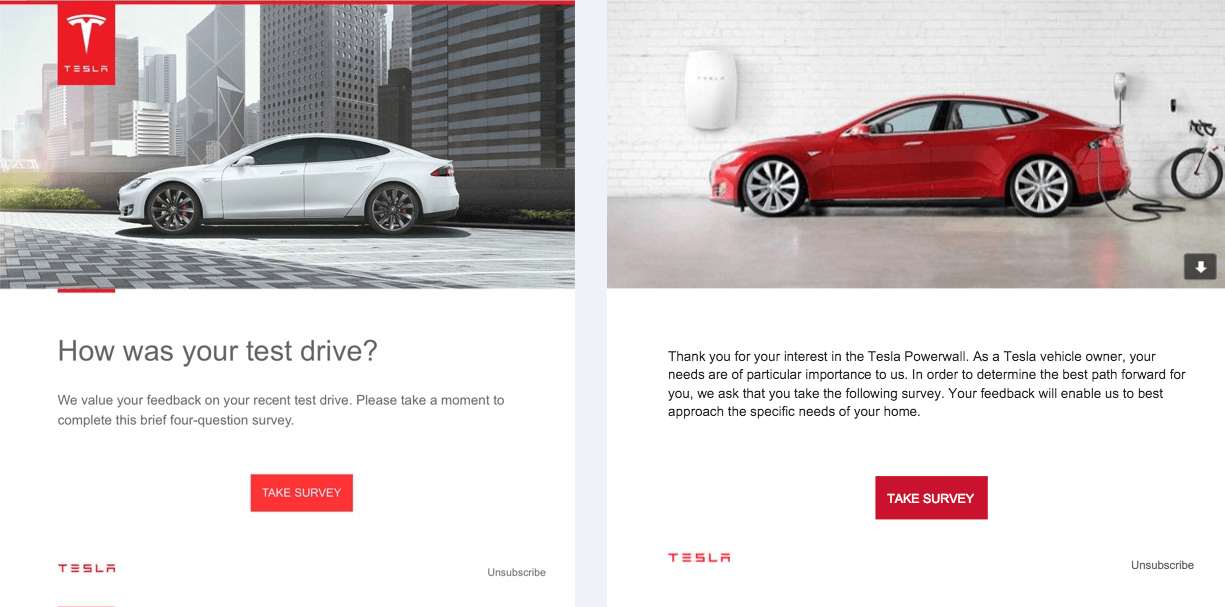
I personally never owned a Tesla before, but I did a test drive of the Tesla Model S once. The next day I received an email asking me to complete their customer satisfaction survey. I took some time to offer feedback because I knew someone on the other end would actually listen to what I had to say.
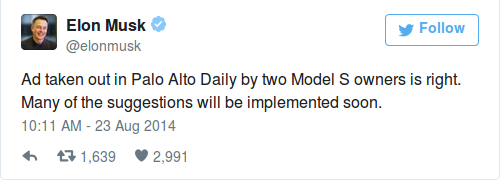
Tesla has been known to respond to customer feedback and implement their ideas. A great example occurred when two Tesla drivers submitted an open letter to Musk via a full-page ad in a Palo Alto newspaper. They asked Tesla to make a few changes to its Model S.
In response to this customer feedback, Musk tweeted a photo of the open letter saying that Tesla would indeed implement some of the suggested changes.
There was another instance when a Tesla owner complained about fellow consumers hogging spots at a local charging station. Musk reacted immediately.
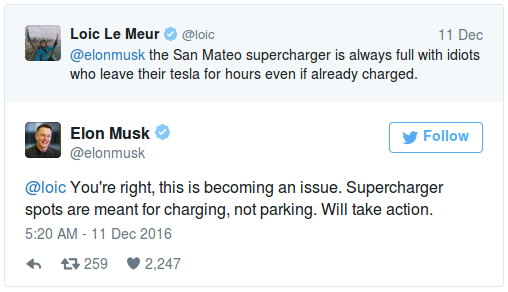
Six days later, Tesla announced the following policy on its official website:
“We designed the Supercharger network to enable a seamless, enjoyable road trip experience. Therefore, we understand that it can be frustrating to arrive at a station only to discover fully charged Tesla cars occupying all the spots. To create a better experience for all owners, we’re introducing a fleet-wide idle fee that aims to increase Supercharger availability.”
When a client complained about a very pushy sales guy from the Tesla Stanford shop while shopping for Model X, Musk’s reply and action on the customer’s feedback were instant. He made sure that customer service representatives were reminded about the company’s goals and that their approach aligned:
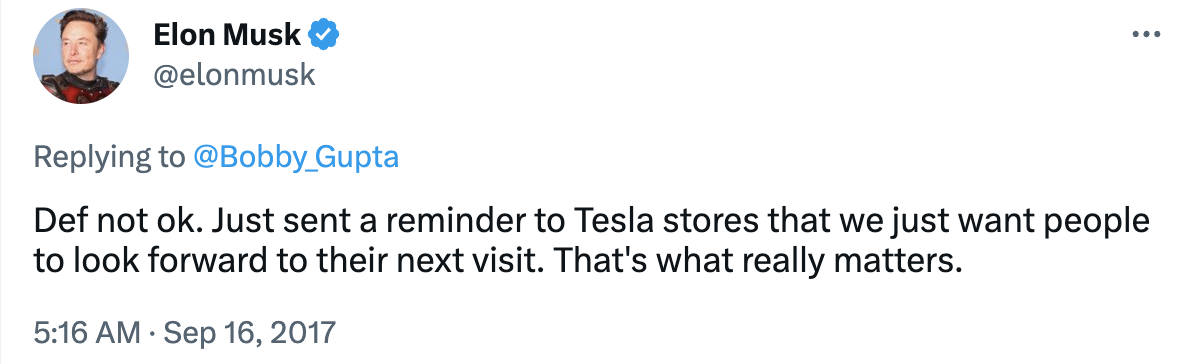
N.B. Check our dedicated article on customer service tips for actionable insights to improve customer satisfaction.
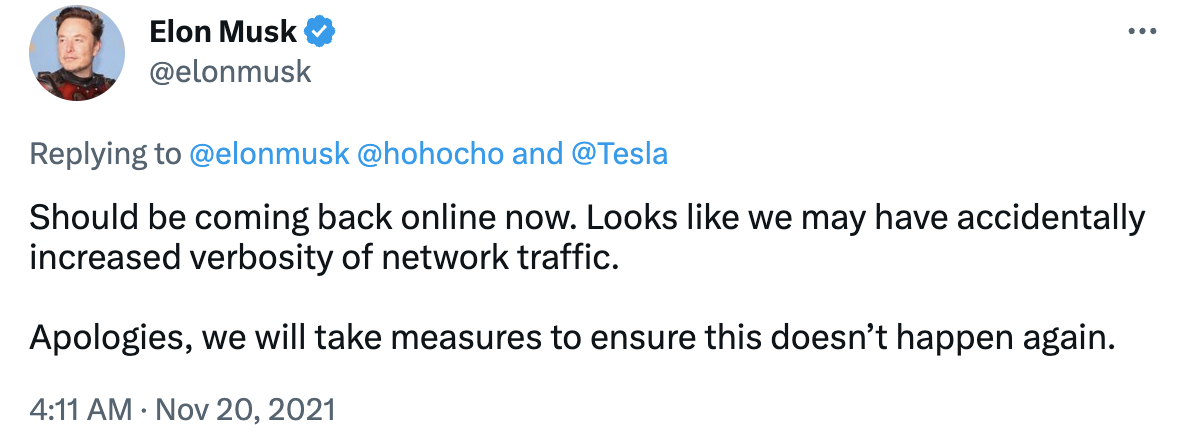
You may think this was the case only for the early days when the company was making its way on the auto market. However, Musk is still very active on social media, taking up any flagged issue in no time to ensure customers benefit from the best experience possible. Let’s take a more recent example of a customer in Seoul who posted online about the error he experienced when connecting to Model 3 on the iOS app. In a couple of minutes, Musk was already checking the issue, which turned out to be worldwide, and closed the feedback loop with an update as soon as they got it under control. He took ownership of the problem and worked on a solution promptly.
In 2024, a young Chinese Tesla owner named Molly posted a video on X, addressing Musk directly about a bug in her car’s screen: ”Hello Mr. Musk. I am Molly from China. Can you fix it?” Musk replied publicly within hours: “Sure.” The clip went viral with over a million views – not because of the bug, but because the idea of a customer reaching the CEO directly and getting an instant response still feels remarkable.
It’s no wonder why Tesla has such a high NPS. From efficiently communicating its brand vision with people to publicly addressing customer issues and delivering its promises, Tesla truly knows how to build brand loyalty.
The bigger picture
Tesla is still one of the most relevant loyalty case studies in the auto industry, even if the brand now faces a more complex satisfaction picture than in its early growth years.
Tesla’s exceptional NPS is not the result of any single decision – it is the compounding effect of a clear mission, relentless product innovation, a seamlessly designed ownership experience, and an organizational culture that genuinely listens to its customers.
Challenges remain: regulatory pressure on autonomous driving, rising competition from legacy automakers now investing heavily in EVs, and the constant task of maintaining quality at scale. But the loyalty foundations Tesla has built are among the strongest in the industry.
That strength does not come from a flawless experience, but from the fact that, for many customers, the product, software, charging ecosystem, and mission still outweigh the friction. That is a useful lesson in its own right: loyalty does not require a flawless experience. It requires one where the highs are high enough to absorb the lows.
For any business looking to move the needle on customer satisfaction, Tesla offers a straightforward lesson: lead with purpose, obsess over the experience, and treat your customers as partners – not transactions.
Measure and improve your Net Promoter Score with Retently
Now that you are inspired and motivated by Tesla’s staggering success, it’s time to start implementing their CX strategies into your company.
Retently NPS helps you build that special connection with the customer by providing the tools to effectively communicate with them and gather valuable feedback.
Boost your customer satisfaction and improve retention rates by sending customers an automated Net Promoter Score survey. Identify who is on the edge of churning, or loves your company so much that, if given the resources, will act as a brand advocate.
Start your NPS campaign today to improve your customer satisfaction tomorrow.

 Christina Sol