



Table of Contents
In 2025, the average apartment community held onto just 58% of its residents, against an industry target of 63%. That’s from Zego’s 2025 Resident Experience Management Report, and it’s the gap that keeps property managers up at night. Every resident who leaves costs roughly $4,000 to replace, once you tally marketing, repairs, concessions, and lost rent.
So the real question isn’t whether to run a tenant satisfaction survey. It’s when to send it, what to ask, and what to do with the answer.
A tenant satisfaction survey (you’ll also see it called a resident satisfaction survey, the industry tends to say “resident”) is simply a short, well-timed question that tells you how a renter feels about living in one of your properties. The mistake most managers make is treating it as one big annual questionnaire. The firms that actually move their renewal numbers do the opposite: they break the survey into a handful of short, sharp moments spread across the resident journey, and they ask the right kind of question at each one.
This guide walks through those moments. For each stage of the journey you’ll get the metric to use, the exact question to ask, the right timing, and a few sample questions you can lift directly. It’s grounded in how real property management firms run these programs (details anonymized).
Key Takeaways
- Don’t send one giant annual survey. Place short surveys at the six moments that actually carry signal: application, the 30-day move-in, maintenance resolution, the ongoing relationship, lease renewal, and move-out.
- Match the metric to the moment. Use a star rating at move-in, CES for effort-heavy steps like maintenance and renewal, and NPS for the ongoing loyalty read.
- Timing beats volume. Give new residents a grace period before the first relationship survey, dedupe transactional sends, and throttle so nobody gets two surveys in a week.
- The renewal window is your highest-stakes survey. Roughly 23% of residents are undecided about renewing, and first-year renters churn the most, so front-load your listening in year one.
- Route happy residents toward public reviews. Online reputation directly shapes how fast your next vacancy fills.
Map the Journey Before You Survey It
Before you write a single question, sketch the journey a resident actually travels with you. It runs from the moment they apply, through move-in, the years of living and maintenance requests in between, the renewal decision, and finally move-out. (If you’ve never put it on paper, our guide to mapping the customer journey is a good template.)
Each of those moments tells you something different, and a single survey can’t capture all of it. A renter who just had a great move-in experience and a renter weighing whether to renew are in completely different headspaces. Asking both the same generic “how are we doing?” gets you mush.
So instead of one survey, think of six. Most of them are a single question. Here’s the full map, with the metric and the actual question property managers are using at each stage:
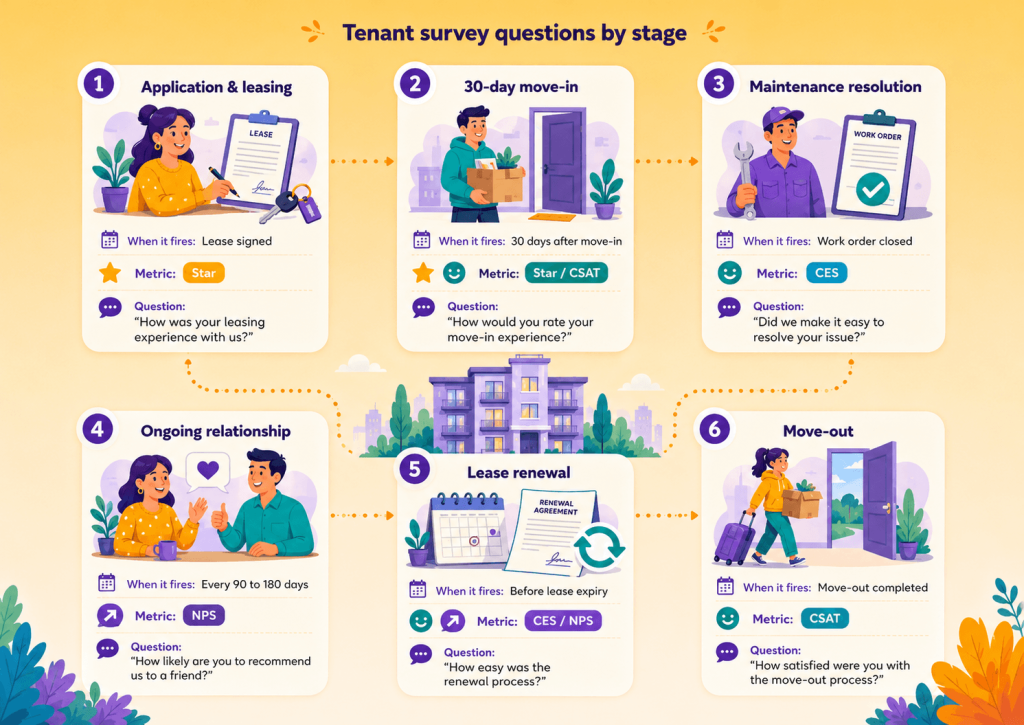
The rest of this guide takes them one at a time.
Stage 1: Application and Leasing
The leasing process is the first real impression a resident forms of how you operate, and it happens before they’ve even picked up the keys. A clunky application, slow responses, or a confusing lease signing tells a prospective resident exactly what living with you will feel like.
Use a star rating here. It’s the format renters know from every other app and review site, so it’s frictionless, and a strong rating gives you a natural opening to ask for a public review while the excitement of a new place is still fresh. Fire it right after the lease is signed.
The question one firm uses, almost word for word: “How was your leasing experience with us?” followed by a one-to-five-star scale.
A few questions you can borrow for this stage:
- How would you rate the ease of the application process?
- Did our team respond to your questions quickly enough?
- Was anything about the lease/move-in instructions unclear?
Keep it to two or three questions. The applicant just gave you a lot of paperwork. Don’t make their reward another long form.
Stage 2: The 30-Day Move-In Survey
If you only run one transactional survey, make it this one. The 30-day move-in survey is the highest-leverage moment in the entire resident relationship, and it’s the most common single survey we see in real property management programs.
Here’s why the timing matters. Send it the day they move in and they haven’t lived there yet. Send it six months later and the early problems have either been fixed or hardened into resentment. Around the 30-day mark, the resident has unpacked, run the dishwasher, found the quirks, and formed a real first opinion that’s still very much changeable. The firms that get this right set the survey to wait exactly 30 days after move-in, automatically, so it always lands in that window.
The question, as it actually runs: “How would you rate your move-in experience?” Some firms use a star rating here, some use a satisfaction scale. Either works.
This is also your best review-generation moment. A resident who rates their move-in five stars is as happy as they’ll ever be with you. That’s the moment to ask if they’d share that experience on Google or your community’s review page.
Sample questions for the move-in survey:
- How satisfied are you with the condition of your home at move-in?
- Was the move-in process organized/well communicated?
- Is there anything in your unit that still needs attention?
That last question is doing double duty. It surfaces a maintenance issue you can fix before it sours the whole tenancy.
Stage 3: Maintenance Resolution
Maintenance makes or breaks more resident relationships than anything else you do, and it’s by far your highest-frequency touchpoint. A resident might have one move-in but a dozen maintenance requests over the course of a lease. Each one is a small test of whether you actually deliver.
This is the stage to use Customer Effort Score (CES). The reason is subtle but important: with maintenance, residents don’t expect perfection, they expect ease. Was it simple to report? Did someone show up when they said they would? Did it get fixed without three follow-up emails? Effort is what they remember, and CES is built to measure exactly that.
Trigger it automatically when a work order is marked closed in your system. The question one firm runs: “Did we make it easy to resolve your issue?” That single question, sent the moment a ticket closes, is one of the most reliable early-warning signals you have. A run of low maintenance scores at one property is a renewal problem you can see coming months ahead. These event-based surveys are usually wired up as transactional surveys, which fire on an action rather than a schedule.
Questions worth asking after a maintenance visit:
- How easy was it to submit your maintenance request?
- Was your issue resolved within a reasonable time?
- How would you rate the technician’s professionalism?
Stage 4: The Ongoing Relationship Pulse
The transactional surveys above each capture a single moment. You also need a read on the overall relationship, the slow drift that no single event explains. That’s what a recurring NPS survey is for.
What is NPS? Net Promoter Score asks one question on a 0 to 10 scale: “How likely are you to recommend us to a friend or colleague?” Run it on a cycle to your whole resident list. Most firms land on one of three cadences: every 90 days (quarterly), every 120 days (three times a year), or every 180 days (semi-annual). For residents, 120 days is a comfortable middle ground that keeps a pulse without becoming noise.
Now the trick that separates a polished program from an annoying one: the grace period. You don’t want a resident who moved in last week getting a “would you recommend us?” survey before they’ve had a real experience to judge. The fix is a delay on new contacts. One firm waits a full 90 days before a brand-new resident enters the relationship NPS rotation. The move-in survey covers those first weeks. The relationship survey takes over once there’s an actual relationship to measure.
Keep the recurring survey to the one NPS question plus an open-text follow-up. The whole point of a relationship pulse is that it’s low-effort enough to answer every quarter.
Stage 5: Lease Renewal
The renewal window is where your retention math gets settled, and it’s the highest-stakes survey of them all. Zego’s data shows that about 23% of residents are undecided about renewing at any given time, and that first-year residents renew at just 52%, compared with 64% for those who’ve stayed six or more years. The takeaway is blunt: the residents most likely to leave are your newest ones, and a large share are still making up their minds. A survey in this window catches them while you can still do something.
Two metrics work here, depending on what you want to learn. Use CES to measure whether renewing was easy (“How easy was it to renew your lease?”), since a painful renewal process pushes wavering residents toward the door. Or use NPS to gauge overall loyalty heading into the decision. Some firms send a renewal survey on the event itself; the more proactive ones send it 60 to 90 days before the lease expires, so there’s still runway to address a complaint.
Whatever the score, treat a renewal-stage Detractor as urgent. Reach a wavering resident two weeks before their decision and you can still change the outcome. Once the notice is in, you’re just collecting an exit interview.
Sample renewal-stage questions:
- How easy was it to complete your lease renewal?
- How fairly do you feel your renewal terms reflect the value you get?
- What’s the single biggest factor in your decision to stay or go?
Stage 6: Move-Out
It’s tempting to stop surveying once a resident gives notice. Don’t. A move-out survey does two things nothing else can.
First, it tells you why people actually leave, which is often different from why you assume they leave. Patterns in exit feedback (a specific maintenance issue, a rent increase that felt arbitrary, a neighbor problem that never got handled) point straight at the things costing you renewals upstream.
Second, the move-out experience itself shapes your reputation. A resident who leaves on good terms, gets their deposit handled fairly, and feels heard on the way out is far more likely to leave a positive review than a bitter one. Use CSAT here: “How satisfied were you with the move-out process?”
Questions for the move-out survey:
- What was the main reason for your decision to move out?
- How satisfied were you with the move-out and deposit process?
- Would you consider renting from us again in the future?
How Often Is Too Often
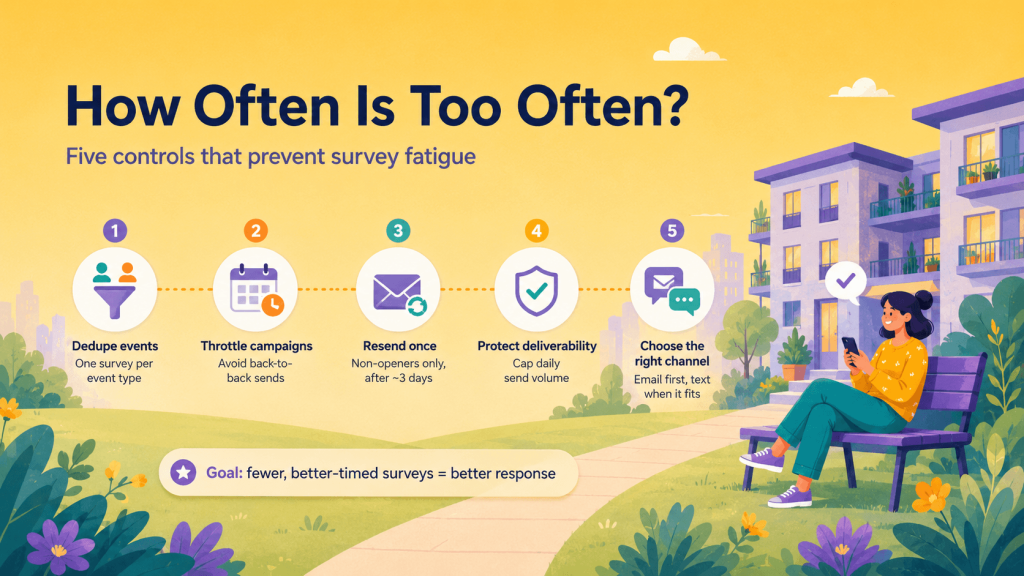
Run all six of these and a single resident could, in theory, get a survey every few weeks. That’s how you train people to ignore you. Survey fatigue is the fastest way to tank your response rates, and low response rates make the whole program worthless. A few controls keep it healthy.
Dedupe your transactional surveys. Set a window (a year is common) so the same resident isn’t re-asked about the same event type twice in quick succession. One maintenance survey per closed ticket, not one per email in the thread.
Throttle across campaigns. A resident who just answered a maintenance survey on Monday shouldn’t catch the quarterly relationship NPS on Wednesday. A throttle suppresses a second survey to the same person for a set period, no matter which campaign wants to send it.
Resend to non-openers, once. A lot of surveys get missed, not declined. Resending to people who didn’t open the first email after about three days reliably lifts response without nagging. If response rates are a sticking point, we’ve collected 26 ways to improve survey response rate that apply directly to resident surveys.
Protect deliverability. Cap your daily sends so a big resident list doesn’t go out as one giant blast that trips spam filters. And think about which channel fits: email is the default for residents, though a text survey can boost response for younger renters who never open email.
One more rule: don’t ask about something you’re not prepared to act on. If residents repeatedly complain about parking, package rooms, noise, security, or renewal pricing and nothing ever changes, the survey teaches them that feedback is performative. Start with the moments where your team has a real operational lever.
Closing the Loop: The Part That Actually Matters
Collecting scores is the easy half. The value is in what happens next, and it splits cleanly in two directions.
For Detractors, the move is speed. A low score should trigger an instant alert (a Slack message to the property manager is the common setup) so someone can pick up the phone while the renewal is still in play. The window is everything. Reach them while the problem is fresh and you can often save the renewal. Wait until the next monthly report and the resident is already gone.
Assign ownership before any alert goes live. Leasing feedback belongs to the leasing team. Move-in and maintenance feedback usually belongs to the property manager or resident services team. Renewal feedback needs an escalation path to someone who can actually fix issues, adjust terms, approve concessions, or involve ownership. Without ownership, survey data becomes another dashboard everyone checks and no one acts on.
For Promoters, the move is amplification. When a resident rates their move-in five stars or gives you a 9 on the NPS scale, ask them to put that in a public review (here’s how to turn Promoter feedback into reviews without being pushy). This isn’t a vanity exercise in property management. Online reputation directly shapes leasing: J Turner Research finds that 70% of residents choose to live in communities with a better online reputation. The same source also suggests renters are becoming more review-sensitive, with 64.8% saying they spend even more time reading apartment reviews than they do for everyday purchases. Fresh reviews from your happiest residents compound into the kind of reputation that fills vacancies faster than any ad budget.
Passives – an NPS 7-8, or a middling star/CSAT score – don’t need an alert or a review ask. But they’re not nothing: a property where scores cluster in the passive range, even with no individual score low enough to trigger anything, is often the earliest version of the same drift the relationship survey exists to catch. Worth watching the trend, not just the extremes.
Catch the unhappy ones early enough to keep them. Point the happy ones toward the public reviews that bring you your next application. That’s the whole loop.
Wrapping Up
You don’t need all six surveys live on day one. Build up. Start with the three that carry the most signal:
- The 30-day move-in survey. Your highest-leverage moment and your best source of early reviews.
- Maintenance resolution. Your highest-frequency signal and your earliest churn warning.
- A relationship NPS on a 120-day cycle, with a grace period for new residents.
Get those running, act on the alerts they generate, then layer in leasing, renewal, and move-out as you go.
One more thing. Residents are only half of a property management business. The people who pay your management fees, the owners, need their own feedback program, and it looks quite different. If you manage both, our companion guide on how property managers survey both owners and residents covers the owner side and how to wire all of this to your property management software through a webhook or Zapier, no native plugin required.
The firms that keep their residents aren’t the ones with the longest surveys. They’re the ones who ask the right question at the right moment and actually do something with the answer.
If you want to run resident surveys across the whole journey on one platform, with each one triggering at exactly the right moment, Retently is built for it. Start a free trial to set up your first move-in and maintenance surveys, or book a demo and we’ll map a resident program to your properties with you.
Frequently Asked Questions
What is a tenant satisfaction survey? A tenant satisfaction survey is a short questionnaire a property manager sends to residents to measure how they feel about living in the property: the condition of their home, the responsiveness of maintenance, the ease of processes like applying and renewing, and their overall likelihood to stay or recommend. The most effective programs run several small surveys timed to specific moments in the resident journey rather than one long annual form.
What is the difference between a tenant satisfaction survey and a resident satisfaction survey?
In most property management contexts, the terms are used similarly. “Tenant satisfaction survey” is common in rental housing and commercial property contexts, while “resident satisfaction survey” is often used in multifamily and residential communities. Both measure how people feel about the property, service quality, maintenance, communication, and their overall living experience.
What questions should a tenant satisfaction survey include? Match the question to the stage. After maintenance, ask about ease and speed (“How easy was it to get your issue resolved?”). At the 30-day move-in mark, ask about the condition of the unit and the move-in process. In the renewal window, ask what’s driving the stay-or-go decision. For the recurring relationship pulse, one NPS question plus an open-text follow-up is enough. Keep any single survey to one to three questions.
How often should you survey residents? Run a recurring relationship survey every 90 to 180 days (120 days is a comfortable middle ground), with event-triggered surveys layered on top at move-in, maintenance, renewal, and move-out. Use a throttle so no resident gets two surveys within a short window, and give new residents a grace period before their first relationship survey.
Should tenant surveys be anonymous? There’s a trade-off. Anonymous surveys can draw more candid answers, but they make it impossible to follow up with the unhappy resident, and following up is where the retention value lives. Most property management programs run identified surveys, so a low score triggers personal outreach, and reserve anonymous formats for occasional community-wide pulse checks.

 Christina Sol