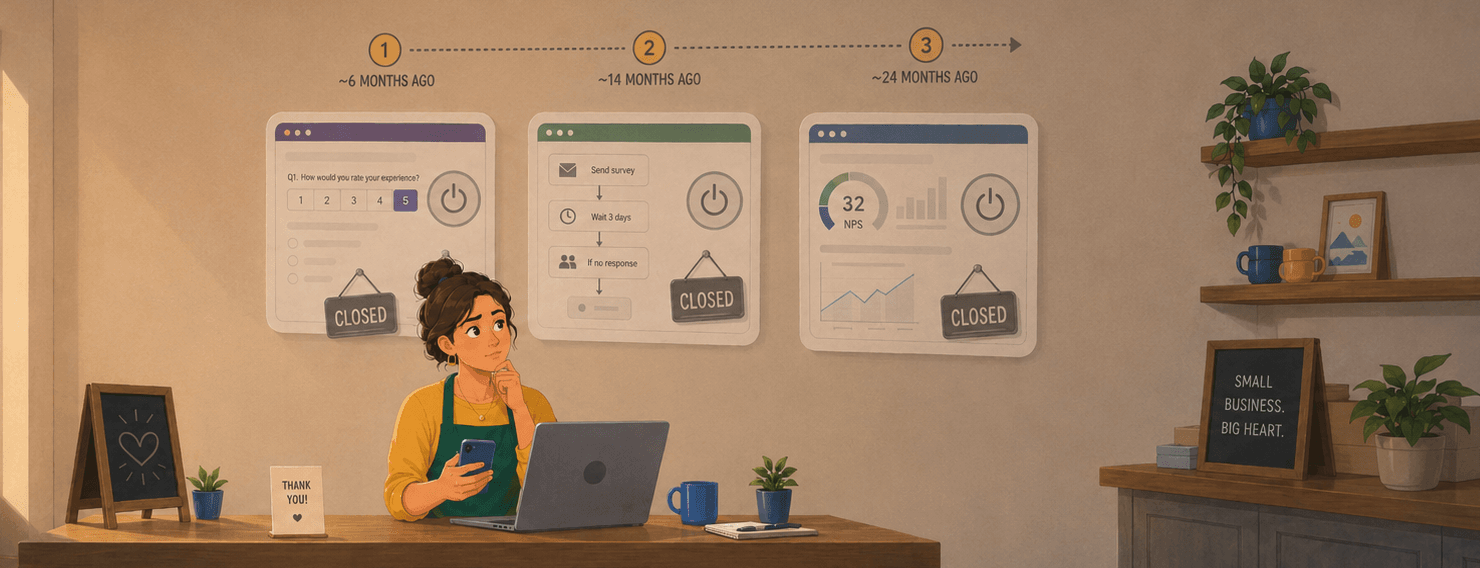



In the last 18 months, three of the survey tools that small and mid-market businesses spent a decade adopting have been quietly killed off. Delighted, the simple-NPS darling acquired by Qualtrics in 2018, will go fully dark on June 30, 2026. GetFeedback, the Salesforce-native survey suite built by former Salesforce executives, will follow on December 31, 2026. And Promoter.io, the San Antonio startup, was wound down so quietly that most of its old customers never noticed it die.
Three shutdowns, the same script every time: founded for SMBs, acquired by a much larger CX or analytics platform, starved of investment, and finally retired so the parent can free up engineering and marketing for its enterprise roadmap. The press releases never use the word “shutdown.” They use “consolidation,” “alignment,” or “focusing on AI-powered XM Suites.” The outcome is the same.
If you’ve been doing CX work for more than a few years, you’ve watched this movie before. Wootric got absorbed into InMoment in 2021, then InMoment itself got rolled up by Press Ganey Forsta in 2025, and Press Ganey Forsta was in turn acquired by Qualtrics in May 2026. Three acquisitions deep, the brand exists in a kind of administrative half-life: the login page still loads, customer data is still queryable, but there’s nothing happening on the roadmap, and nobody on the inside is building a future for it.
So is this just bad luck running through one market? No. It’s a structural correction, and the timing of these announcements tells you we’re well into the second act, not the first.
This article is the long-form version of what I’ve been telling customers, partners, and a few founders in adjacent markets over the last six months. The horizontal SMB customer experience category, as a venture-backed software category, is finishing a 15-year correction. Three lanes are going to be left standing, and only one of them has room for new entrants. Here’s what the record actually shows, why public-market economics broke this category in particular, and what it means if you’re deciding what tool to put under your CX program for the next three years.
Key Takeaways
- Three of the survey tools small and mid-market businesses adopted over the last decade have either shut down or been absorbed in the last 24 months: Delighted (Qualtrics), GetFeedback (SurveyMonkey), and Promoter.io (Medallia). A fourth, Wootric, exists in administrative half-life under InMoment.
- The pattern isn’t bad luck. Horizontal SMB customer experience is structurally uneconomic for public companies and PE-backed parents. The unit economics break at $20-200/month price points, while enterprise XM customers fund the parent’s growth story.
- Even the giants couldn’t carry it. Medallia was taken private by Thoma Bravo for $6.4 billion in 2021 and handed to its creditors in June 2026, with roughly $5.1 billion of equity wiped out. Qualtrics and Momentive (SurveyMonkey) were both taken private within weeks of each other in the summer of 2023. The public-market thesis collapsed, and in Medallia’s case, the private one did too.
- Three lanes are left in CX: enterprise XM at the top, vertical CX in the middle (healthcare, hospitality, automotive), and independent SMB-focused specialists at the bottom. The horizontal SMB lane owned by enterprise parents is the one that’s collapsing.
- “We’ll just build it with AI” is the right answer for some teams and the wrong answer for most. Deliverability, compliance, multi-channel send, and benchmark scale aren’t features. They’re years of plumbing.
Three shutdowns in 24 months
Let’s lay out the facts cleanly, because the speed of these announcements matters as much as the content.
Delighted. Founded in 2013 by Caleb Elston and positioned as the “Stripe for surveys” – a tool that made NPS feel as simple as a Mailchimp campaign. It was acquired by Qualtrics in October 2018 and in mid-2025, Qualtrics announced an end-of-life schedule:
- annual subscription renewals stopped on July 1, 2025;
- remaining monthly subscriptions will not be renewed beginning May 31, 2026;
- the platform shuts down on June 30, 2026, and
- customer data will be deleted in line with local regulations.
The official reason is that Qualtrics is “focusing on AI-powered XM Suites.” The functional reason is that Delighted’s price points and product surface area can’t carry a Silver Lake-owned cost structure.
GetFeedback. Founded by former Salesforce executives with a clean thesis: customer feedback data should live where customer data already lives, inside the Salesforce org, not synced in from outside it. SurveyMonkey acquired the company in 2019.
Today, the story is split: GetFeedback Direct, the Salesforce-native survey product, will be retired on December 31, 2026, while GetFeedback Digital, a separate website-feedback product, continues for now. Customers are being directed toward SurveyMonkey Enterprise, which is not Salesforce-native in the way GetFeedback was. As one industry observer put it in Salesforce Ben, the product “didn’t get the investment it needed to evolve” after the acquisition.
Promoter.io. Founded in 2014 in San Antonio by Chad Keck. One of the first NPS-focused tools that actually understood SaaS-style growth, with response-based pricing and a developer-friendly API. It was acquired by Medallia in July 2019 for a reported $2.3M, with a commitment to keep the core team in Texas. The website still loads, yet the product is no longer marketed as a standalone offering. New buyers can’t really purchase Promoter.io as Promoter.io anymore; the assets have been quietly folded into Medallia’s portfolio. No public sunset date has been announced, which in some ways is more telling than if one had been.
Three different acquirers, three different SMB-focused products, three roughly identical outcomes. Now consider what doesn’t fit the “bad management” or “single bad deal” explanation: these acquirers are not amateurs. Qualtrics is one of the largest experience management companies in the world. Medallia has been a category leader for two decades. SurveyMonkey is the most recognized brand in survey software. If the issue were execution, you’d expect at least one of them to get this right. None of them did.
The fourth death most people missed
Before we get into why, let’s add the case nobody’s writing about, because it changes the shape of the pattern.
Wootric. Acquired by InMoment in January 2021, the product was rebranded as “InMoment Surveys” inside the broader XI Platform. Wootric.com still exists. The login page at app.wootric.com still works. Existing customers can still send NPS, CSAT, and CES campaigns.
But there’s no real product roadmap, no new logos being acquired under the Wootric brand, and the company has kept getting folded deeper: InMoment was acquired by Press Ganey Forsta in 2025, and Press Ganey Forsta was acquired by Qualtrics in May 2026. Wootric is now three acquisitions deep, sitting inside the same parent that just sunsetted Delighted, with no incentive anywhere in the chain to invest in an SMB-priced product line.
This is what I’d call an ambient death, as opposed to the announced deaths of Delighted and GetFeedback. There’s no end-of-life banner, no deletion date, no migration deadline forcing customers to act. The product simply stops mattering, quietly, over the years. The login page keeps loading. The integrations stop being maintained. The roadmap page gets removed from the website. Eventually, some quarterly review at the parent company decides it’s not worth keeping the lights on, and three months later, your data is gone.
I’d argue that ambient deaths are the more common pattern in this category, and the more dangerous one for buyers. With Delighted and GetFeedback, at least you know. There’s a date on the calendar. You can plan a migration. With Wootric, or with Promoter.io, you’re operating a product that may or may not be alive in 18 months, and there’s no announcement to tell you which.
If you’re sitting on a vendor that’s been “absorbed” rather than “shut down,” the right framing is: the announcement happened. You just didn’t get an email about it.
Why the math doesn’t work
The obvious question is why. If these are good products with real customers and recurring revenue, why do they keep dying?
The honest answer is that horizontal SMB customer experience is one of the hardest segments in software to monetize at venture-or public-scale, and the math gets visibly worse the larger the parent company gets.
Here’s the structure of the problem. A typical SMB NPS tool sells in the $20-200/month range to a customer who churns at 3-5% a month. The lifetime value of that customer, even on optimistic assumptions, sits somewhere between $1,000 and $4,000. The cost to acquire that customer, between paid search, content marketing, sales touchpoints, and onboarding support, runs $300-1,200, depending on the channel mix. The LTV/CAC ratio you get from that, blended across the funnel, lands somewhere between 1.5:1 and 3:1 in a good year. In a bad year, especially for products that depend on paid acquisition, it can drop below 1:1, which means you’re destroying value with every sale.
Compare that to enterprise XM. A Qualtrics or Medallia deal lands at $50,000-500,000 annual contract value, with multi-year terms and 110-130% net revenue retention. Even at a $50,000 customer acquisition cost, the LTV/CAC math is comfortably 5:1 or higher. That’s the slide that goes into the parent’s quarterly earnings call. SMB CX customers, by contrast, are the slide that quietly disappears.
For an independent, founder-controlled SMB CX company, like Retently, that 2:1 LTV/CAC ratio is a perfectly reasonable business. You hire slowly. You don’t take aggressive growth funding. You’re profitable. You’re not chasing IPO multiples; you’re chasing customer retention and word-of-mouth. The model works, just at a smaller scale than venture-backed enterprise SaaS expects.
For a publicly traded acquirer, that same 2:1 ratio is poison. It drags down blended metrics. It distracts the sales org. It eats engineering bandwidth that could be funding enterprise AI features that move the stock price. The rational financial decision, every single time, is to sunset the SMB product line and migrate as many customers as possible to the enterprise tier (where 80% will churn rather than pay the increase).
This isn’t bad faith. It’s gravity. The same gravity pulls every acquirer in the same direction, regardless of what they promise at the press release stage. You can read it in the SaaS unit-economics literature and in Tomasz Tunguz’s writing on the pressure SMB SaaS startups face to move upmarket. The pattern is well-documented; what’s new is how visible it’s become in our specific corner of the market over the last 24 months.
The giants couldn’t carry it either
Now here’s the part most readers haven’t connected. It’s not just that the SMB-priced tools inside the giants got starved. The giants themselves couldn’t carry the public-market story.
In the summer of 2023, within roughly 30 days of each other, both of the largest publicly traded survey/CX companies were taken private.
Qualtrics was acquired by Silver Lake and CPP Investments for $12.5 billion, closing on June 28, 2023. SAP, which had taken Qualtrics public in 2021 at a peak valuation near $21 billion, sold its stake as part of the deal. The take-private price was a meaningful step down from what the market had once believed Qualtrics was worth.
Momentive, the holding company that owns SurveyMonkey, was taken private by Symphony Technology Group for $1.5 billion in a deal announced in March 2023 and closed on May 31, 2023. SurveyMonkey common stock ceased trading on Nasdaq.
And they weren’t even the first. Medallia had already left the public markets years earlier, acquired by Thoma Bravo for $6.4 billion in 2021, barely two years after its own IPO. That deal just delivered the category’s harshest verdict yet: in June 2026, Thoma Bravo handed Medallia over to its lenders, a creditor group including Blackstone, KKR, and Apollo holding roughly $3 billion of the buyout debt, rather than put in fresh capital. Around $5.1 billion in equity was wiped out.
Orlando Bravo’s own public explanation was blunt: the firm overestimated Medallia’s growth rate and paid too much. To be precise about what that proves, Medallia’s collapse is a leverage-and-valuation story, not an SMB unit-economics story. But it answers the same question from the top of the market: the growth assumptions this category was priced on didn’t survive contact with reality, even at enterprise scale.
Three of the largest names in the entire surveying and experience-management category, all off the public markets within a three-year window, and one of them now owned by its creditors. In each case, the money stopped believing the story: the public markets at the multiples Qualtrics and Momentive were trading at, and the private ones at the multiple Medallia was bought at. The debt markets have kept voting since. When Qualtrics moved to acquire Press Ganey Forsta this spring, leveraged-loan investors refused to fund the $5.3 billion debt package; Qualtrics closed the deal anyway in May 2026, with the arranging banks left holding the paper.
It’s worth being precise about the thesis the money acted on, because it wasn’t just “growth came in low.” Credit analysts assessing which software categories AI puts most at risk keep pointing at the same profile: products that are lightly differentiated and built on rule-based mechanics. Survey tooling fits that profile almost exactly. Form builders, branching logic, and distribution templates are commodity work in 2026. The second layer is quieter but bigger. Six-figure enterprise XM contracts were priced for years on proprietary text analytics, the ability to turn a million open-ended comments into themes and sentiment. Commodity LLMs now do that work for close to free. Debt investors aren’t CX pundits; they priced a category whose analytics premium had just collapsed, and they declined to fund it at the old numbers.
When private equity steps in, the playbook is mechanical: cut costs, focus on the highest-margin segments, prune product lines that don’t contribute proportionately to profit, and prepare for a sale to a strategic buyer or a re-IPO in 5-7 years. For the SMB-priced products sitting inside those companies, that playbook is an existential threat.
Delighted’s sunset announcement came under Silver Lake-owned Qualtrics. GetFeedback’s sunset announcement came under STG-owned Momentive/SurveyMonkey. These are not coincidences. They are the natural output of the private-equity restructuring process applied to product portfolios that include unprofitable SMB segments. And when the leverage math fails outright, the playbook gets harsher still. Promoter.io’s owner of record is now a company controlled by its creditors, and creditors do not fund roadmaps for $2.3M SMB acquisitions from 2019.
Put another way: the question of “will Qualtrics keep maintaining Delighted?” was effectively answered the day Silver Lake took the parent company private. Same for GetFeedback, the day STG took Momentive private. The official announcements just took 18 months to arrive.
The three lanes left in CX
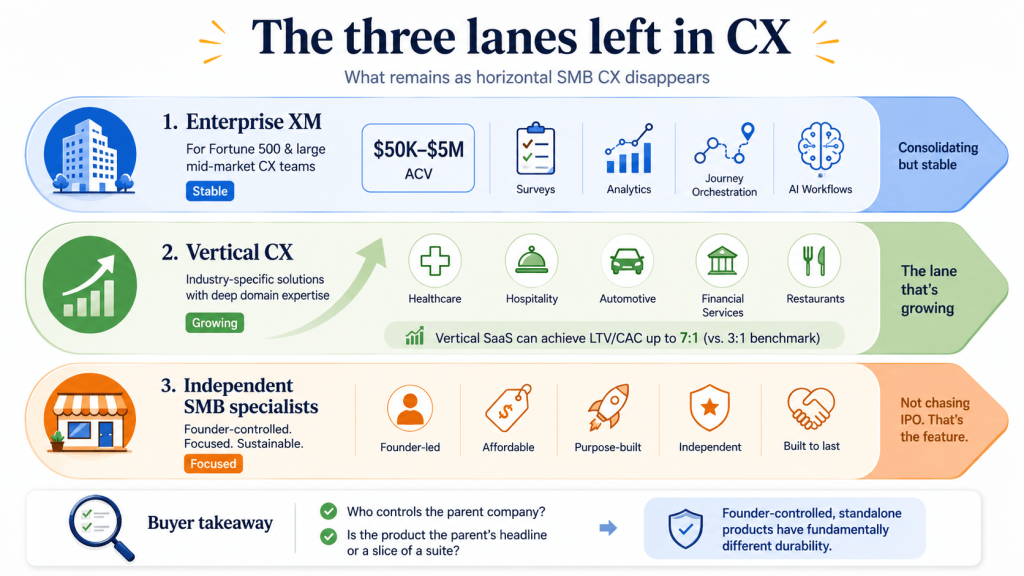
So if horizontal-SMB CX as a venture-backed category is collapsing, what’s left? Three lanes, in my read of the market.
Lane 1: Enterprise XM, at the top. Qualtrics (which now owns Press Ganey Forsta, after closing that acquisition in May 2026), creditor-owned Medallia, and a few smaller names competing for Fortune 500 and large mid-market budgets. These are $50K-5M annual contract value deals. The customers are global brands with dedicated CX teams. The products combine survey deployment, text and voice analytics, journey orchestration, and increasingly, AI-driven action workflows. This lane will survive, but it is consolidating fast and not painlessly: the giants are buying each other, Medallia belongs to its lenders, and the smaller specialty XM players (think text-analytics firms, journey-mapping tools) get absorbed every quarter. The lane’s survival does not make every vendor in it safe.
Lane 2: Vertical CX, in the middle. This is the lane that’s actually growing. Healthcare CX (Press Ganey, NRC Health), hospitality CX (Medallia’s Zingle, Revinate), automotive (MaritzCX, now part of InMoment), patient experience, financial-services NPS, restaurants. The economic structure of vertical CX is different in a useful way: the integrations, regulatory awareness, and benchmark data only make sense if you focus on a single industry. That focus lets the vendor charge prices closer to enterprise but serve mid-market customers who’d otherwise be left out. Tomasz Tunguz has written that vertical SaaS companies can hit LTV/CAC ratios as high as 7:1, well above the 3:1 benchmark for general SaaS. Vertical CX is one of the cleanest examples of that thesis.
Lane 3: Independent SMB-focused specialists, at the bottom. This is where Retently lives. It’s also where SurveySparrow, Refiner, Nicereply, Simplesat, Survicate, and a small bench of others live. These companies are typically founder-controlled, profitable or near-profitable, and deliberately not chasing the kind of growth that requires aggressive enterprise expansion. The model works because the founders chose it: stay focused, stay independent, charge SMB-friendly prices, ship product driven by actual customer feedback rather than enterprise RFP cycles. None of these companies will IPO. None of them are trying to. That’s the feature, not the bug.
The lane that’s collapsing is the one that doesn’t appear in this list: horizontal SMB CX owned by an enterprise parent. Delighted, GetFeedback, Wootric, Promoter.io all lived there. None of the survivors in lane 3 do. AskNicely, which raised $32M in 2022, is interesting because it’s trying to navigate out of lane 3 and into a frontline-success category that has more enterprise headroom. Time will tell whether that move works or whether it puts them in the same lane that just collapsed.
For a buyer, the practical takeaway is: look at who controls the parent company, and look at whether the product is the parent’s headline or a slice of a suite. A standalone product at a founder-controlled company has a fundamentally different durability profile than the same product nested three levels deep inside a PE-owned conglomerate.
Can’t you just build it with AI now?
A reasonable objection at this point is: surely with Cursor and Claude and v0, a small team can just build their own NPS tool in a weekend. Why pay anyone?
It’s a fair question, and I’ll give you the honest answer rather than the defensive one. For some teams, the answer is genuinely yes. A 12-person SaaS company sending 200 surveys a quarter to a friendly customer base, with Slack as the response channel and a Notion doc as the analysis layer, doesn’t need a $300/month NPS product. They need a Google Form and a webhook, and AI-assisted coding has made even that easier than it was five years ago.
The honest version of what AI-generated tooling can and can’t replace in customer experience comes down to a few specific things.
What you can build: A survey form. A response storage table. A simple dashboard. A Slack notification. A CSV export. Most of the visible product surface of a basic NPS tool is, in fact, a manageable project for a competent engineer with modern AI tools.
What you can’t build in a weekend: Email deliverability is a multi-year reputation play. Sending 10,000 NPS emails from a freshly registered domain will land most of them in spam, and customers won’t tell you why your response rate is 1%. Multi-channel send (email + SMS + in-app web + mobile SDK + embedded signature link) is plumbing, not a feature. Each channel has its own anti-abuse rules, rate limits, regional regulations, and accessibility requirements. GDPR, CCPA, and increasingly state-level US privacy laws are a continuous engineering tax. Industry-level benchmark data only exists if you have multi-tenant scale, which you can’t fake by querying your own database. Sampling science, response-rate optimization, and survey throttling are not intuitive; getting them wrong damages your sender reputation and pollutes your data. Closed-loop workflows (alerts to support, CRM sync, escalation rules) sound trivial and aren’t.
The clean test I’d offer is this: if you’re sending fewer than 1,000 surveys a month, don’t need industry benchmarks, don’t need cross-channel deliverability, and don’t have a regulated industry compliance burden, build it yourself. The economics genuinely favor that now, and they didn’t in 2020. If you’re at scale, in a regulated industry, or trying to run a real CX program rather than just collect an NPS number, the build path costs more in engineering time than buying a tool would cost you in cash. You can read our deeper take on this in DIY NPS: when to build, when to buy.
The other AI question: do you need to ask at all?
The build-versus-buy question has a sharper sibling, and it’s the one doing the real damage to this category’s story: why survey anyone at all? Customers already tell you how they feel, the argument goes, in support tickets, product reviews, app store comments, and sales calls. AI can read all of it at scale, around the clock, without interrupting a single customer. Response rates have been declining across the industry for years. Why keep asking people what a model can infer? The pitch even has a name now: surveyless VoC.
Parts of that argument are simply right, and I’ll concede them rather than defend around them. Badly run survey programs deserve to die: the ones that blast every customer every month, never act on a single response, and exist to produce a number for a quarterly slide. And AI synthesis of the text you already have is genuinely useful. We use it ourselves. It’s a feature of our platform, not the pitch.
But the surveyless argument fails on the collection side, not the analysis side, and it fails in four specific ways.
- The durable value was never the questionnaire. As covered above, the asking infrastructure (deliverability, timing, lifecycle triggers, channel plumbing) is measured in years, not features. Dropping the survey doesn’t make that layer unnecessary; it just moves you to inference over whatever text happens to arrive on its own.
- Closed-loop follow-up is an operations problem, not a text-analysis problem. Detecting an unhappy customer is step one, and it’s the easy step. Routing that customer to an owner, holding a service-level agreement on the response, and actually having the recovery conversation is where retention happens. No amount of sentiment inference does any of that for you.
- You cannot reconstruct a trendline you never collected. Longitudinal first-party data is the quiet asset of a survey program. Passive synthesis starts its history the day you switch it on; benchmarks, trend-based alerts, and board-level reporting all need the archive. Teams that keep asking are compounding a dataset the surveyless teams will eventually wish they had.
- The silent majority is invisible to surveyless VoC by construction. Passive synthesis only hears customers who already write to you: the ticket-filers, the reviewers, the complainers. The customer who says nothing, renews without enthusiasm, and leaves without warning never shows up in that corpus. Catching exactly that customer is the reason relationship surveys exist.
Our own numbers point the same way. In our survey response rate study, in-app surveys sustain response rates above 30% while email response rates keep sliding. It’s the channel and the timing that decay, not the instrument. We made a longer version of this argument in March, when Medallia’s own 2026 CX report confirmed the survey problem isn’t surveys. What’s changed since then is that the debt markets have now voted, and they voted on the vendors, not the method.
How to choose a tool you can actually rely on
If you’re a CX leader looking at the migration emails from Delighted and GetFeedback right now, the immediate problem is finding a replacement. The longer-term problem is making sure you don’t pick the next one to disappear.
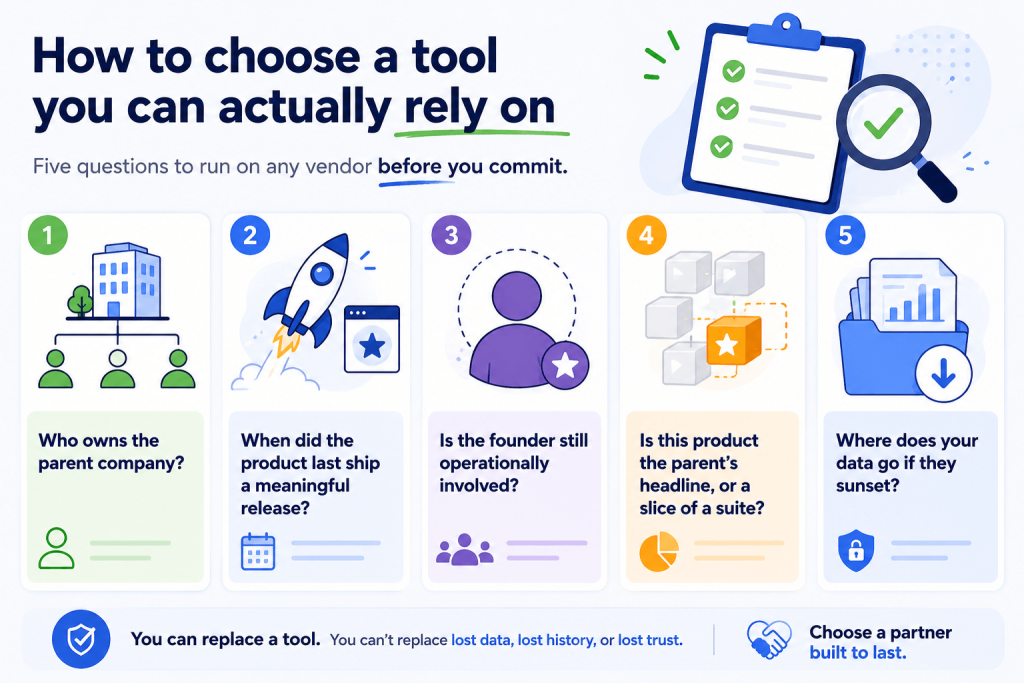
A few questions worth running on any vendor you evaluate:
- Who owns the parent company, and what’s their reporting structure? A founder-controlled, profitable, independent company has different incentives than a PE-owned subsidiary three levels deep in a holding company. A public company has different incentives than a private one. If you can’t tell from the website who actually owns the company, that’s already a signal.
- When did the product last ship a meaningful release? Not a UI refresh. Not a “we added AI” announcement. A real feature you can point to that solves a real customer problem. Six months without one is a yellow flag. Twelve months is red. Two years is the ambient-death pattern playing out in front of you.
- Are the founders still operationally involved? Founders who stay involved past the acquisition window are rare. When they leave, the product usually starts to drift. The opposite is also true: founder-controlled independents are typically the most aggressive about shipping product because that’s what they care about personally.
- Is this product the parent’s headline, or a slice of a suite? A product on the homepage of its own company gets investment. A product four clicks deep in a 14-product enterprise suite gets a maintenance budget. There’s no version of this where “Delighted is a feature of the Qualtrics XM Suite” leads to Delighted getting more investment than it did as a standalone.
- Where does your data go if they sunset? Read the data-export and data-deletion terms before you sign, not after. Reputable vendors will give you machine-readable exports with full historical fidelity. Less reputable ones will give you PDFs that aren’t useful for migration.
If you want a deeper walkthrough of how to evaluate NPS tools across these dimensions, we wrote the 2026 NPS Software Buyer’s Guide earlier this year that goes through 16 specific criteria. For migration-specific guidance, our team also published a list of Delighted alternatives covering 16 platforms across the SMB, vertical, and ecommerce segments, and a separate guide on Qualtrics alternatives for teams looking at a different lane.
The Bottom Line
The death of a beloved product is always emotional, and Delighted, GetFeedback, Promoter.io, and Wootric were genuinely good products built by genuinely talented teams. None of these companies died because their founders failed or because their customers stopped loving them. They died because the structural economics of horizontal SMB customer experience are uneconomic for the kind of parent companies that ended up owning them.
The market is finishing a correction it started 15 years ago, when venture capital decided customer experience software was a category that would consolidate to a few giants. It is consolidating, but not in the lane VC thought. The giants are eating the enterprise. The vertical specialists are eating the middle. The independents are quietly running profitable businesses in the SMB segment that the giants can’t economically serve.
If you’re choosing a CX tool for the next three years, the durability question matters as much as the feature checklist. The best NPS or CSAT tool in the world is still a worse choice than a slightly less-featured one that will still exist when you renew next year. Founder-controlled independents, vertical specialists with deep moats, or full-suite enterprise XM platforms (if you genuinely need that scale) are the three categories where your investment will be safe.
If you’re currently on Delighted, GetFeedback, or any product that lives inside a PE-owned or recently-acquired parent company, the migration question isn’t whether to move but where to move to. We’ve covered our own thinking on what the 2026 NPS software market looks like, along with the best NPS tools for B2B and ecommerce buyers. The work of choosing is unfortunate but necessary; the work of choosing well is what determines whether you have to do it again in two years.
Retently sits firmly in lane 3, by design. We’re founder-controlled, profitable, independent, and not for sale. If you’re evaluating where to migrate from a product that’s sunsetting, or just choosing your first serious CX tool, we’d be glad to walk you through how we think about NPS, CSAT, and CES programs for SMB and mid-market businesses. Start a free trial or book a setup call with our team.
The category isn’t dying. The companies that don’t fit it are.
Frequently Asked Questions
What happened to Medallia? Thoma Bravo took Medallia private for $6.4 billion in 2021 and handed it to its creditors in June 2026 rather than inject fresh capital. A lender group including Blackstone, KKR, and Apollo, holding roughly $3 billion of buyout debt, took control, and around $5.1 billion of equity was wiped out. Medallia continues to operate under creditor ownership.
Are customer surveys dead in 2026? No. Badly run survey programs are dying, and the premium vendors once charged for proprietary text analytics has collapsed. But direct feedback collection still does things passive AI synthesis can’t: it hears the silent customers who never write tickets or reviews, it powers closed-loop follow-up, and it builds the longitudinal record that benchmarks and trend alerts depend on.
Is Delighted shut down? What about Wootric? Delighted shut down on June 30, 2026, at the end of the sunset schedule Qualtrics announced in 2025. Wootric, now sold as InMoment Surveys, has no announced end-of-life date. It sits three acquisitions deep inside Qualtrics, the same parent that just retired Delighted, and nobody outside Qualtrics knows its roadmap. That uncertainty is itself the procurement point.
What is surveyless VoC, and does it work? Surveyless voice of customer means inferring how customers feel from text you already have (support tickets, reviews, call transcripts) using AI, instead of sending surveys. It works well as a complement and poorly as a replacement: it only hears customers who already write to you, and it can’t run the follow-up workflows where retention is actually won.

 Christina Sol