



Ask a marketer how many customers they have, and you get a number in seconds. Ask how many people in their market have heard of the brand, and you get a shrug, a follower count, or a guess dressed up as a metric. Brand awareness has a reputation for being immeasurable, so most teams proxy it with whatever is easy to count and hope the two move together.
They don’t, reliably. But awareness is measurable, and you measure it the same way you measure anything about people: you ask them. The catch is asking the right people, the right question, on a schedule you keep. This guide hands you the whole thing – the actual survey wording, how to turn the answers into a percentage, who to send it to, and how often to send it.
Key Takeaways
- Brand awareness is the share of your target market that recognizes or recalls your brand. You measure it with a survey, not with follower counts.
- Two questions define it: unaided recall (name a brand with no prompt) and aided recognition (pick your brand from a list). Ask the unaided one first, always, or you bias the result.
- Score each metric as a plain percentage of your sample. No tool required for the math.
- True market awareness needs a representative sample of your market, not a list of your own customers. Your customer base can still measure recall, sentiment, and how people found you.
- One reading is a data point. Run the same survey on a cadence and you have brand tracking. Your first wave is your benchmark.
What brand awareness actually measures
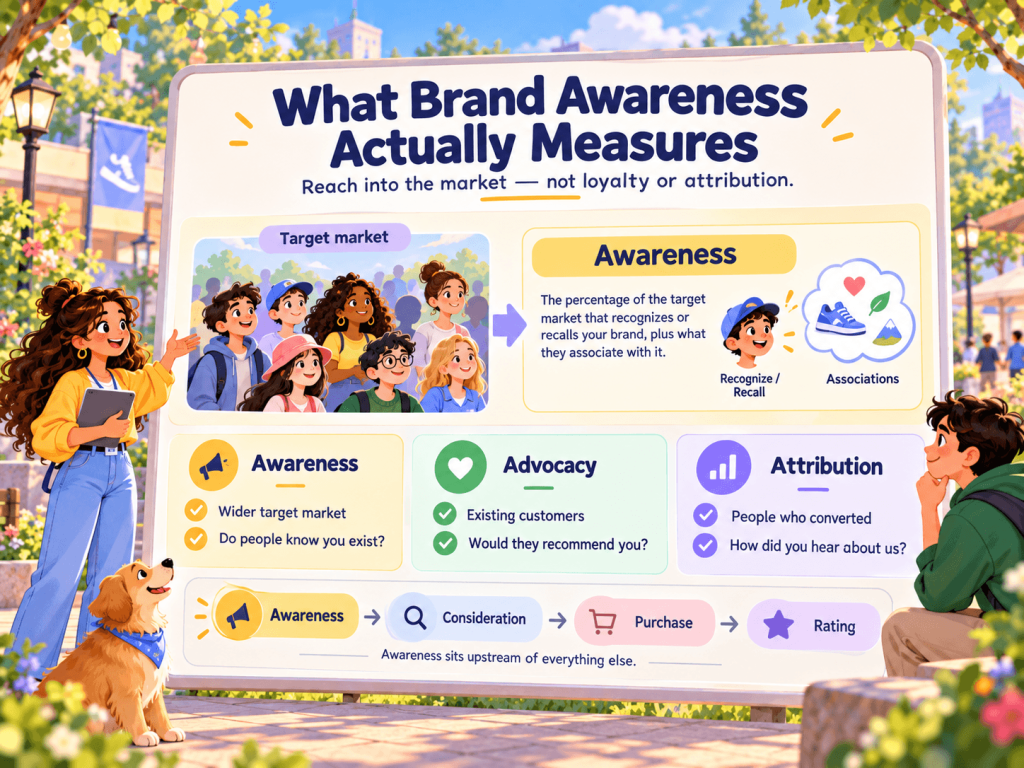
Brand awareness is the percentage of your target market that recognizes or recalls your brand, plus what they associate with it when they do. That’s the whole definition. It’s a measure of reach into a market, not of how the people already inside your funnel feel.
That distinction trips up a lot of dashboards, because three different things get filed under one word. Keep them apart:
- Awareness is not advocacy. How much your existing customers like you and would recommend you is loyalty, and you measure it among people who already use the product, which is a different instrument entirely (see NPS vs social media for market research for where that line sits).
- Awareness is not attribution. “How did you hear about us?” tells you the discovery channel of people who have already converted. It says nothing about how many people in the wider market know you exist. We give that question its own section below, because it is useful and not awareness.
Awareness sits upstream of everything else. Before someone can consider you, buy from you, or rate you, they have to know you exist, which is why it’s the first stage of any serious customer experience management program, even though it lives in the marketing team’s world. Measure it wrong and every metric downstream inherits the error.
Aided vs. unaided awareness: the two questions that define it
Almost every way of measuring awareness reduces to two questions, and the split between them goes back to the brand-equity models marketers have used for decades (David Aaker’s awareness pyramid, Kevin Lane Keller’s work on brand knowledge). You don’t need the theory to run the survey. You do need to know which question you’re asking.
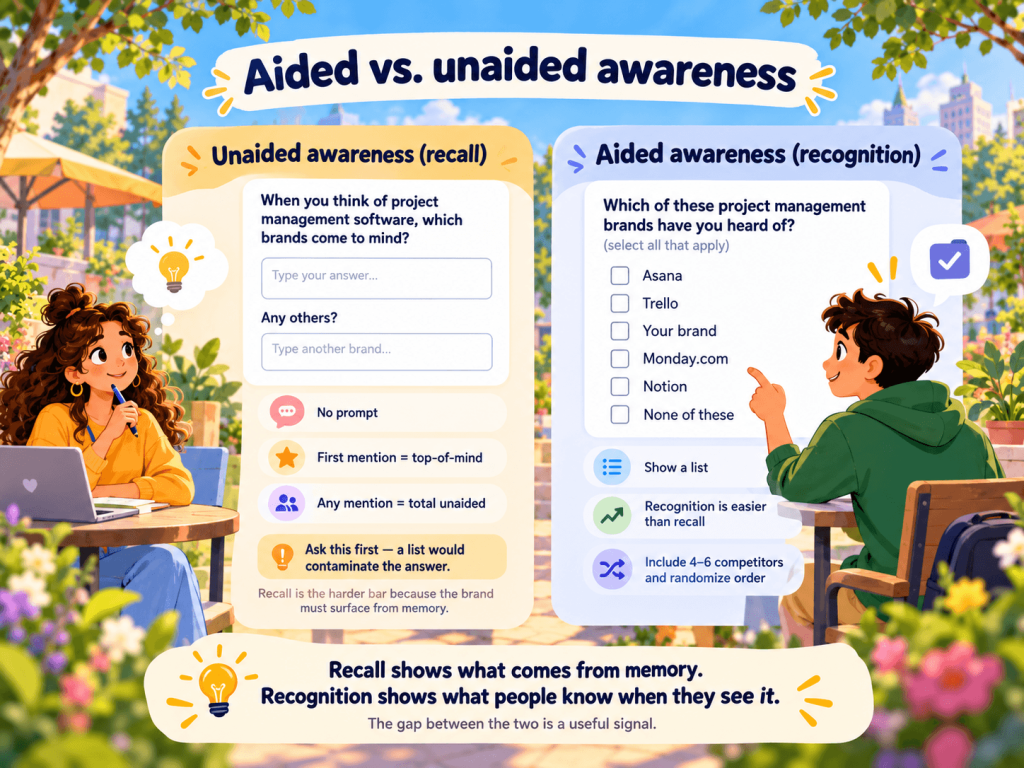
Unaided awareness (recall)
Unaided awareness is whether someone names your brand with no prompt at all. You give them a category and a blank box.
When you think of project management software, which brands come to mind? [ open text ]
Any others? [ open text ]
The first brand a person types is top-of-mind awareness, the strongest position there is. Any mention across both answers counts toward total unaided awareness. Recall is the harder bar to clear and the better predictor of behavior because it means your brand surfaced from memory rather than being recognized when shown. Ask this question first, before any list appears, or the list contaminates the answer.
Aided awareness (recognition)
Aided awareness is whether someone recognizes your brand when they see it. You show a list and ask them to tick what they know.
Which of these project management brands have you heard of? (select all that apply) ☐ Asana ☐ Trello ☐ Your brand ☐ Monday.com ☐ Notion ☐ None of these
Include four to six real competitors alongside your brand and randomize the order so position doesn’t skew the ticks. Recognition is easier to earn than recall, so aided numbers always run higher than unaided ones. That gap between the two is itself a useful read on how well-established you are.
How to score each
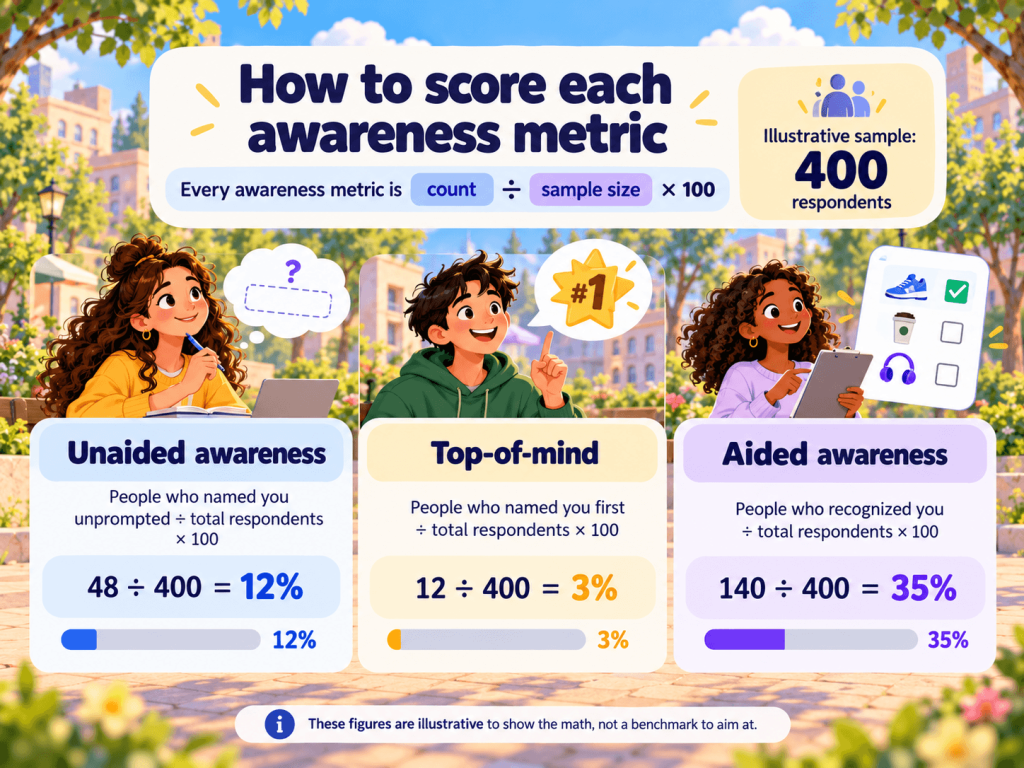
Every awareness metric is a count divided by your sample size, times 100. No tool needed.
- Unaided awareness = people who named you unprompted ÷ total respondents × 100
- Top-of-mind = people who named you first ÷ total respondents × 100
- Aided awareness = people who recognized you ÷ total respondents × 100
Here is the arithmetic on an illustrative sample. Say you field the survey to 400 people in your target market. If 48 name you without a prompt, unaided awareness is 48 ÷ 400 = 12%. If 12 of those named you first, top-of-mind is 12 ÷ 400 = 3%. When 140 tick your name on the aided list, aided awareness is 140 ÷ 400 = 35%. Those figures are made up to show the math, not a benchmark to aim at.
The brand awareness survey, question by question
This is the part most guides keep behind a panel signup. Here is a complete short questionnaire you can lift, roughly five questions and three to four minutes for the respondent. Order does real work here: recall first, then recognition, then the softer questions, so nothing you show early biases what people remember later. For help choosing formats, see our guide to survey question types, and for keeping the wording neutral, write good survey questions.
1. Top-of-mind and unaided recall
Open text, asked first, no options visible.
When you think of [category], which brands come to mind? [ open text ]
Any others you can think of? [ open text ]
2. Aided recognition
A multi-select from a randomized list of you plus real competitors.
Which of these [category] brands have you heard of? (select all that apply) ☐ Competitor ☐ Your brand ☐ Competitor ☐ Competitor ☐ None of these
3. Campaign recall
A yes/no with an open follow-up. This is where “measure brand sentiment” starts to overlap with awareness, because you learn whether people saw you and what stuck with them.
Have you seen or heard anything from [your brand] in the last 30 days? ◯ Yes ◯ No ◯ Not sure
If yes: where did you see it, and what was it about? [ open text ]
4. Consideration and preference
Two closed questions that move from awareness toward intent.
Which of these would you consider for [need]? (select all that apply) ☐ Competitor ☐ Your brand ☐ Competitor ☐ Competitor
And which would be your first choice? ◯ Competitor ◯ Your brand ◯ Competitor ◯ Competitor
5. Brand association and sentiment
One open question that tells you what your name actually means to people.
In a word or two, what do you associate with [your brand]? [ open text ]
Theme those answers afterward the way you would any open-text field, and you get the qualitative half of awareness: not just how many people know you, but what they think they know. That block is the survey. Swap your category and competitors in, keep the order, and you can field it this week.
Who to actually survey: a market panel vs. your own customer base
The catch that gets glossed over is this: true aided and unaided awareness needs a representative sample of your target market, not a list of your own customers. Your customers are, by definition, already aware of you, so surveying them inflates every number and quietly answers a different question.
To reach the market cold, you need an audience you don’t already own: a paid research panel, an ad-recruited sample, or a community you can reach that isn’t made up of buyers. That is the instrument the panel vendors sell, and for genuine market-level awareness, it is the right one.
Your own customer base is still worth surveying, as long as you’re honest about what it measures. Among people who already know you, you can read brand health well: recall and association, sentiment, and the discovery channels behind the “how did you hear about us?” question. That’s our lane at Retently. It’s a real read, just not the same as market reach, and mixing the two is the most common way these numbers go wrong.
On sample size, you don’t need thousands. A few hundred responses per segment give you a directional read, and the discipline that matters more than raw count is consistency: pull from the same source every wave so the trend is comparable to itself.
How often: turning one survey into brand tracking
One survey is a single data point, and a single awareness number means almost nothing on its own. There’s no reliable public figure to hold it against, so the reading only becomes useful when it becomes a trend. Run the same questionnaire, on the same audience source, on a set cadence, and you have graduated from a one-off survey to brand tracking.
Quarterly is the sensible default for most teams. Move to monthly if you are running heavy campaigns and want to catch the lift while it is happening. Whatever you pick, hold the wording and the audience source steady, because a change in the survey looks exactly like a change in awareness, and you won’t be able to tell them apart.
Your first wave is your benchmark. Instead of chasing a borrowed industry percentage that may have been measured on a different market with a different question, you judge every later wave against your own baseline. Tie your campaigns to the wave calendar and you can start to attribute the lifts, which is the entire point of tracking in the first place.
Beyond surveys: the signals that corroborate awareness
The survey is the measurement. A handful of other signals move roughly with awareness and are worth watching between waves, as long as you treat them as corroboration and not as the number itself. Branded search volume tells you whether more people are googling you by name. Direct traffic, referral traffic, and earned media hint at reach. Social listening picks up mentions and the sentiment around them, and Google Trends shows the shape of interest over time.
Share of voice
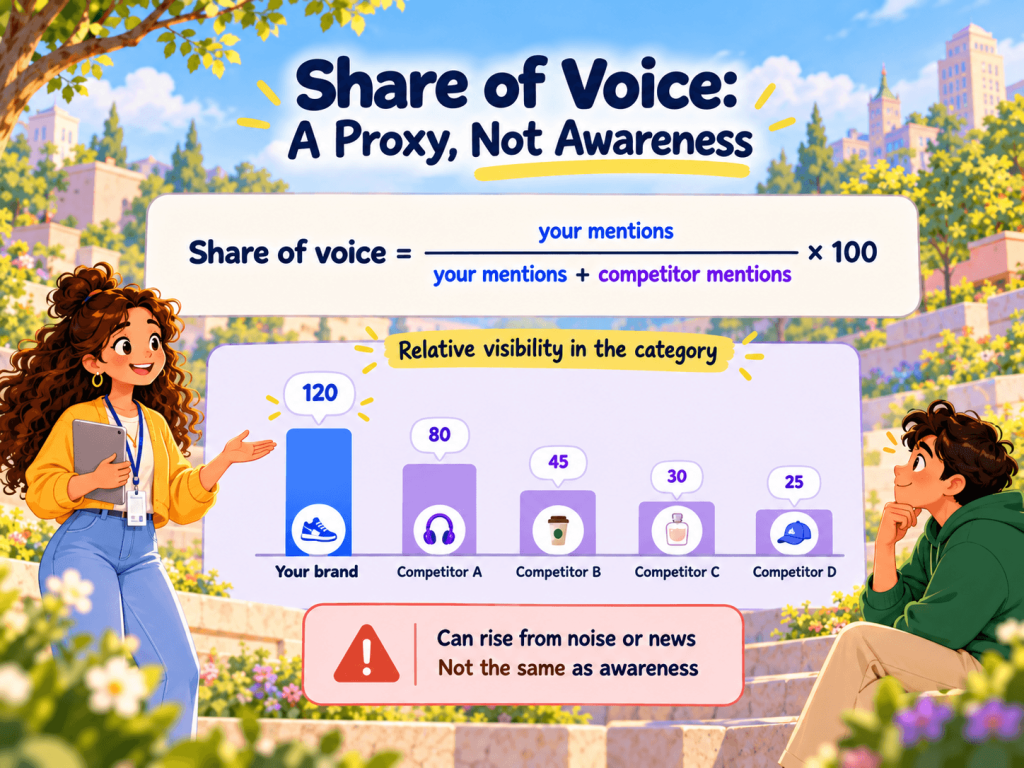
Share of voice is the one worth defining, because “share of voice marketing” is a metric people quote without agreeing on. The simple version is your brand mentions divided by total category mentions, which is you plus the competitors you track, ideally broken out by channel and pulled from a social-listening or SEO tool.
Share of voice = your brand mentions ÷ (your mentions + tracked competitor mentions) × 100
Read it as relative visibility: how loud you are compared with the field, not how many people know you. It’s a proxy that moves with noise as much as with awareness. A news cycle can swing it in a week without one new person having heard of you.
None of these signals is awareness on its own. They are the corroborating evidence between survey waves, a way to tell that your quarterly number is probably still pointing the right way before you field it again.
Where “how did you hear about us?” fits (attribution, not awareness)
It’s worth expanding the earlier boundary because this question is genuinely useful and is constantly miscast. You ask it after someone converts, and it tells you the discovery channel that brought that particular person in. That’s attribution, and a well-built how did you hear about us survey is one of the cheapest reads you can run.
What it doesn’t tell you is market reach. It only sees people who have already found you and acted, which is a self-selected slice, not a representative sample. Run it alongside a tracking survey and the two complement each other cleanly: attribution tells you which channels are working on the people you converted, and the tracking survey tells you how much of the market you have reached in the first place.
Related surveys worth running
Once you can field one survey to a defined audience and read the results honestly, the same muscle runs the rest of your research. A product-market fit survey uses the same sampling logic to tell you how badly your best users would miss you, and your CX surveys reuse the same discipline on the customer side.
Conclusion
Brand awareness earned its unmeasurable reputation because the honest way to measure it, asking a representative sample of your market on a schedule, is more work than screenshotting a follower count. The method itself isn’t complicated. Two questions define it: the scoring is arithmetic, and the only real judgment calls are who you survey and how often.
Start with what you can field today. Retently runs the customer-side half of this well: recall, sentiment, and attribution surveys sent to people who already know you, scored the standard way and tracked over time. Start a free trial to send your first one, or book a demo to see how the tracking fits together.
Frequently Asked Questions
What is the difference between brand awareness and brand recognition? Brand recognition is aided awareness: whether someone recognizes your brand when they see it on a list. Brand awareness is the broader term and includes recall, which is unaided (naming you with no prompt at all). Recognition numbers always run higher than recall, because picking a familiar name out of a lineup is easier than producing it from memory.
How is brand awareness calculated? Each metric is a count divided by your sample, times 100. Unaided awareness is the share of respondents who named you without a prompt. Aided awareness is the share who recognized you on a list. Top-of-mind is the share who named you first. All three come straight from the survey responses, no special tool required.
How often should you measure brand awareness? Quarterly is the practical default for most teams, often enough to catch real movement without survey fatigue. Move to monthly if you are running heavy campaigns and want to see the lift in real time. The rule that matters more than frequency: keep the questionnaire and the audience source identical across all waves, so any change in the number reflects awareness, not the survey.
Can you measure brand awareness without a research panel? Partly. Your own customer base can measure brand health among people who already know you: recall, association, sentiment, and how they found you. True market-level awareness, the share of your whole target market that knows you, needs a representative sample of that market, which usually means a paid panel or a cold-reachable audience rather than your customer list.
What is aided and unaided brand awareness? Unaided (recall) is whether someone names your brand with no prompt, given only a category. Aided (recognition) is whether they tick your brand when shown a list. Unaided is the harder, stronger signal because it means you surfaced from memory. Aided is easier to earn and always higher. Ask the unaided question first so the list never contaminates recall.

 Christina Sol