


The cookie deadline that reshaped every ecommerce data plan quietly got called off. On April 22, 2025, Google confirmed Chrome would keep its current approach to third-party cookies, with users deciding in settings, and not roll out a new standalone prompt. Six months later, it retired most of the Privacy Sandbox technologies that were supposed to replace them. The cookie apocalypse most marketers built around never arrived.
Here is the part that did survive. Shoppers still guard their data, Apple and the browsers still block the easy tracking, and the regulators did not blink. So the most reliable way to know what a customer actually wants is also the oldest one: ask them, then use the answer.
That answer has a name: zero-party data.
Key Takeaways
- Zero-party data is information a customer shares with you deliberately, so it is the most accurate and the most privacy-safe input you can hold about them.
- The 2025 cookie reversal did not lower the stakes. Apple’s tracking prompt, Safari’s tracking prevention, and GDPR/CPRA still make inferred data expensive and fragile.
- Surveys are the cleanest collection tool because the ask is the consent, and you get the reason behind a behavior instead of a guess.
- Four ecommerce touchpoints are a practical place to start: post-purchase attribution, a preference and profile survey, an NPS or CSAT follow-up, and a product-finder quiz.
- Declared data only pays off when you act on it. Route answers into segments and trigger flows so the next message reflects what the customer told you.
What is zero-party data?
Zero-party data is information a customer deliberately tells a brand. Their sizes, the categories they shop, how often they want to hear from you, why they bought, why they almost didn’t. It is volunteered, not observed and not bought.
The term is credited to Forrester Research, which defines it as data “that a customer intentionally and proactively shares with a brand,” including preference-center data, purchase intentions, and personal context. The word “zero” places it one step ahead of first-party data: not what you watched the customer do, but what they chose to tell you before you had to guess.
That distinction is the whole point, so it helps to see all four data types side by side.
Zero-party vs first-, second-, and third-party data
Marketers use four labels for customer data. They differ on one axis that matters most: how the customer’s consent enters the picture.
| Data type | How you obtain it | Ecommerce example | Consent | Reliability |
|---|---|---|---|---|
| Zero-party | The customer volunteers it | A shopper picks “I buy for sensitive skin” in a quiz or sets email frequency | Explicit, given by the customer | Highest. It is what they told you |
| First-party | You collect it from your own channels | Purchase history, on-site clicks, email opens | Implied through your terms and privacy policy | High, but you still infer intent from behavior |
| Second-party | A partner shares their first-party data with you | A co-marketing partner’s audience list | Depends on the partner’s consent chain | Varies with the partner’s data quality |
| Third-party | Aggregated by data brokers who never met the customer | Bought audience segments, cross-site tracking cookies | Little to none, usually opaque | Lowest. Modeled, decaying, privacy-exposed |
The pattern reads top to bottom. As you move away from the customer, consent gets murkier and the data gets less trustworthy. Third-party data is the classic case: someone the shopper never met sold a profile of them to someone else. Zero-party sits at the opposite end, where the customer is both the source and the reason for sharing.
Why zero-party data still matters
It would be easy to read Google’s reversal as a reprieve: cookies are staying, so why chase declared data at all?
Because the cookie was never the only pressure, and the others are not reversing. Apple’s App Tracking Transparency, enforced from iOS 14.5 in April 2021, requires every app to ask permission before tracking a user across other apps and websites, and most people decline. Safari’s Intelligent Tracking Prevention has capped and expired cross-site cookies for years. Firefox blocks trackers by default. GDPR in Europe and CPRA in California put real teeth behind consent and data-access rights. None of that unwound when Chrome kept its cookies.
Then there is the customer. In an October 2023 study, the Pew Research Center found that 81% of U.S. adults are concerned about how companies use the data they collect about them, and 73% feel they have little or no control over it. Those are not people won over by better cross-site tracking. They will tell you what they want, though, if you ask plainly and give them a reason.
This is the same shift we covered in our look at the privacy changes reshaping ecommerce retention: the signal that used to arrive for free through tracking now has to be earned through a direct relationship. A survey is that relationship in its simplest form.
Why surveys are the cleanest way to collect it
Plenty of tactics can gather zero-party data. Surveys sit at the center of them for three reasons.
The ask is the consent. When a shopper answers “which of these do you shop for most?” they have chosen to tell you, on the record, in their own words. There is no interpretation layer, no modeled probability, no tracking pixel to explain in a privacy policy.
You get the “why,” not a guess. Behavioral data tells you a customer bought running shoes. It cannot tell you they bought them for a first marathon, or that they almost abandoned the cart over sizing. A survey can, and the answer changes the next thing you send.
And it fires at the exact moment. A survey can trigger the instant an order ships, the day a subscription renews, or the first time someone lands on a category page, the point where the customer has the context to answer it well.
Four ecommerce survey touchpoints (and the zero-party data each collects)
You do not need a dozen surveys to start with. Four touchpoints, placed where a shopper already has something to say, collect most of the declared data an ecommerce brand can act on. If you want the full cycle, from the first visit through delivery and product use, our guide to mapping the buyer’s journey with surveys covers it.
Post-purchase survey: attribution and product fit
The moment right after checkout is the highest-intent survey window you have. The customer just converted, so they are invested and paying attention.
The classic zero-party question here is attribution: how did you hear about us? Ad platforms lost precision when tracking tightened, so a one-tap “where did you first find us” question on the confirmation page often reads truer than your analytics dashboard. Add a short product-fit question (“what almost stopped you from buying?”) and you also learn what nearly cost you the sale.
Keep it to one or two questions and trigger it on order confirmation or fulfillment. Our guide to post-purchase surveys covers the timing in detail. The mirror image of this touchpoint is the shopper who did not buy, which is where cart-abandonment surveys come in.
Preference and profile survey: declared interests
This is the touchpoint people picture when they hear “zero-party data.” You ask, directly, what the customer wants: which categories they shop, their sizes or skin type or dietary needs, how often they want email, which channel they prefer.
The home for this is a preference center, a page where a customer sets and updates their own choices, plus short profile questions you can slot into a welcome flow. Ask demographic questions only when the answer will change what you show them, and say why you are asking. A skincare brand that knows a shopper’s skin type stops recommending the wrong serum, a value exchange the customer can feel.
NPS or CSAT follow-up: stated sentiment and reasons
Every NPS or CSAT survey has a quiet second half that is pure zero-party data: the open-text box after the score. The number tells you a customer is a 6. The comment tells you it is because delivery ran three days late, and that is the part you can act on.
If you already run a feedback program, you are collecting declared sentiment whether you frame it that way or not. Treat the “why” behind each score as customer-shared data, not just a support ticket to close, and your survey program becomes a standing zero-party pipeline.
Quiz or onboarding survey: intent and self-segmentation
A product-finder quiz is a survey wearing a friendlier outfit. “Answer four questions and we will recommend the right kit” is an offer a shopper happily accepts, and every answer is a declared preference you keep.
The trick is that the shopper self-segments as they go. Someone who picks “gift for someone else,” “under $50,” and “delivered by Friday” has handed you their intent, budget, and urgency in three taps. Done well, the quiz earns its data by giving something back on the spot: a tailored recommendation. The exchange feels fair, not nosy.
Turn answers into action: segmentation and flows
Collected data that sits in a spreadsheet is a cost, not an asset. The payoff comes when an answer changes the next message.
The workflow is straightforward. A survey response becomes a customer attribute, that attribute becomes a segment, and the segment triggers a message. Someone who declared “sensitive skin” enters a segment that only ever sees the fragrance-free line, in the welcome and replenishment flows alike. A shopper who said sizing almost stopped the purchase gets a fit guide and an easy-exchange note in the next email. A Detractor who flagged slow shipping/late delivery gets a recovery flow with a shipping update, not the next promo. It is the same logic behind RFM segmentation: group customers by what you know, then treat each group differently.
A few examples of the full chain:
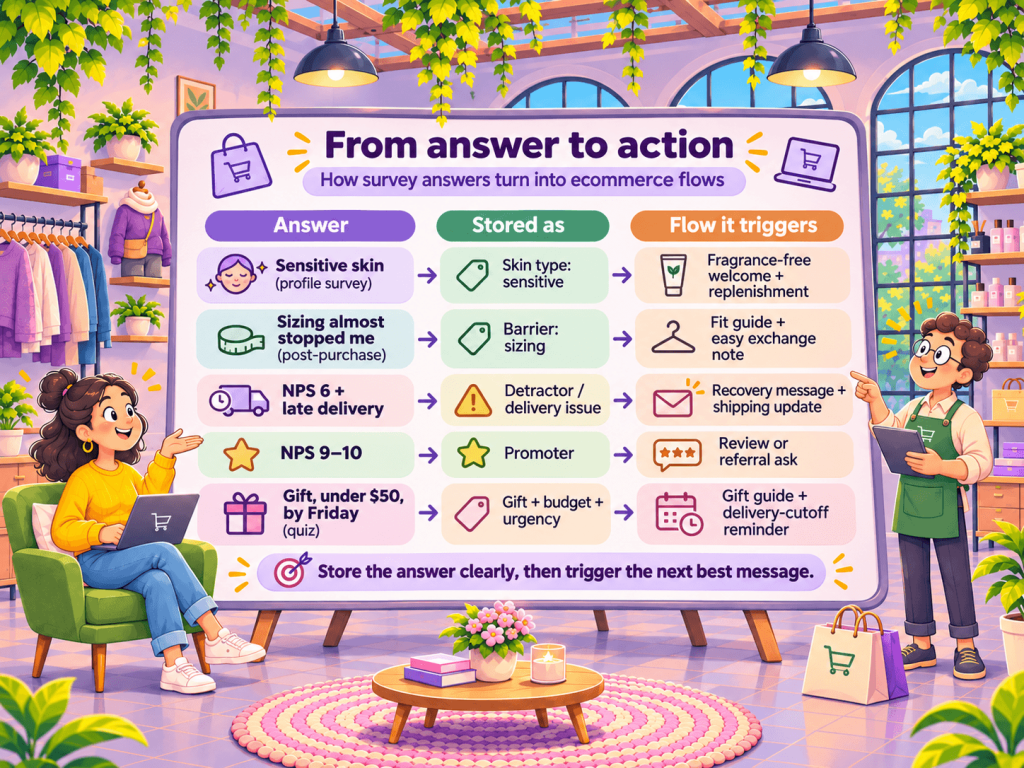
Retently connects to Klaviyo for exactly this. Survey triggers can fire off your existing Klaviyo flows, and the responses you collect become segmentation criteria, so a post-purchase answer or an NPS score routes a shopper into the right winback, replenishment, or thank-you flow without manual tagging. It is the same idea behind our broader take on NPS for ecommerce: the survey is the sensor, the flow is the response.
Collect it without the creep factor
Zero-party data is consented by definition, which does not make every survey feel welcome. The line between “they know me” and “they watch me” is thin, and easy to cross even with volunteered data.
Three habits keep you on the right side of it. Disclose the use: tell the shopper why you are asking and what they get for answering. Keep the ask short: a two-question survey respects time in a way a fifteen-field form does not. And deliver on the exchange, so the sizing question visibly leads to better recommendations rather than vanishing into a database. Our piece on personalization without feeling creepy goes deeper, but the short version: declared data earns trust only when the customer sees it working for them.
Conclusion
The cookie phase-out that dominated marketing planning for half a decade got canceled, and the privacy pressure that made zero-party data valuable did not. The most trustworthy data about a customer is still the data they chose to give you, and a survey is the most direct way to ask for it.
Start with one touchpoint, most likely the post-purchase moment, and grow from there into preferences, feedback, and a quiz. Then close the loop by feeding every answer into the segment and the flow it should change.
Retently runs those surveys across the ecommerce journey and connects the answers to the tools you already use. Start a free trial to collect your first zero-party data this week, or book a demo to see it mapped to your store.
Frequently Asked Questions
What is zero-party data? Zero-party data is information a customer deliberately tells a brand, such as their preferences, purchase intentions, sizes, or the reasons behind a purchase. Unlike first-party data, which you observe from behavior, zero-party data is volunteered directly by the customer, usually through a survey, quiz, or preference center. That makes it both highly accurate and privacy-safe.
Who coined the term “zero-party data”? The term is credited to Forrester Research, which defines it as data a customer intentionally and proactively shares with a brand, including preference-center data, purchase intentions, and personal context. The “zero” positions it one step ahead of first-party data.
What is the difference between zero-party and first-party data? First-party data is collected from your own channels by watching what customers do, such as purchases, clicks, and email opens. Zero-party data is what customers tell you on purpose, like their stated preferences or reasons. First-party data infers intent from behavior; zero-party data captures the intent directly, which makes it more reliable and less dependent on tracking.
What are examples of zero-party data? Common examples include answers to a “how did you hear about us” survey, product-quiz responses, declared category or size preferences, email-frequency and channel choices set in a preference center, and the open-text reason a customer gives after an CX score. Each is volunteered by the customer rather than observed or purchased.
Is collecting zero-party data GDPR-compliant? Zero-party data is well suited to GDPR and CPRA because the customer provides it knowingly and for a stated purpose, which supports lawful, consent-based processing. You still owe the basics: tell people why you are collecting it, use it only for that purpose, and let them view or update their choices. Declared data does not exempt you from those duties, but it makes them easier to meet.

 Christina Sol




 Greg Raileanu