



How many of your unhappy customers actually tell you they’re unhappy? For most companies, the honest answer is: barely any of them. The angry email in your inbox is the rare one. Behind it sits a much larger group who felt let down, said nothing, and simply started spending less or drifted to a competitor.
That gap is the whole problem with how complaint management usually gets discussed. Search the term and you’ll find page after page written for bank auditors and quality managers: regulatory logs, record retention, examiner expectations. Useful if you run a compliance program. Close to useless if you run a customer experience team and you’re trying to keep customers from leaving.
This guide takes the other view. A complaint is a retention signal before it’s a compliance artifact, and the companies that treat it that way turn a cost center into one of their better sources of loyalty. Here’s what complaint management actually involves, a process a small team can run without a GRC platform, and how to tell whether the system you’re paying for closes the loop or just files it.
Key Takeaways
- Most unhappy customers never file a complaint, so your biggest risk sits in the feedback you never collect. Proactive surveys are how you surface it before the customer is gone.
- Run complaint management as a loop, not a ticket queue: intake, triage by topic and severity, route with clear ownership and deadlines, close the loop with the customer, then measure the outcome.
- Handled fast, a complaint can leave a customer more loyal than if nothing had gone wrong. Handled slowly or not at all, it quietly costs you the account.
- A complaint management system earns its keep on five things: channel coverage, tagging and sentiment, routing and escalation, close-the-loop workflows, and measurement. Whether the loop actually closes matters more than the length of the feature list.
What Is Customer Complaint Management?
Customer complaint management is the end-to-end process of catching, sorting, resolving, and learning from the moments a customer tells you something went wrong. It spans the first signal (a survey comment, a support ticket, a one-star review) through resolution and follow-up, and back into the product or process changes that stop the same complaint from recurring.
Notice what that definition includes that the audit-flavored version leaves out. It starts with catching the complaint, not logging one that already arrived. In a regulated industry, a complaint is often a formal submission with a legal definition. In customer experience, the far more common complaint is informal and easy to miss: a “3 out of 10, checkout kept failing” left in an NPS box, a frustrated aside in a chat, a review that names the exact thing you’ve been meaning to fix.
So a working definition for a CX team is narrower and more useful: complaint management is the discipline of turning expressed dissatisfaction into resolution and retention. Everything downstream (tags, routing, SLAs, reporting) exists to serve that, not the other way around.
Why Complaint Management Is a Retention Problem, Not a Compliance One
The reason to take complaints seriously isn’t that a regulator might ask. It’s that badly handled dissatisfaction is one of the largest quiet drains on revenue you have.
A 2024 survey of more than 28,000 people across 26 countries puts a number on it: it estimated $3.7 trillion in global sales at risk from bad experiences that year. Customers stopped spending with a company entirely after 13% of the bad experiences they had, and organizations disappointed customers in more than 1 in 10 interactions. That should not be read as a precise forecast for your business, but the direction is hard to argue with: dissatisfaction that goes unresolved doesn’t stay neutral. It shows up later as churn.
Now pair that with what happens when a complaint is handled well. The foundational research here comes from TARP, the group that studied complaint behavior for the U.S. Office of Consumer Affairs, later summarized by John Goodman and Steve Newman in “Understand Customer Behavior and Complaints”. For a serious problem, a customer who never complained went on to buy again, only about 9% of the time. A customer who complained and was satisfied with the resolution bought again 54% of the time. For smaller problems, the gap points the same way: roughly 37% for the silent customer versus more than 95% when the issue is fixed fast. Goodman and Newman noted the pattern has since been confirmed across hundreds of separate studies.
Read those two findings together and the strategic point lands. The customer who complains and gets a fast fix is often your most loyal segment, more loyal than the customer who never had a problem at all. That counterintuitive result has a name: the service recovery paradox. Later work has been more cautious about it, and it holds mainly when the failure is genuinely resolved and wasn’t your customer’s tenth strike. Treat it as a lever, not a law. But it explains why a complaint is worth chasing rather than dreading.
The complaints you never hear are the expensive ones
Here’s the part complaint-management content often skips entirely. The complaints that reach your desk are a small, self-selected sample of the dissatisfaction that’s actually out there. The often-quoted shorthand is that only 1 in 26 unhappy customers bothers to complain, a figure usually attributed to Esteban Kolsky’s ThinkJar research. That number gets repeated far more than it gets sourced, so treat it as a shape rather than a measurement. The shape is the point: for every complaint you can see, there’s a larger silent group you can’t.
The silent group is where the retention risk concentrates, because those customers give you no chance to recover. They don’t argue. They just don’t renew. If your complaint process only handles what comes through the front door, you’re managing the least dangerous fraction of the problem and calling it coverage. Reading the customers who never respond is part of the same discipline: silence is data, and a proactive intake system exists to convert it into a complaint you can act on while the customer is still yours.
The Complaint Management Process: A Loop You Can Actually Run
You don’t need an enterprise GRC suite to do this well. You need a loop that reliably runs, five steps, small enough for a five-person team and rigorous enough that nothing falls through. The compliance-heavy “lifecycle” diagrams out there stretch this to six or seven boxes; what matters is that each step below has a clear owner.
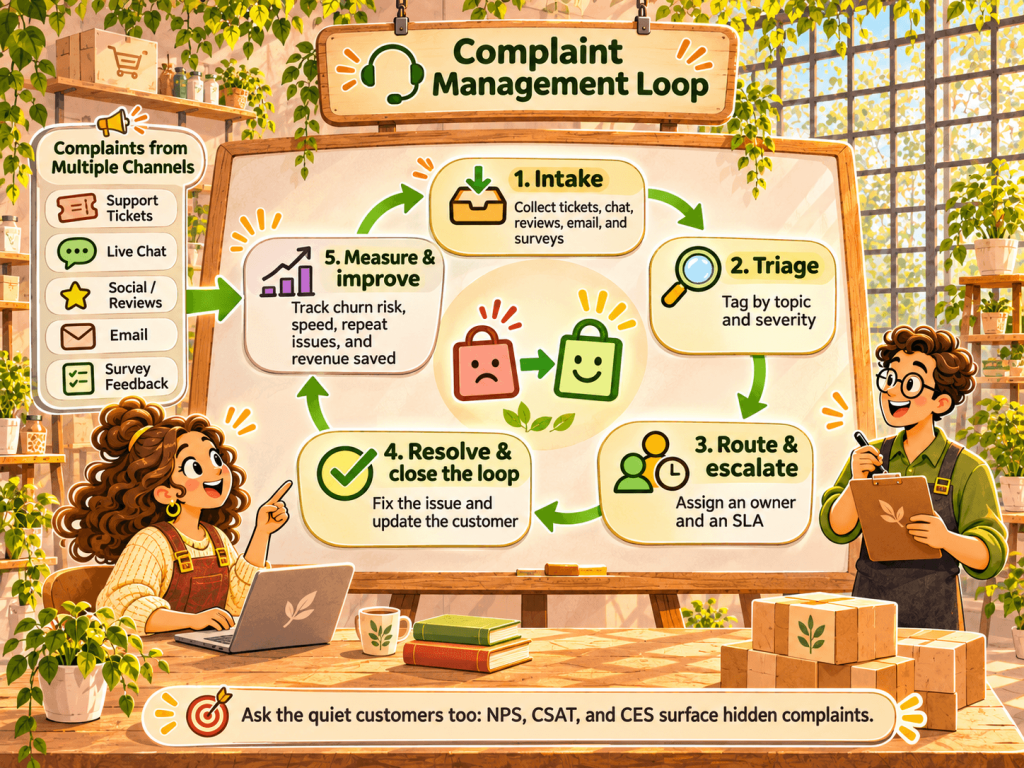
1. Intake: open every channel, including the silent one
Complaints arrive through support tickets, live chat, social mentions, app-store and marketplace reviews, and direct email. Collect all of them into one place so a pattern in one channel isn’t invisible to the person watching another.
Then add the channel most teams miss: proactive feedback. An NPS, CSAT, or CES survey timed to a real moment in the journey (right after a delivery, a support interaction, a renewal) pulls complaints out of the silent group before they harden into churn. This is where a survey-based customer feedback program does work a help desk can’t. The help desk waits for the customer to get angry enough to write in. A well-placed survey asks the quiet ones directly, and a low score with a comment is a complaint you’d otherwise never have seen.
2. Triage: tag by topic and severity
Raw complaints are noise until they’re categorized. Tag each one on two axes.
By topic: billing, shipping, product defect, onboarding, a specific feature, a specific policy. This is what turns individual gripes into a ranked list of what’s actually breaking, so you fix root causes instead of re-handling the same complaint a hundred times.
By severity: how much is at stake and how upset the customer is. A payment failure for a key account and a minor cosmetic bug are not the same event and shouldn’t get the same clock. Severity drives what happens next. Manual tagging works at low volume; sentiment analysis and auto-categorization help once you’re past a few hundred complaints a month.
3. Route and escalate: owners and deadlines
Every tagged complaint needs a named owner and a deadline, not a shared inbox where accountability evaporates. Route by topic (billing issues to finance, bugs to product) and set escalation SLAs by severity: a high-severity complaint from a high-value account might carry a two-hour first-response target, a routine one twenty-four hours.
The deadline is the point. TARP’s numbers weren’t about resolution alone, they were about resolution quickly. Speed is most of what separates the 95% loyalty outcome from the 70%. An escalation rule that pings a manager when a severe complaint sits untouched is worth more than any amount of after-the-fact reporting.
4. Resolve and close the loop with the customer
Resolving the underlying issue is half the job. The other half is telling the customer you did, in a message that references their specific complaint rather than a template. This closes the feedback loop, and it’s the step that converts a Detractor into someone who feels heard.
Closing the loop is also how you turn Detractors into Promoters. A customer who scored you a 2, got a personal reply, and watched the problem get fixed has a very different story to tell than one who got an auto-acknowledgment and silence. The recovery paradox lives entirely in this step: no genuine resolution, no paradox.
5. Measure what the complaint cost and what recovery saved
Most teams stop at “ticket closed.” Retention-minded teams measure the loop itself. Four numbers are enough to start:
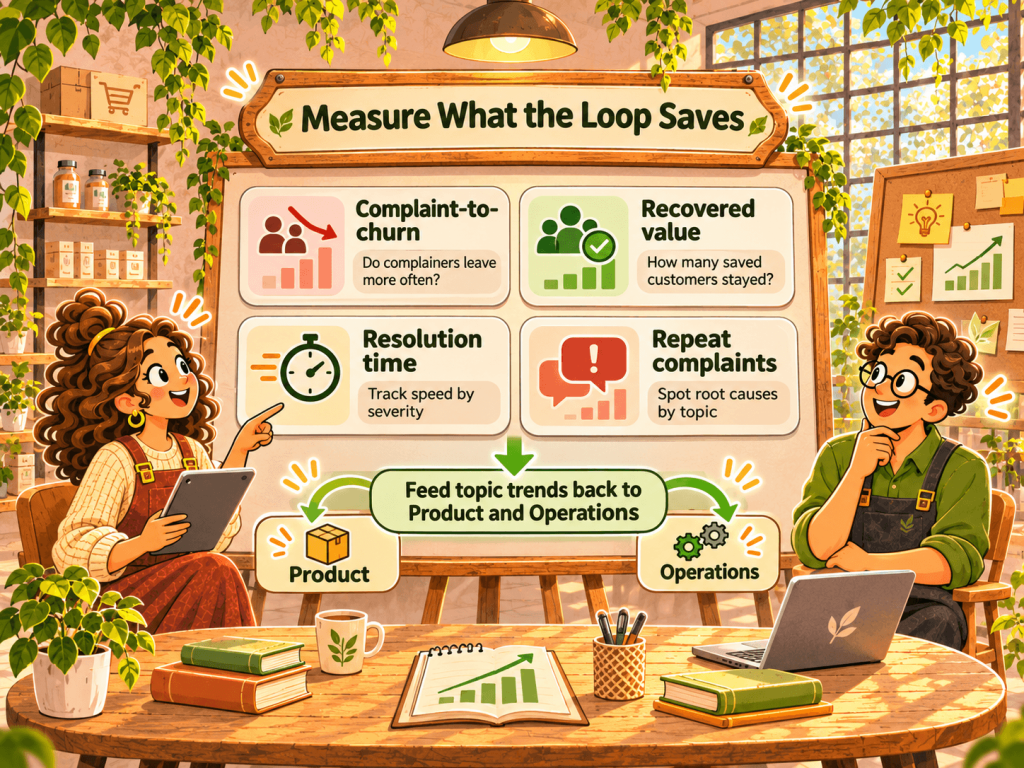
- Complaint-to-churn correlation. Track whether customers who complained, or scored low, churn at a higher rate over the following months, and by how much. This turns complaints from anecdotes into a leading indicator.
- Recovered-customer value. Of the customers you closed the loop with, count how many stayed and what they’re worth. That’s the revenue your process saved, and the number that justifies its existence in a budget meeting.
- Resolution time by severity. Because speed is the variable that moves loyalty, track it on its own rather than folding it into raw volume.
- Repeat-complaint rate by topic. If the same topic keeps resurfacing, you’re re-handling a symptom instead of fixing the cause.
Feed the topic tally back to product and operations, and the loop closes on itself: the best complaint management eventually produces fewer complaints.and operations, and the loop closes on itself: the best complaint management eventually produces fewer complaints.
How to Handle Customer Complaints in the Moment
The process above is the system. This is the conversation, the part your frontline lives in when a specific person is specifically unhappy. Four moves, in order.
Acknowledge fast, before you can fully fix it. A quick “we’ve got this and here’s who’s on it” buys patience that silence burns. Customers forgive problems far more readily than they forgive being ignored.
Own it without defending. Skip the explanation of why it happened until the customer knows you understand what happened to them. Empathy first, root cause second. A complaint is emotional before it’s technical, and a reply that leads with policy reads as a brush-off.
Resolve, then confirm the resolution landed. Fix the actual issue, then check that the customer agrees it’s fixed. “Should be sorted now” is not the same as “is this working for you?” The gap between those two sentences is where repeat complaints breed.
Follow up after the dust settles. A short check-in a week later does two things: it catches an incomplete fix, and it signals that the relationship mattered beyond the ticket. This is also the cleanest moment to ask whether to survey customers with open complaints, a judgment call worth getting right so you learn from the recovery without reopening a wound. For the everyday mechanics of these conversations, our customer service tips go deeper on tone and response speed.
Do these four consistently and complaint handling stops being damage control. It becomes one of the more reliable ways you build customer retention, because a well-recovered customer has seen, first-hand, that you show up when it counts.
Choosing a Complaint Management System: What Actually Matters
The software market here splits into two lineages, and neither was built for what a CX team needs. One grew out of GRC and quality management, engineered for audit trails and regulatory reporting. The other grew out of help-desk ticketing, good at handling complaints that arrive but blind to the ones that don’t. A comparison listicle will hand you ten logos and a pricing grid. The real test is simpler: does the tool support the loop, end to end?
Judge a complaint management system on five things.
- Intake breadth. Can it pull complaints from every channel and generate them proactively through surveys? A system that only ingests inbound tickets manages the visible fraction and misses the silent majority.
- Tagging and sentiment. Can it categorize by topic and severity, ideally with sentiment analysis, so triage scales past manual sorting?
- Routing and escalation. Can it assign an owner, set severity-based SLAs, and escalate automatically when something stalls? Ownership and deadlines are where most processes quietly fail.
- Close-the-loop workflows. Can it trigger the follow-up, create the task, and track whether the customer was actually contacted, not just whether a ticket was closed?
- Measurement. Does it connect complaints to retention outcomes, or does reporting stop at volume and resolution time?
This is the layer Retently is built for. It collects NPS, CSAT, and CES across the journey, so silent complaints get surfaced, instead of missed. Its AI-powered insights flag what’s breaking and why it matters, and automated actions route feedback, trigger follow-ups, and alert your team based on sentiment and urgency, with response workflows and task creation to close the loop. It’s honest to say Retently is strong on the intake and workflow side of complaint management and is not a regulatory GRC records system. If your requirement is bank examiner documentation, that’s a different category of tool. For catching complaints early and turning them into retention, it’s built for exactly that.
Conclusion
The companies that get complaint management right aren’t the ones with the thickest audit trail. They’re the ones that hear the complaint early, act on it fast, tell the customer what changed, and keep score on whether the customer stayed. Reframed that way, a complaint stops being a problem to file and becomes one of the clearest, cheapest retention signals you’ll get – an unhappy customer telling you exactly what to fix while there’s still time to fix it.
Start with intake. If most of your dissatisfaction is walking out silently, the highest-return move is to ask before it does.
Retently surfaces the complaints you’d otherwise miss and moves them through to resolution: NPS, CSAT, and CES across every touchpoint, AI that flags what’s breaking, and automated workflows that route, follow up, and close the loop. See where your customers actually stand. Start a free trial or book a demo to see it in action.
Frequently Asked Questions
What is complaint management? Complaint management is the process of catching, categorizing, resolving, and learning from customer complaints. For a customer experience team, it runs as a loop: collect complaints from every channel including proactive surveys, triage them by topic and severity, route them to an owner with a deadline, resolve and confirm with the customer, then measure the retention outcome.
What are the stages of the complaint handling process? A practical complaint handling process has five stages: intake (gather complaints from tickets, reviews, social, and surveys), triage (tag by topic and severity), routing and escalation (assign an owner and an SLA), resolution and close-the-loop (fix the issue and confirm with the customer), and measurement (track resolution speed, repeat rates, and complaint-to-churn). Compliance-heavy versions add formal logging and record retention.
What is a complaint management system? A complaint management system is software that centralizes and moves complaints through that process. The versions that matter for retention do five things: collect complaints across channels including surveys, tag by topic and sentiment, route with owners and escalation SLAs, run close-the-loop follow-ups, and tie complaints to retention metrics. Many tools cover only part of that, so match the system to the whole loop, not one step.
How do you measure complaint management success? Look past ticket volume. Track resolution time by severity (speed drives loyalty), repeat-complaint rate by topic (recurring topics mean unfixed root causes), recovered-customer value (revenue kept by closing the loop), and the correlation between complaints or low survey scores and later churn. Those four turn complaint handling from a cost center into a measurable retention driver.

 Christina Sol




 Greg Raileanu