



★☆☆☆☆ “Ordered almost two weeks ago. Package never showed, and three emails to support went unanswered. Save yourself the headache and buy somewhere else.”
Read that again, because a prospect is reading it right now. It sits on your Google listing, above the fold, in the exact moment someone is deciding whether to trust you. And here’s the part that stings: the person who wrote it almost certainly tried to reach you first. Nobody’s opening move is a one-star review. It’s the escalation after a private complaint went nowhere.
So a negative review is really two problems wearing one coat. There’s the public one you have to answer well, today, in front of an audience. And there’s the quieter one behind it: a customer got unhappy enough to go public, and your feedback process never caught them in time.
This guide handles both. You’ll get a response framework that works on any platform, sixteen copy-and-paste templates sorted by the kind of review, the platform rules that actually govern what you can and can’t do, and the move few write about: catching unhappy customers before they ever reach the review box.
Key Takeaways
- 89% of consumers expect a business to respond to reviews, and most expect it within a week, so silence reads as indifference.
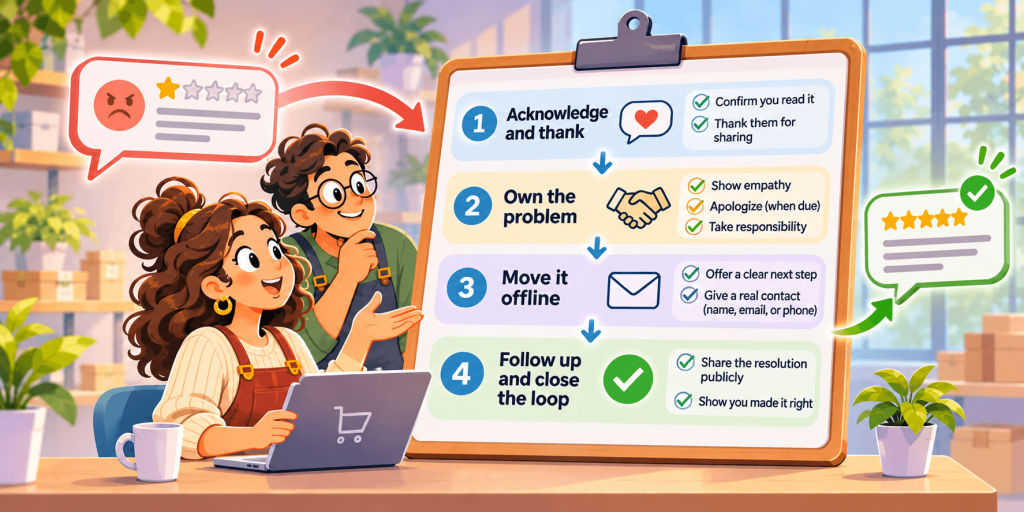
- A strong response follows four beats: acknowledge and thank, own the problem, move the details offline, then come back and close the public loop.
- Match the reply to the review type. A billing dispute, a shipping delay, and a suspected fake each need a different opening move.
- Half of consumers avoid businesses whose replies look templated, so personalize every send. Use the templates below as a skeleton, not a script.
- The cheapest negative review to handle is the one that never posts. Close your survey feedback loop early.
Why responding to negative reviews stopped being optional
Start with the audience math. In BrightLocal’s 2026 Local Consumer Review Survey, 97% of consumers said they read reviews for local businesses, and 89% said they expect the business to respond. Speed expectations climbed too: 19% now want a reply the same day they post, up from 6% a year earlier, and 81% expect one within a week.
A reply isn’t only for the person who complained. It’s for the dozens of quieter shoppers reading the thread later, deciding what kind of company you are by how you behaved when something went wrong. A calm, specific, human answer to a harsh review often does more for a wavering prospect than a wall of five-star praise, because it shows exactly what happens if their own order goes sideways. It also shows up in the numbers: a study of TripAdvisor hotels found that when hotels began responding to reviews, their ratings rose by an average of 0.12 stars and they received 12% more reviews.
There’s a catch, and it shapes everything below. In the same survey, 50% of consumers said they’re unlikely to choose a business whose review responses look generic or templated. So the goal isn’t to respond fast with a canned line. It’s to respond fast and still sound like a person. The templates in this guide get you to a solid draft in seconds; the ten seconds you spend personalizing them is what earns the trust.
The four-part framework behind every good response
Before the templates, the shape. Almost every effective reply to a negative review moves through the same four beats, in order. Learn the beats and you can write a response to anything, on any platform, without a script.
1. Acknowledge and thank
Open by naming that you read it and you’re glad they told you. Not because the feedback feels good, but because a public complaint is a chance to fix something and be seen fixing it. Lead with a genuine thank-you, never a defensive throat-clear. Our roundup of thank-you-for-your-feedback responses has phrasings you can borrow.
2. Own the problem
Empathize with the specific frustration, apologize where an apology is due, and take responsibility for the part that’s yours. This is where most bad replies fall apart: they argue. You don’t have to accept a version of events you know is wrong, but you do have to acknowledge the person’s experience was bad. Those are two different things.
3. Move it offline
Give a real path to a resolution and a real human to reach. A name, a direct email, a phone line. Public threads are terrible places to trade order numbers and refund details, and every extra reply in public keeps the complaint pinned to the top. The point of the public reply is to earn the offline conversation, not to win the argument in front of an audience.
4. Follow up and close the loop
Once it’s sorted privately, come back to the public thread with a short, factual update: “We shipped a replacement and refunded the delay, thanks for giving us the chance to make it right.” This is the step almost everyone skips, and it’s the most valuable one, because it’s the line every future reader sees. A resolved complaint handled in the open can build more trust than no complaint at all. That’s the service recovery paradox doing its work.
Keep it short. Two to four sentences is plenty. You’re not writing an essay, you’re showing character.
Response templates by scenario
Use these as a starting draft. Swap in the reviewer’s name, the specific detail they mentioned, and the actual fix you’re offering. Strip anything that reads like boilerplate. A response that names their exact issue in their words beats a polished template every time.
1. A defective or poor-quality product
Hi [Name], thank you for flagging this, and I’m sorry the [product] arrived in this condition. That’s below the standard we hold ourselves to, and I’d like to put it right with a replacement or a full refund – your call. I’ve followed up by email so we can sort it quickly.
[Your name], [Company]
2. A service or support failure
Hi [Name], you’re right to be frustrated. Waiting [three days] for a reply isn’t the experience we want anyone to have, and I’m sorry we left you hanging. I’ve looked into what happened on our side. Could you email me at [email] so I can pick this up personally and get you an answer today?
[Your name]
3. A late, missing, or damaged delivery
Own the lack of updates, even when the delay was the carrier’s, and commit to a specific next step with a time.
Hi [Name], a two-week wait with no update is genuinely bad, and I understand why you’re done. Shipping is partly out of our hands once a parcel leaves us, but keeping you informed is entirely on us, and we dropped that. I’m tracking your order now and will email you within the hour with a replacement or a refund.
[Your name]
4. A billing or overcharge dispute
Hi [Name], thank you for raising this, and I’m sorry for the worry an unexpected charge causes. I’d rather get to the bottom of it with you than guess in public. Please email me at [email] with the date of the charge and I’ll trace it today, then refund anything that shouldn’t be there.
[Your name]
A note on this one: never confirm or dispute account, billing, or card specifics in a public thread. Acknowledge the concern, then take the details offline immediately.
5. The lukewarm 3-star or mixed review
A three-star review is a fork. The person liked enough to come back, but something held them at arm’s length. Reinforce the good, then dig for the gap.
Hi [Name], thanks for the honest middle-ground review. I’m glad [the thing they liked] worked for you, and I don’t want to leave the other half unfixed. What would have made this a five-star experience? If you’ll email me at [email], I’d like the specifics; they genuinely shape what we change next.
[Your name]
6. The angry, all-caps rant
Match heat with calm. Don’t quote their tone back at them, and don’t get defensive. A composed reply to a furious review is the most persuasive thing a future reader can see.
Hi [Name], I hear you, and I’m sorry. This clearly went badly, and your frustration is fair. I don’t want to hash out the details in public, but I do want to fix it. My name is [Name], I’m on this personally: [email] or [phone]. Reach me directly and I’ll make it right.
[Your name]
7. A review that gets the facts wrong (but a real customer)
Correct the record once, gently, without calling anyone a liar. State your version, offer proof privately, keep the door open.
Hi [Name], thank you for the feedback, though our records show this a little differently: [the one factual correction, stated plainly]. I could be missing something, so I’d rather compare notes than argue. Email me at [email] and I’ll pull up the details with you. Either way, I want you to walk away satisfied.
[Your name]
8. A suspected fake review or one from a non-customer
Respond anyway, for the audience, while you flag it through the platform (more on that below). Stay factual and unrattled.
Hi [Name], we take every review seriously, but we can’t find an order or account matching this, and we’d like to help. If you’re a customer, please email [email] with your order details and we’ll look into it right away. If this was posted about the wrong business, we’d appreciate you letting us know.
[Your name]
9. B2B or SaaS: a missing feature or a churn threat (G2, Capterra)
On software review sites the reader is an evaluator, often mid-purchase. Stay professional, admit the gap honestly, and route to a person rather than a marketing line.
Hi [Name], thanks for the candid review, and sorry [the workflow] fell short for your team. You’re right that [feature] isn’t there yet. It’s on our roadmap, though I won’t pretend a date I don’t have. I’d value 15 minutes to better understand your use case. Please email our team lead at [email].
[Your name]
10. An app-store review about a bug, crash, or outage
Name the version, confirm the fix status, and invite them back once it ships (on platforms that notify the reviewer, an update to their rating follows).
Hi [Name], sorry about the crash on [version], that one’s on us. The team has reproduced it and a fix is in the next release. Email [email] and I’ll let you know the moment it’s live so you can get back to a working app. Thanks for your patience.
[Your name]
11. The “resolved offline” public follow-up
Come back once it’s fixed. This is the line future readers trust most.
Update: we connected with [Name] over email, shipped a replacement, and refunded the delay. Thanks for giving us the chance to make it right.
[Your name]
12. The win-back or second-chance offer
When someone left over a real miss and you’ve since fixed it, a small, specific gesture can flip a Detractor. Offer it privately, not as a public bribe.
Hi [Name], now that we’ve sorted the [issue], I’d like to earn a second look. I’ve added [specific gesture] to your account, no strings. If we fall short again, I want to hear it from you first.
[Your name]
Note: Where a template says you’ve already emailed the customer or looked up the order (for example, in templates 1, 2 and 3), only say so if you’ve matched the review to a customer. If you can’t, replace that line with an invitation to email you with their order number.
Platform nuances: the rules change by where the review lives
Same framework, different fine print. Each platform has its own mechanics and its own policies, and getting them wrong can cost you the very rating you’re trying to protect. These four short openers are tuned to each platform’s reality.
Google is where most people read reviews, so this is usually the priority. Respond from your Business Profile under “Read reviews,” keep it concise, use the reviewer’s first name once, and take specifics offline. You can respond to any review, but you can only get one removed if it violates Google’s content policies. Google is explicit that you should not report a review “just because you disagree with it,” and that it “doesn’t get involved in conflict between businesses and customers.” (More on flagging below.)
Hi [Name], I’m sorry about [the issue], that’s not the visit we want anyone to have. I’d like to fix it: please reach me at [email].
[Your name], [Company]
Yelp
Yelp is the exception that trips people up. You can and should respond publicly, and you can send a private “Thank You” message. But Yelp actively prohibits asking customers for reviews, and its software down-ranks reviews it thinks were solicited, so the growth play that works on Google can hurt you here. On Yelp, respond well and let reviews arrive on their own. See Yelp’s own “Don’t Ask for Reviews” guidance, and note that the reply below never invites a re-review.
Hi [Name], I’m sorry [the visit] missed the mark. I’d genuinely like to make it right. Please reach me at [email] or [phone], and I’ll take care of it personally.
[Your name]
App stores (Apple App Store, Google Play)
In App Store Connect, users with an Admin or Customer Support role can respond to any review. Apple notifies the reviewer, who can then update their rating, which is why an app-store reply that names the fix version is worth so much. Responses can take up to 24 hours to appear. Prioritize the lowest ratings and anything mentioning a bug in the current build.
Hi [Name], this is fixed in [version 4.2], just released. Update when you have a moment and the crash should be gone for good. Thanks for flagging it, and sorry for the hassle.
[Your name]
G2, Capterra, and B2B review sites
On G2, sellers are invited to respond publicly, and it’s expected of a serious vendor. What you can’t do is get a review edited or removed on request. G2 states plainly that it does “not edit or remove reviews at a seller’s request or act as fact-finders.” If a review breaks the guidelines, anyone can flag it using the “Report a Concern” button, but a review you simply dislike is there to stay. The winning move on B2B sites is a measured public reply plus an offline conversation with a real CSM.
Thanks for the detailed review, [Name]. [The feature gap] is real and on our radar. I’d like to get you time with [CSM name] to see whether there’s a workaround today. Reach us at [email].
[Your name]
What NOT to write
The fastest way to make a negative review worse is a bad reply. Avoid these:
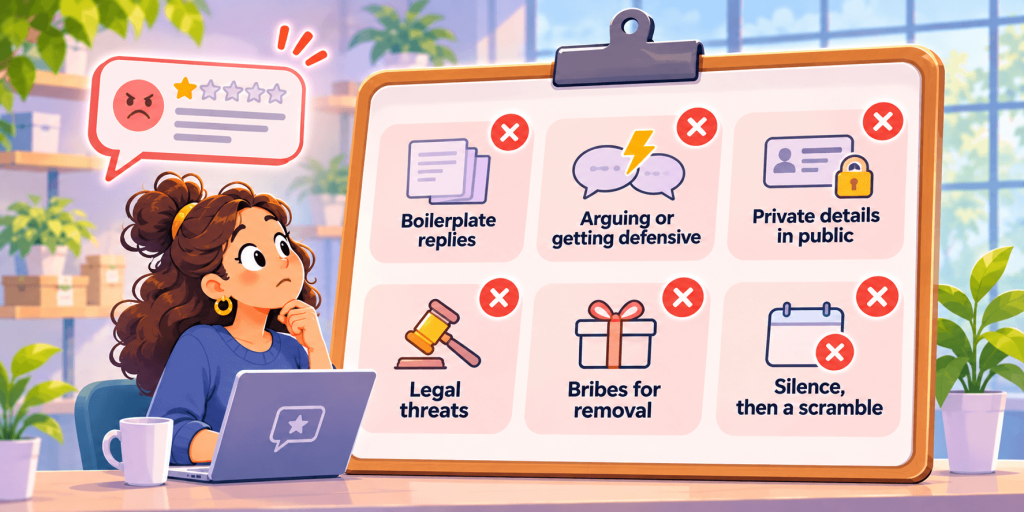
- Boilerplate. Half of consumers steer clear of businesses whose responses look copy-pasted. Personalize every one.
- Arguing or getting defensive. You will not win a public debate with an angry customer, and future readers side with the calm party every time.
- Private details in public. Order histories, account data, anything about their payment. Move it offline, and never confirm card or billing specifics in a public thread.
- Legal threats. Threatening to sue a reviewer is how a small complaint becomes a news story.
- Bribes for removal. Offering money or freebies to take a review down violates most platform policies and reads as a cover-up if it ever surfaces.
- Silence, then a scramble. Don’t ignore reviews for weeks and then respond only when one goes viral. Consistency is the signal.
When a review is fake or breaks the rules: your real options
Sometimes a review isn’t honest feedback. It’s spam, a competitor, a case of mistaken identity, or extortion. Here’s what you can actually do, and what you can’t.
You can flag it, but the platform decides. On Google, report the review from your Business Profile or the Reviews Management Tool and choose the violation reason. Only reviews that break Google’s policies are eligible for removal, and evaluation takes several days. On G2, use “Report a Concern” and keep the dispute focused on the single guideline you believe was broken. In both cases, disagreement is not grounds. A review has to actually violate a rule (spam, profanity, a conflict of interest, no genuine experience) to come down.
While you wait, respond publicly anyway, using template #8 above. A composed, factual reply noting that you can’t find a matching order does two jobs: it reassures readers, and it documents your side if the platform reviews the case.
If someone threatens to post negative reviews unless you pay, that’s extortion, and platforms treat it separately from ordinary disputes. Don’t negotiate. Document the threat and report it through the platform’s dedicated channel.
Catch the Detractor before the review goes public
Everything above is defense. The teams who rarely fight fires in public are the ones who moved the fight upstream.
Go back to that opening review. By the time it posted, the customer had already had the bad experience, already tried to reach you, and already given up. A public one-star review is almost always a Detractor you didn’t catch in time. The work that pays off most happens weeks earlier, in private.
That’s what a survey feedback loop is for. When you run CX surveys across the customer journey, unhappy customers raise their hand privately, on a 0-to-6 score with a comment, before they ever think to broadcast it. That’s your window. Closing the feedback loop fast – reaching out, apologizing, fixing the thing – is the difference between a private Detractor you win back and a public review you’re managing in front of prospects. For how private surveys and public reviews play different roles, see our breakdown of product reviews vs NPS surveys.
The second half is volume, and that is where offense pays off. If one angry customer posts and you have nine recent reviews, that one-star wrecks your average. If you have ninety, it barely registers. BrightLocal found 94% of consumers are open to writing a review, and 83% of the people who were asked went on to leave one. Your Promoters, the 9s and 10s from your surveys, are sitting on exactly these reviews. You just have to ask, on the right platform, at the right moment. Our guide on turning Promoters into a steady stream of reviews walks through the mechanics, yet remember the Yelp exception.
Do both, catch Detractors early and keep asking Promoters, and the review pile slowly stops being a threat and starts being social proof that sells for you. The reviews you respond to become the rare exception, not the daily grind, which frees your team to give each real complaint the personal, unhurried response that actually changes minds.
Conclusion
A negative review feels like a verdict. It’s closer to a conversation you’re having in public, and the people watching care less about the complaint itself than about how you carry yourself in response. Answer fast, sound like a person, own what’s yours, and take the details offline. Then come back and close the loop where everyone can see it.
But the reviews you respond to are only the ones that got away. The real win is quieter: catch unhappy customers in a private survey before they ever reach the review box. Defense keeps you standing. Offense is what makes reviews work for you instead of against you.
Retently helps you close that loop, running CX surveys that flag Detractors early and turn your Promoters into reviews. Start a free trial to see where your customers actually stand, or book a demo to walk through it with our team.
Frequently Asked Questions
Should you respond to every negative review?
Respond to every negative review on the platforms that matter to your business, and to as many others as your volume allows. Negative and mid-range reviews are the priority, because that’s where a reply changes a reader’s mind. If you can’t cover everything, work from the lowest ratings up, and focus on the sites your prospects actually read before buying.
How fast should you respond to a negative review?
Faster than you’d think. In BrightLocal’s 2026 survey, 19% of consumers expected a same-day reply and 81% expected one within a week. A same-day or next-day response is the safe target for public reviews. Speed signals that you’re paying attention, while a reply that lands three weeks later reads as damage control rather than care.
Can you get a negative review removed?
Only if it violates the platform’s content policies. Google removes reviews for things like spam, profanity, or conflicts of interest, not because a business dislikes them, and it says so plainly. G2 won’t edit or remove a review at a seller’s request at all. You can flag a rule-breaking review and let the platform decide, but a genuine, negative, on-topic review is there to stay. Your real influence is the response, not removal.
Should you offer a refund or discount in your reply?
Not in the public reply. Acknowledge the issue publicly, then move the specifics, including any refund or goodwill gesture, to a private channel. Offering compensation in the open invites gaming and can read as buying silence. Handle the money offline, then post a short factual update once it’s resolved.

 Christina Sol




 Greg Raileanu