



A new customer can log in every day for two weeks and still be failing at onboarding. Logins tell you they showed up, not whether setup felt effortless or whether they’re quietly wrestling your product and losing. That gap, between the activity you can see and the experience you can’t, is what an onboarding survey closes.
Done well, it isn’t one generic “how’s it going” blast. It’s a short question fired at each onboarding milestone, each measuring the single thing that milestone was built to reveal, from the effort of getting set up to whether the customer would recommend you later.
One clarification first, because the search results are a mess. This is about surveying your customers as they get started, not your new employees in their first week. New-hire onboarding surveys are an HR topic, closer to employee Net Promoter Score (eNPS) than anything here.
Key Takeaways
- A customer onboarding survey measures a new customer’s early experience, not a new hire’s first week. It’s aimed at the onboarding stage of the lifecycle, where more churn is decided than anywhere else.
- Effort is the onboarding metric that matters most. A customer can be satisfied and still worn down by a hard setup, which is why CES fires right after the first key setup task.
- The milestones hold for SaaS and ecommerce alike. Only the definition of “first value” changes: a first report or integration versus a first order that arrives and works.
- Scores earn their keep only if two loops run: reach out to the stuck customer (inner loop), and route recurring friction to whoever owns the step (outer loop).
What is a customer onboarding survey?
A customer onboarding survey is a short, timed survey you send during the onboarding stage, when a new customer sets up your product and reaches first value. Its job is narrow: measure how that early experience is landing, at the moments that decide whether the customer sticks.
That scope is worth pinning down. This isn’t the new-hire questionnaire HR runs on someone’s first week, and it isn’t the intake form an agency sends to collect a new client’s assets. It’s experience measurement, aimed at the onboarding stage of the customer lifecycle.
Onboarding has a clean start and a clean end. It begins when someone becomes a customer and ends when they hit first value. Everything in between is what you’re measuring.
Why the onboarding survey is where the effort metric earns its keep
Onboarding decides more churn than any other stage, for a blunt reason: a customer who never reaches first value has no reason to renew. Everything you do later to keep them is recovering ground you lost in the first week.
Here’s the part most onboarding surveys get wrong. They ask whether the customer is satisfied, and satisfaction is the wrong lens this early. Someone can like your product, hand you a friendly 4 out of 5, and still be quietly ground down by a setup that took three support tickets. What you want to know during onboarding is how hard it was. That’s Customer Effort Score, and it catches what a satisfaction question misses. Low effort is what good onboarding feels like from the inside.
One metric per onboarding milestone (the map)
Most question banks hand you fifty onboarding questions and leave you to guess when to ask them. The more useful move maps one metric to each milestone, so every survey reads the one thing that milestone was built to reveal.
Four milestones, four jobs:
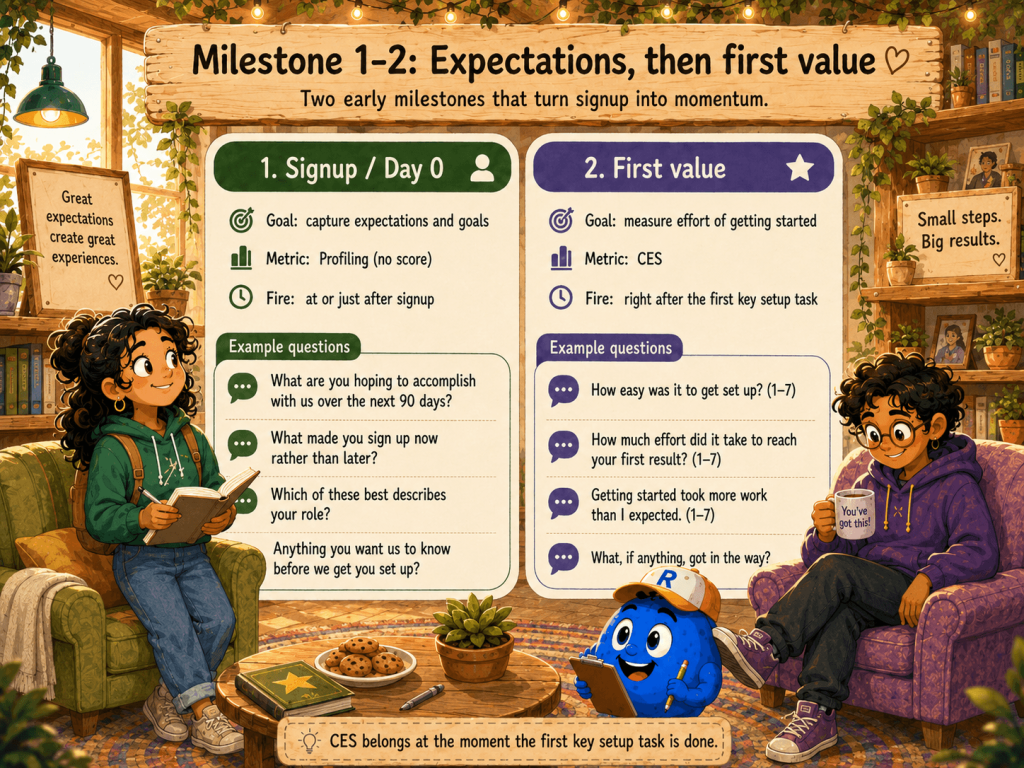
| Milestone | Metric | What it tests | When it fires |
|---|---|---|---|
| Signup / Day 0 | Profiling (no score) | Expectations, goals, jobs to be done | At or just after signup |
| First value | CES | Effort of getting started | Right after the first key setup task |
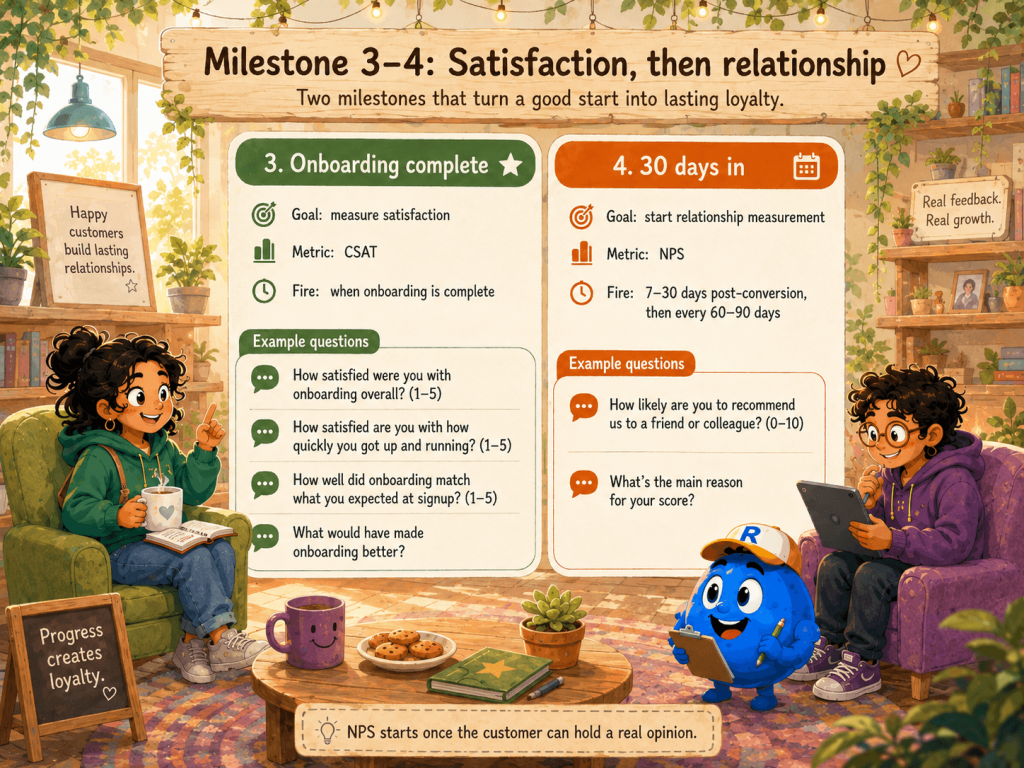
| Onboarding complete | CSAT | Satisfaction with the onboarding experience | At the completion of onboarding |
| 30 days in | Relationship NPS (begins) | Overall loyalty; hands off to retention | 7-30 days post-conversion, then every 60-90 days |
Read down the metric column and the logic falls out. CES reads effort on a task, so it fires the moment a task is done. CSAT reads satisfaction with a moment, so it waits for onboarding to finish. NPS reads the whole relationship on a slow clock, so it doesn’t belong at day one: it starts once the customer can hold a real opinion. It’s the same metric stack (NPS, CSAT, CES) we run across the platform, pointed at the first thirty days.
The onboarding question bank, by milestone
Here’s the bank, milestone by milestone. Keep three to five core questions plus one open follow-up per milestone, and never fire more than one set at a time.
Milestone 1 – Signup / Day 0: expectations and goals
This first survey sets a baseline, not a score: you’re capturing what the customer came to do, so you can tell later whether they got there. Fire it at or just after signup, while intent is fresh. It pairs naturally with the broader first-impression questions worth asking in an early session.
Core questions:
- What are you hoping to accomplish with us over the next 90 days? (open)
- What made you sign up now rather than later? (multiple choice)
- Which of these best describes your role? (multiple choice)
- What were you using to solve this before, if anything? (multiple choice / open)
- How familiar are you with tools like this? (multiple choice: first time / used one before / I run these daily)
Open follow-up:
- Anything you want us to know before we get you set up? (open)
Milestone 2 – First value: measure effort with CES
Fire this the moment the customer finishes the first key setup task, the step between them and a result: connecting data, inviting the team, running the first configuration. This is the CES moment, and effort is the point.
Core questions:
- How easy was it to get set up? (1-7)
- How much effort did it take to reach your first result? (1-7)
- Getting started took more work than I expected. (1-7, agree to disagree)
Open follow-up:
- What, if anything, got in the way? (open)
Milestone 3 – Onboarding complete: measure satisfaction with CSAT
When the customer crosses the finish line, first value delivered, switch metrics. Now satisfaction is the right question, because there’s a complete experience to rate, not just a task.
Core questions:
- How satisfied were you with onboarding overall? (1-5)
- How satisfied are you with how quickly you got up and running? (1-5)
- How well did onboarding match what you expected at signup? (1-5)
Open follow-up:
- What would have made onboarding better? (open)
Milestone 4 – 30 days in: hand off to relationship NPS
Onboarding is over; the relationship is starting. NPS takes over here, handing the customer off to retention. Our own guidance is to start relationship NPS 7 to 30 days after a customer converts, once they’ve lived with the product enough to mean their answer, then run it every 60 to 90 days.
Core question:
- How likely are you to recommend us to a friend or colleague? (0-10)
Open follow-up:
- What’s the main reason for your score? (open)
To get this survey into the emails you already send, we’ve covered lifecycle survey emails separately.
SaaS vs ecommerce onboarding (same milestones, different moments)
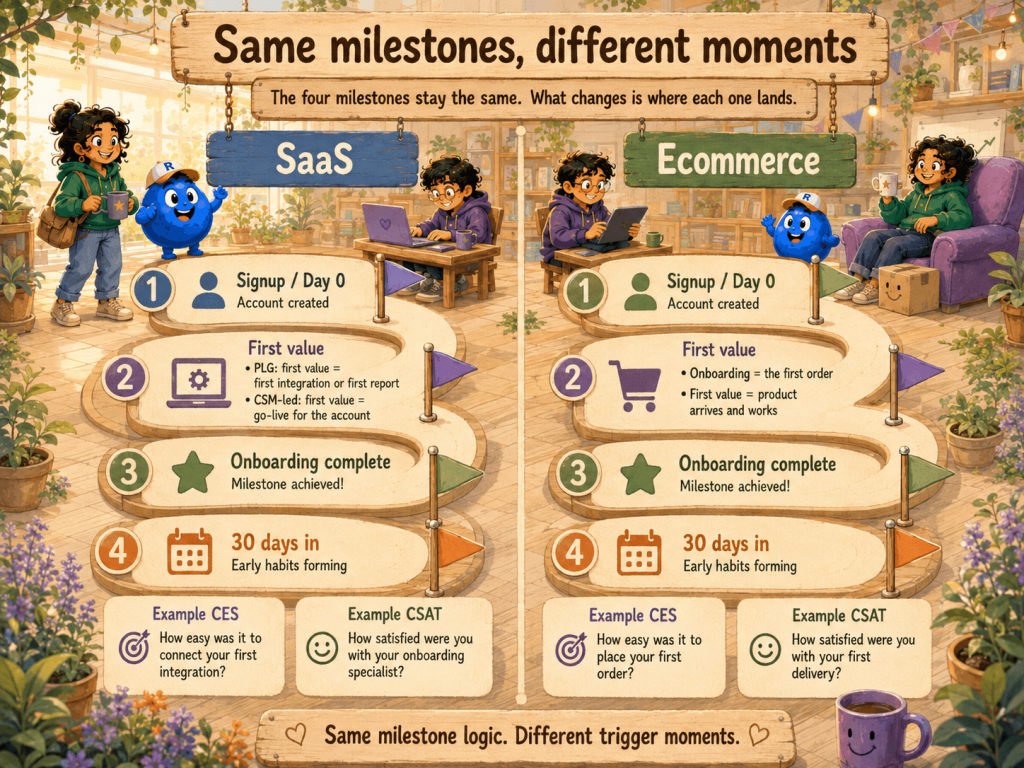
The milestones hold across business models. What changes is where each one lands.
In SaaS, onboarding comes in two flavors. Product-led (PLG) onboarding is the user setting themselves up in-app, where first value is the first integration or report. B2B onboarding is often CSM-led, a guided rollout where first value is go-live for the whole account. A couple of variants:
- PLG: “How easy was it to connect your first integration?” (CES, 1-7)
- CSM-led: “How satisfied were you with your onboarding specialist?” (CSAT, 1-5)
How surveys sequence across a whole product experience is covered in our guide to SaaS journey surveys.
In ecommerce, onboarding is the new customer’s first order. First value is simpler and physical: the product arrives and works. The variants shift with it:
- “How easy was it to place your first order?” (CES, 1-7)
- “How satisfied were you with your first delivery?” (CSAT, 1-5)
Same four milestones, same four metrics. Only the moment each one fires moves.
How to write and format onboarding questions
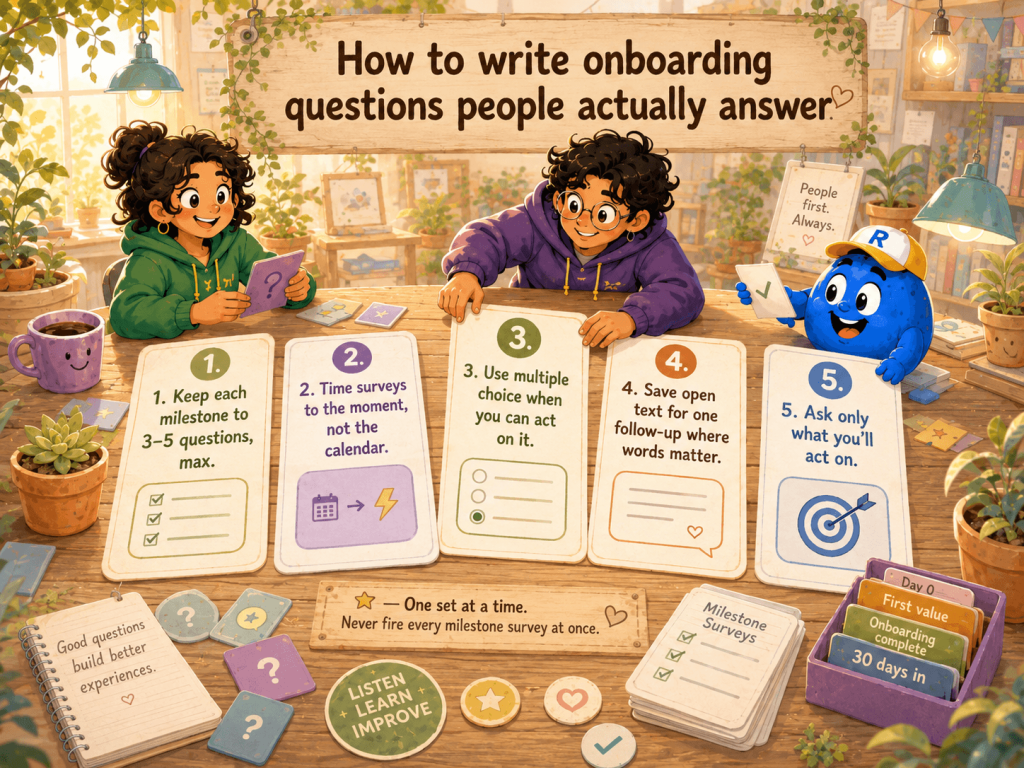
A handful of rules keep these surveys answerable:
- Three to five questions per milestone, tops. Response rates fall off a cliff once a survey feels like homework.
- Time to the moment, not the calendar. Fire CES when the setup task finishes, not on a fixed “day 7,” or you’ll ask people who haven’t started yet.
- Prefer multiple choice where you can act on the answer, and save open text for the one follow-up per milestone where the words matter.
- Ask only what you’ll act on. Every question you won’t route anywhere spends a customer’s patience for nothing.
Which format fits which question is its own craft. The survey question types catalog covers the options, and there’s a full guide to how to write good questions worth a read before you lock wording.
Close the loop: what to do with the answers
A survey nobody acts on trains customers to stop answering. Onboarding scores are worth collecting only if two loops run behind them.
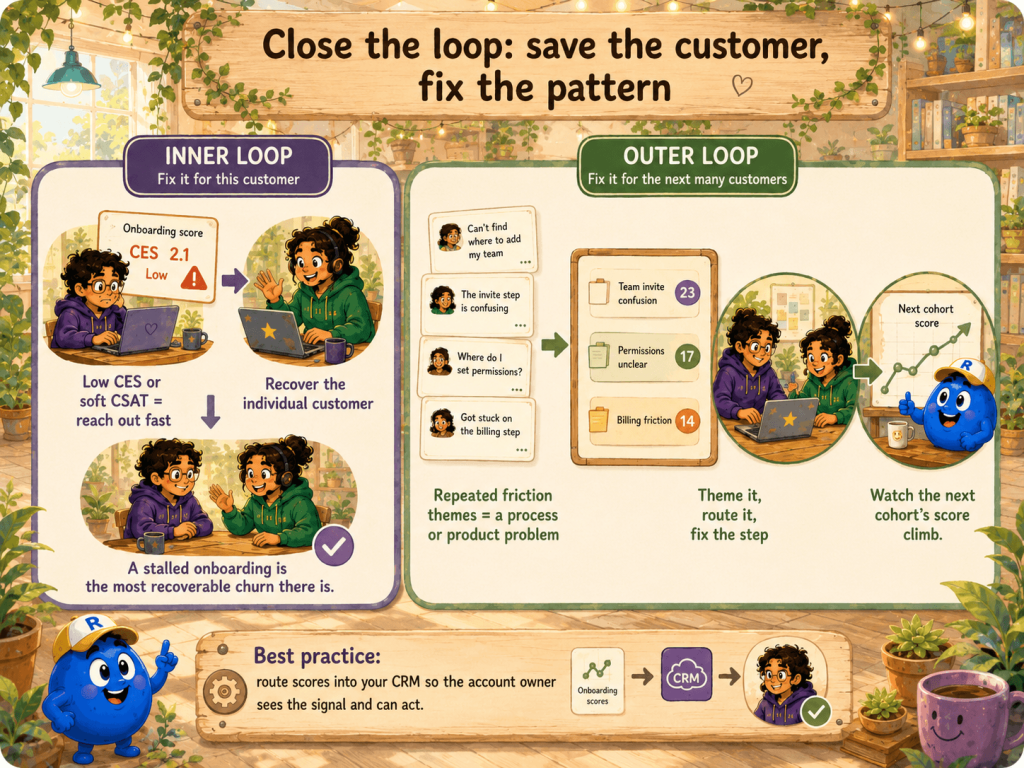
The inner loop recovers the individual. A low CES on the setup task, or a soft CSAT at completion, is a signal to reach out to that specific customer while they’re still new enough to save. A stalled onboarding is the most recoverable churn there is, caught in week one instead of at renewal.
The outer loop fixes the pattern. When the same friction theme shows up across a dozen open-text answers, that’s a product or process problem, not a customer one. Theme it, route it to whoever owns that step, and treat those product feedback questions as the handoff into the roadmap. Fix the step, and watch the next cohort’s CES climb.
Both loops depend on the score reaching a person, not a dashboard. Wiring onboarding scores into your CRM, so the account owner sees a new customer’s effort score next to their record in Salesforce or HubSpot, turns a survey into a save. That’s the part Retently automates: fire the right metric at the right milestone, route low scores into a followed-up conversation, and push the signal into the CRM you already run.
Free customer onboarding survey template
Here’s the full sequence in one place, ready to copy. Fire each block at its own milestone, not all at once.
MILESTONE 1 – Signup / Day 0 (profiling, no score)
- What are you hoping to accomplish with us over the next 90 days? (open)
- What made you sign up now rather than later? (multiple choice)
- Which of these best describes your role? (multiple choice)
- How familiar are you with tools like this? (multiple choice)
- Anything you want us to know before we get you set up? (open)
MILESTONE 2 – First value / CES (fire right after the first key setup task)
- How easy was it to get set up? (1-7)
- How much effort did it take to reach your first result? (1-7)
- What, if anything, got in the way? (open)
MILESTONE 3 – Onboarding complete / CSAT (fire at completion)
- How satisfied were you with onboarding overall? (1-5)
- How well did onboarding match what you expected at signup? (1-5)
- What would have made onboarding better? (open)
MILESTONE 4 – 30 days in / Relationship NPS (start 7-30 days post-conversion, repeat every 60-90 days)
- How likely are you to recommend us to a friend or colleague? (0-10)
- What’s the main reason for your score? (open)
Measure onboarding while you can still change the outcome
Onboarding decides the most churn and gives you the least time to react. Measuring it well isn’t about asking more, it’s about asking one right question at each milestone and acting on the answer before the customer goes quiet.
That’s the layer Retently is built for: fire the right survey (CES, CSAT, NPS) at the right onboarding milestone, route low scores into followed-up conversations, and wire the whole thing into the CRM you already run. Start a free trial to see where your new customers actually stand, or book a demo to walk through it with us.
Frequently Asked Questions
What is a customer onboarding survey? A short, timed survey sent while a new customer is setting up your product and reaching first value. It measures how the early experience is landing at specific milestones, so you can catch a stalled customer before a rough onboarding turns into quiet churn.
What are good customer onboarding survey questions? The good ones are tied to a milestone and a metric: an effort question at first value (“How easy was it to get set up?”, 1-7), a satisfaction question at completion (“How satisfied were you with onboarding?”, 1-5), and the relationship question around 30 days (“How likely are you to recommend us?”, 0-10). One open follow-up per milestone catches the why.
When should you send a customer onboarding survey? At the moment, not on a fixed calendar day. Fire CES right after the customer finishes the first key setup task, CSAT when onboarding is complete, and start relationship NPS 7 to 30 days after they convert. Timing to the milestone beats timing to the clock.
Should you use CES, CSAT, or NPS for onboarding? All three, one per milestone, rather than one metric for everything. CES measures effort right after the first setup task, CSAT measures satisfaction at completion, and relationship NPS starts around 30 days in. Each reads something the others miss.
How many questions should an onboarding survey have? Three to five core questions per milestone, plus a single open follow-up. Past five, completion rates drop and people rush their answers. Since you’re surveying at four milestones, keeping each one short is what makes the whole sequence answerable.

 Christina Sol




 Greg Raileanu