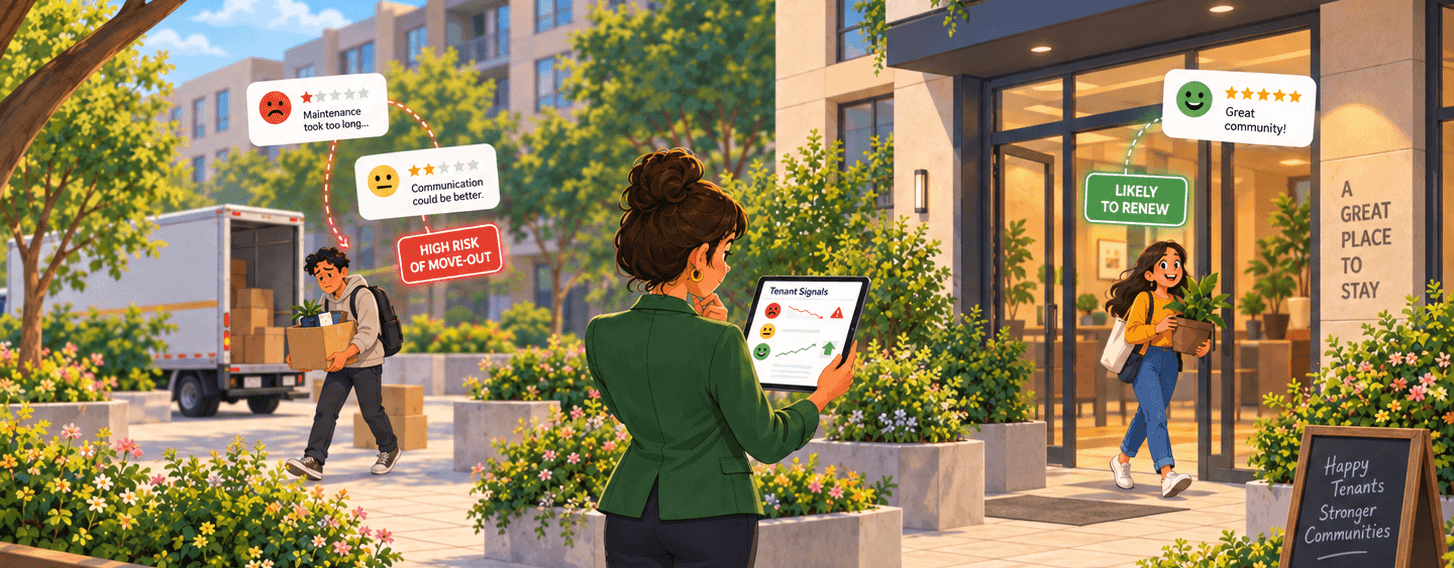



The resident in unit 204 decided not to renew in February. You found out in June.
In between, nothing dramatic happened. She submitted a maintenance request that took two visits, rated the experience poorly in a survey nobody read, stopped answering the quarterly pulse, and started browsing listings on her lunch break. The move-out notice, when it finally arrived, looked sudden. It was anything but.
This is the thing about tenant retention: the renewal decision is made mid-lease, quietly, and the renewal offer arrives months too late to change it. Industry numbers say the stakes plainly. In 2026, communities renewed just 57% of residents against a 63% target, per Zego’s resident experience report, and every turn costs roughly $3,872 in make-ready, marketing, and vacancy loss. The same report found 23% of residents undecided about renewing, which is another way of saying: a quarter of your rent roll is persuadable, if you find them in time.
Surveys are how you find them in time. Here’s how to read the signals, build the risk flags, and turn tenant retention from a renewal-season scramble into a year-round system with a list of names instead of hope.
Key Takeaways
- Residents decide whether to renew months before the renewal window. By offering time, you’re confirming a decision, not influencing one.
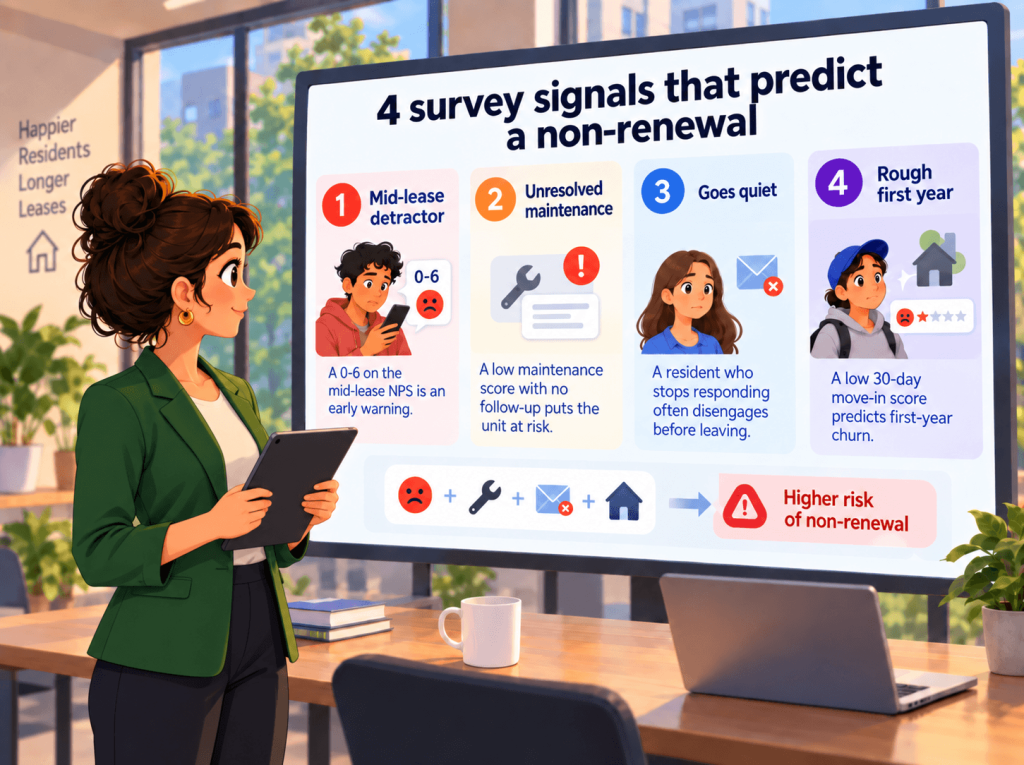
- Four survey signals predict non-renewal: a mid-lease Detractor score, a bad maintenance experience left unresolved, a resident who stops responding, and a low first-year move-in rating.
- Turn the signals into a simple renewal-risk flag per unit, reviewed monthly, with an owner for every flagged name. A flag nobody acts on is a spreadsheet, not a system.
- Survey the renewal process itself with CES: industry-wide, renewal is one of the lowest-rated resident touchpoints, and friction in the process loses people who wanted to stay.
- The math is forgiving: at roughly $3,872 per turn, saving even two move-outs per hundred doors a year pays for the entire feedback program several times over.
The Renewal Decision Happens Mid-Lease
Ask residents when they decided to leave, and the stories cluster in the middle of the lease, not the end. The maintenance saga in month five. The rent conversation that felt like a form letter. The sense, accumulated across small moments, that staying is a default rather than a choice anyone earned.
Retently’s property management CX study puts numbers on where those moments go wrong. Residents across the dataset rate lease renewal at 3.0 out of 5, the lowest-scoring touchpoint measured, with move-in close behind at 3.69. Translation: the industry’s weakest resident experiences sit exactly at the two moments that bracket the stay decision.
The operational consequence: renewal is not a season. It’s a year-round condition you’re either monitoring or ignoring. Firms that treat it as a 60-day sprint before lease expiry are marketing to people who mentally moved out in winter.
The Four Signals That Predict a Non-Renewal
If you’re running resident surveys across the lifecycle (the setup is in our tenant satisfaction survey guide), the predictive signals are already in your data. You just have to treat them as predictions.
1. The mid-lease Detractor
A resident who answers the relationship NPS pulse with a 0-6 in month six is telling you their renewal answer early. That’s a gift. Detractor scores with comments are the highest-value alarms you’ll get, because they name the fixable thing. The response window matters: reached within days, a mid-lease Detractor is a save candidate. Discovered in a quarterly report, they’re a statistic.
2. The unresolved maintenance experience
A single bad repair doesn’t end a tenancy. A bad repair that nobody followed up on often does, because it teaches the resident what reporting problems gets them. Watch for low scores on the maintenance satisfaction survey where the recovery loop didn’t close: no callback, no reopened ticket, no acknowledgment. Those units automatically belong on the risk list.
The loop needs to close during the repair, not just after it: 89% of residents rate mid-repair status updates as crucial to how they judge the experience, yet a third of properties only communicate weekly or at completion. A missing 48-hour update is itself a signal worth logging.
3. The resident who goes quiet
Response behavior is data. A resident who answered the first two pulses and then stopped is disengaging, and disengagement precedes departure. Most survey tools throw this signal away because they only report on responses. Track non-response per resident, and flag pattern breaks.
4. The rough first year
First-year residents churn hardest, and a low move-in score is the earliest warning you’ll ever get, arriving eleven months before the decision it predicts. A sub-par 30-day move-in rating should trigger a specific intervention (a call, a fix, a follow-up) rather than a note in a file, because you have most of a lease term to repair the first impression.
Worth checking before you build the flag: does your retention budget match what these signals are actually telling you? The same 2026 Zego data found a real disconnect – operators rank “tech-enabled lifestyle” amenities as their top retention investment, while residents rank maintenance, security, and property upkeep as what actually keeps them, and don’t mention tech amenities at all. If your reds keep clustering on signal #2, a package-locker upgrade won’t move them. The budget needs to follow the signal, not the assumption.
None of these signals is exotic. The failure mode is that they live in four different reports that nobody owns, which brings us to the flag.
Building a Renewal-Risk Flag That People Actually Use
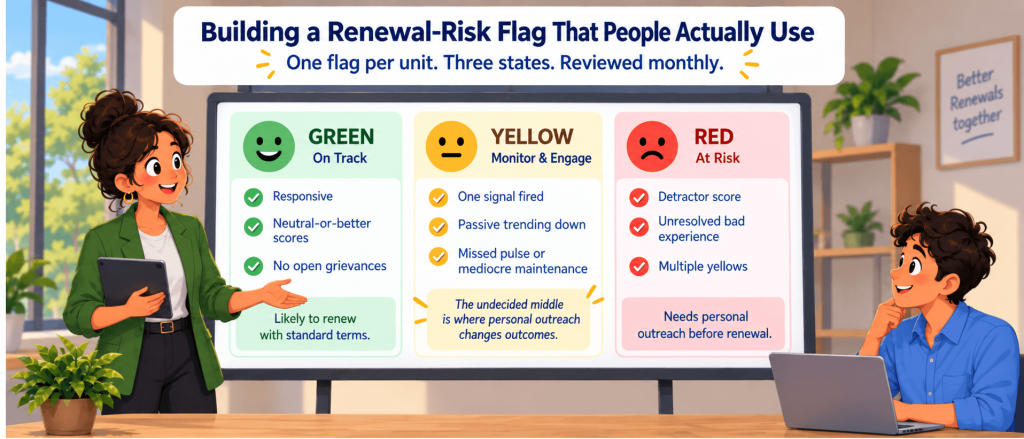
The system that works is almost embarrassingly simple: one flag per unit, three states, reviewed monthly.
Green: responsive, neutral-or-better scores, no open grievances. Yellow: one signal fired (a passive trending down, a mediocre maintenance score, a first missed pulse). Red: a Detractor score, an unresolved bad experience, or multiple yellows.
The rules that keep it alive:
- Flags come from data, not vibes. Wire your survey platform’s alerts to the flag directly: a Detractor response flips the unit red the day it lands. On Retently, this is alert-and-tag territory. The scores carry drivers, so the flag arrives with its reason attached. Keep the record itself minimal and consistent – unit, current color, triggering signal, date flagged, owner, next action, resolution date. That’s the whole schema; anything more elaborate won’t get maintained.
- Every red has an owner and a next action. “Sarah calls unit 204 this week about the February plumbing job” is a system. A conditional-formatted spreadsheet reviewed quarterly is decoration.
- The renewal offer reads the flag. Reds get a personal conversation well before the offer letter, ideally resolving the named grievance first; a rent increase mailed to an unresolved Detractor is a move-out notice you wrote yourself. Greens can absorb standard terms. That 23% undecided middle is where the personal touch changes outcomes. One caveat worth building in from day one: whatever varies by flag color – offer terms, outreach, incentives – needs to be applied on a documented, consistent basis. Fair housing exposure lives exactly in the gap between “personalized” and “selective.”
- Close the loop visibly. When a flagged resident’s issue gets fixed, they hear about it. “You said, we did” is the cheapest renewal incentive that exists, and it’s the behavior we cover in depth in closing the customer feedback loop.
Firms with mature programs run exactly this shape. Colorado Realty and Property Management surveys residents at every heavy step across 8 lifecycle touchpoints, renewal included, precisely so the risk picture per unit is current when the window opens.
The Renewal-Window Survey Itself
Separate from predicting the decision, measure the renewal process, because friction there loses even the residents who wanted to stay.
The instrument is CES: “How easy was your lease renewal process?”, sent right after the renewal completes (or right after a non-renewal is submitted, where the open comment becomes your exit interview). Confusing paperwork, slow countersignatures, offers that arrive late, portals that fight back: renewal effort is a fixable operations problem hiding inside a retention number.
And the industry has room to fix it. That 3.0/5 average renewal rating isn’t a satisfaction ceiling; it’s what an un-designed process scores. A renewal that takes one click and arrives sixty days early, from a manager who already resolved your open issue, rates differently.
The Save Math: What Two Turns Per Hundred Doors Is Worth
Run the arithmetic your owners will actually care about.
A turn costs about $3,872 once you count make-ready, marketing, concessions, and vacancy days. On a hundred doors renewing at the industry’s 58%, that’s 42 turns a year, roughly $162,000 in churn cost flowing through the portfolio.
Now suppose the risk-flag system saves just two of those: two mid-lease Detractors called back, fixed, and renewed. That’s ~$7,700 kept, per hundred doors, per year, against a feedback program whose software cost is a fraction of one turn. Save five, and you’ve funded a staff position. And this counts none of the second-order effects: the reviews unwritten by rescued Detractors, the referral value of residents who stay long enough to become advocates, the owner retention that follows occupancy.
Hedge it honestly: your turn cost varies by market and asset class, and no flag system saves everyone. But the asymmetry is the point. The downside of monitoring is a modest tool cost. The downside of not monitoring is finding out about the February decision in June, forty-two times a year.
Conclusion
Tenant retention looks like a leasing metric, but it’s really a listening metric wearing a lease. The residents who leave mostly told you first, in a low score, an unresolved ticket, or a silence where answers used to be. The firms that out-renew the market aren’t luckier; they’re the ones with a flag on unit 204 in February and a phone call behind the flag.
Retently gives you the listening layer: lifecycle surveys for every resident touchpoint, Detractor alerts the day they land, driver tags that explain why, and the trend per unit over time. Two 30-minute calls and it’s running. Start a free trial or book a demo before the next quiet decision gets made.
Frequently Asked Questions
How can property managers improve tenant retention? Monitor renewal risk year-round instead of starting at the renewal window. Track four survey signals per unit (mid-lease detractor scores, unresolved maintenance experiences, residents who stop responding, and weak move-in ratings), flag at-risk units monthly, and resolve named grievances before the renewal offer goes out.
When do tenants decide whether to renew? Mostly mid-lease, months before the renewal window, based on accumulated experiences like maintenance handling and communication. 2026 data puts retention at 57%, down from 60% in 2024 and still short of the industry’s 63% target, with 23% undecided, and that undecided group is most influenced by how issues were handled during the year.
What is a lease renewal survey? A short survey sent when the renewal process completes, usually a Customer Effort Score question like “How easy was your lease renewal process?” plus an open comment. It measures friction in the renewal itself, which industry-wide is among the lowest-rated resident touchpoints at about 3.0 out of 5.
What does tenant turnover cost? Roughly $3,872 per move-out on average, counting make-ready repairs, marketing, concessions, and vacancy loss. Costs vary by market and property type, but at any realistic figure, preventing even a couple of turns per hundred doors annually outweighs the cost of a resident feedback program.

 Christina Sol