



Most people use survey and questionnaire interchangeably, and most of the time nobody’s the worse for it. The two words only pull apart the moment you have to act on the answers, because that’s when the difference decides what you actually have to build and get right.
The short answer
A questionnaire is the set of questions you ask. A survey is the whole process around them: that same set of questions plus how you distribute it, who you send it to, and how you collect and make sense of what comes back.
The relationship runs one way. Most surveys contain a questionnaire, but not every questionnaire is part of a survey. A questionnaire can stand on its own; a survey can’t exist without one.
That gap between the two is exactly where things go wrong, and we’ll come back to it once the definitions below are in place.
What is a questionnaire?
A questionnaire is the instrument, and nothing more: the list of questions, in some order, that you put in front of someone. It doesn’t care who fills it out or what happens to the responses afterward. That’s what makes it a building block rather than a program.
The clearest way to see it is a questionnaire that’s never part of a survey at all. A checkout form, a patient intake sheet, an event registration page, each one is a set of questions collecting data, with no sampling and no analysis behind it. Getting one right is a question-quality problem: clear wording, sensible order, nothing leading or double-barreled. If you’re assembling one, start with the types of survey questions and the craft of writing good survey questions.
What is a survey?
A survey is everything wrapped around that instrument. It starts before the first question (who are you asking, and why) and keeps going long after the last one (how do the responses get aggregated, analyzed, and acted on). The questionnaire is one link in that chain.
Four moving parts sit inside a survey: the instrument (your questionnaire), sampling (which people get asked, and when, and what share of them actually respond – your response rate), distribution (the channel that delivers it), and analysis (turning raw responses into something you can decide on). Drop any one, and you don’t have a survey. You have a question set that happened to get sent. This is the machinery behind any serious effort to collect customer feedback at scale.
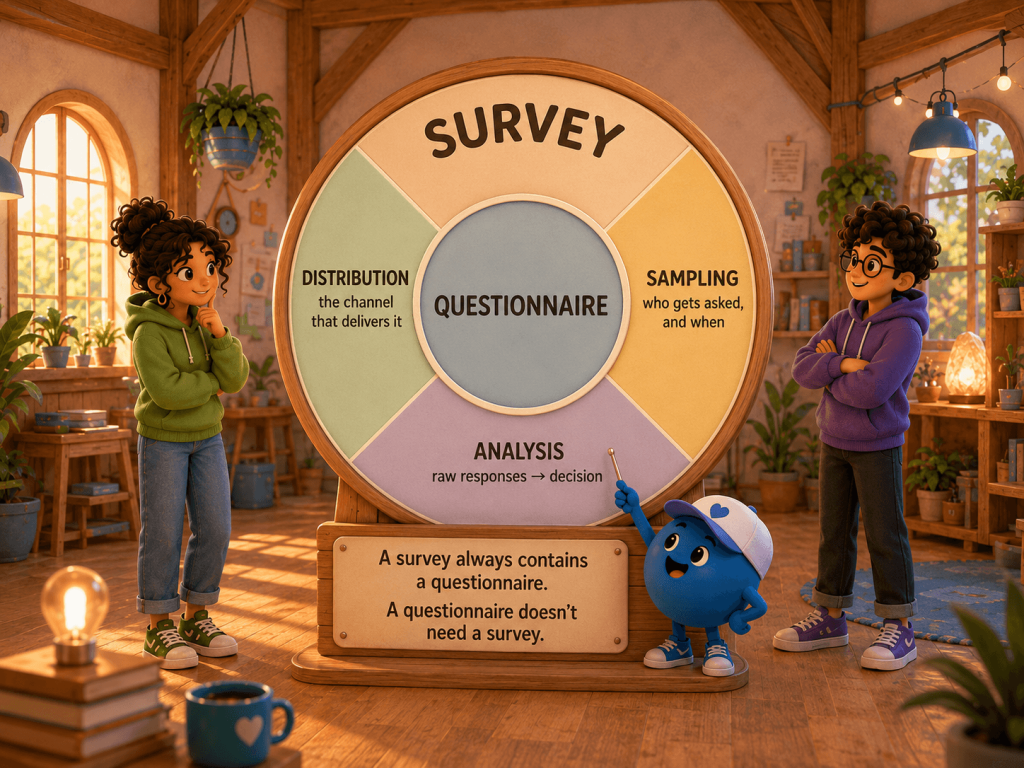
Survey vs questionnaire, side by side
Laid out next to each other, the difference is less about definitions and more about scope, and about what each one asks you to get right.
| Questionnaire | Survey | |
|---|---|---|
| What it is | The instrument: a set of questions | The whole process around that instrument |
| Scope | The questions only | Questions plus distribution, sampling, and analysis |
| What you optimize | Question quality: wording, order, clarity | Also who you ask and how you read the results |
| Typical output | A page of raw responses | Aggregated, analyzed insight you can act on |
| Standalone use | Yes (intake, order, registration forms) | No, it always contains a questionnaire |
When the distinction actually matters
Here’s where the label earns its keep: it changes what you have to get right. Think “questionnaire” and your whole job is the questions, so you polish the wording and stop. Think “survey” and you’ve quietly signed up for two more jobs the questionnaire never mentions: who you sample and how you analyze.
That gap is where good data goes wrong. You can write a flawless question set, send it to a skewed list (only your happiest customers, only the ones who log in), and ship a clean-looking number that describes a subgroup instead of your base. A perfect questionnaire on a biased sample is still misleading data, which is exactly where survey bias lives.
So the practical move: if the answers will drive a decision, plan the sample and the analysis before writing question one. Question quality is necessary. It just isn’t sufficient.
What this looks like in a feedback program
Bring the distinction into a customer feedback program and the two words map onto two different things you own. Your NPS, CSAT, or CES question set is the questionnaire, the questions a customer actually sees. The survey is the program around it: which customers get sampled and at what point in their lifecycle, which channel delivers it (email, in-app, or a shared link), and how each response feeds follow-up and reporting.
The same questionnaire can sit underneath many different surveys over time. Your NPS question doesn’t change quarter to quarter – what changes each quarter is who gets sampled and when. Four quarters, one questionnaire, four surveys. That’s the one-way relationship from the top of this article, made concrete: the instrument is reusable, the survey around it isn’t.
A great NPS question with no sampling plan and no closed loop isn’t a survey program. It’s a questionnaire you happened to email. The teams that get real value from feedback aren’t the ones with the cleverest question; they’re the ones who treat the whole loop as the product. If you want the question set itself, our customer feedback questionnaire guide and ready-made survey templates are the place to start.
Common mix-ups
A few spots where the two words get tangled, and whether it matters depends on the stakes.
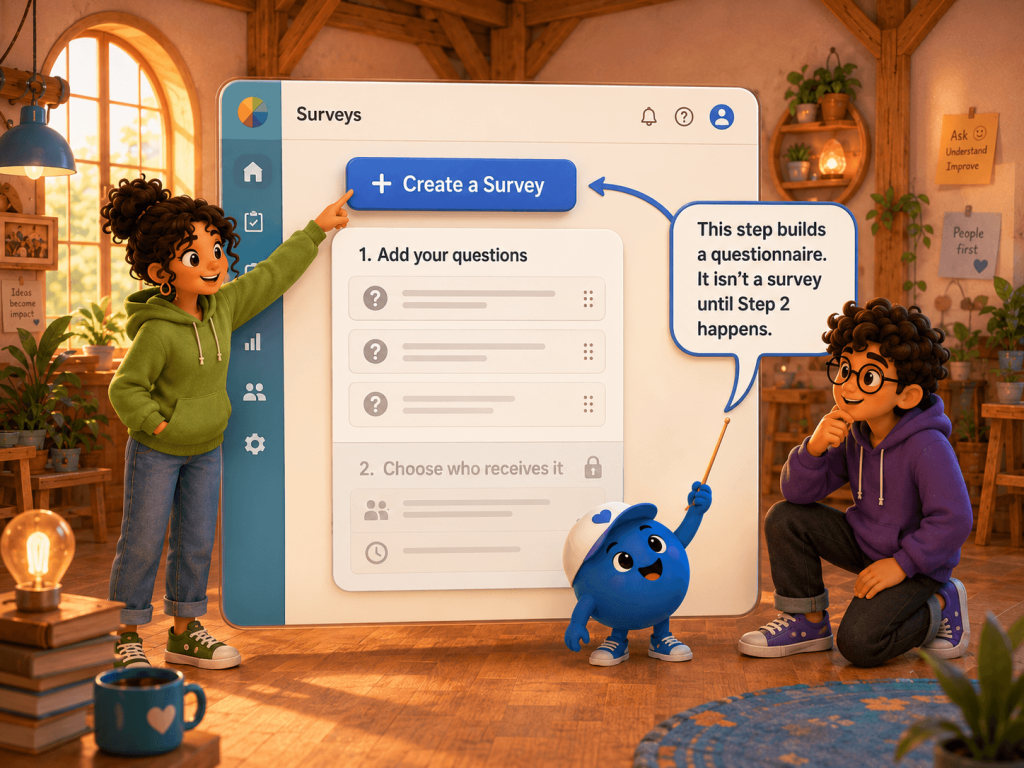
Part of why this mix-up is so persistent right now: the tools themselves blur it. Open almost any survey platform and the button says “Create a survey” – but what you’re actually building at that step is a questionnaire. You don’t become a survey until someone decides who gets it and sends it. The label gets attached before the process it describes has even started, so it’s no surprise the two words collapsed into each other in everyday use.
Calling a standalone Google Form a “survey.” Usually harmless. If you’re gathering RSVPs, it’s a questionnaire, and the label changes nothing about the job.
“We ran a survey” which was really a blast for whoever opened the email. This one matters. With no sampling plan, you collected questionnaire data and called it survey insight, so the results describe your most engaged customers rather than your customer base.
Poll vs survey vs questionnaire. A poll is usually a single, quick, informal question (“which feature next?”). A questionnaire is a set of questions. A survey is the full collect-and-analyze process around either.
Being pedantic about the word in a standup. Not worth it. For most everyday business use, “survey” as a loose catch-all is perfectly clear, and correcting people just slows the meeting down.
From a question set to a feedback program
The distance between a questionnaire and a survey is really the distance between asking and knowing. A question set is the easy part. The sampling, the delivery, and the closed loop are what turn it into something you can act on.
Retently is built for that second half: ready-made NPS, CSAT, and CES question sets, plus the segmentation, multi-channel delivery, and follow-up that make them a running program instead of a form. You can start a free trial and send one that samples fairly and closes the loop from the first response.
Frequently Asked Questions
Is a survey a questionnaire?
No. A survey contains a questionnaire, but it’s the larger thing. The questionnaire is just the set of questions, while the survey adds distribution, sampling, and analysis around them. Put simply, the questionnaire is one part of the survey, not the other way around.
Is every questionnaire part of a survey?
No. Plenty of questionnaires stand entirely on their own. An intake form, an order form, or an event registration page each collect a set of answers with no sampling plan or analysis process behind them. They’re questionnaires doing a job that has nothing to do with research or measurement.
What’s the difference in research specifically?
In research the line is drawn more strictly. “Survey” refers to the whole method: defined sampling, fieldwork, and often weighting to make the results representative. “Questionnaire” is reserved for the instrument used inside that method. The rigor lives in the survey design; the questionnaire is one carefully built component of it.
Poll vs survey vs questionnaire?
A poll is usually a single, quick question, often informal (“which feature should we build next?”). A questionnaire is a set of questions. A survey is the full process of collecting and analyzing responses around one of them. Roughly: a poll asks one thing, a questionnaire asks many, and a survey does something with the answers.

 Christina Sol