



When the anchor tenant on your third floor declined to renew, the surprise wasn’t that they left. It was that the property team learned about the decision from the tenant’s broker, eight months before expiry, after the space-planning consultants had already been through the building on a Tuesday everyone assumed was routine. A tenancy worth years of NOI ended without your side ever hearing a complaint.
That’s commercial property management’s version of silent churn, and it’s quieter than the residential kind. A frustrated resident calls, emails, posts. A frustrated business tenant tells their facilities manager, who tells their CFO, who tells a broker, and the first version you hear has a vacancy date attached. Long leases hide the problem: with five-year terms, the feedback you’re not collecting doesn’t cost you this quarter. It costs you enormously, later, all at once.
Surveying commercial tenants fixes the visibility problem, but the residential playbook doesn’t transfer cleanly. The tenant is a company, not a person; the stakes per tenancy are 10 to 100 times higher; and the renewal conversation starts a year or more before the lease ends. Here’s the program built for that reality.
Key Takeaways
- Commercial tenants churn silently and slowly: decisions form over quarters, involve brokers and boards, and surface long after they’re made. Surveys are your only reliable early signal.
- Survey the account, not just the signatory: the day-to-day contact (office or facilities manager) sees your service; the decision-maker weighs the renewal. Measure both, separately.
- Run relationship NPS once or twice a year per contact, CES after every building-services request, and a fit-out/move-in survey after occupancy begins.
- Time the pre-renewal read 18 to 24 months before expiry on major tenancies. By the time the renewal negotiation opens, satisfaction is already priced in.
- One saved anchor tenancy pays for decades of the program; the ROI math barely needs a calculator.
How Commercial Differs From Residential
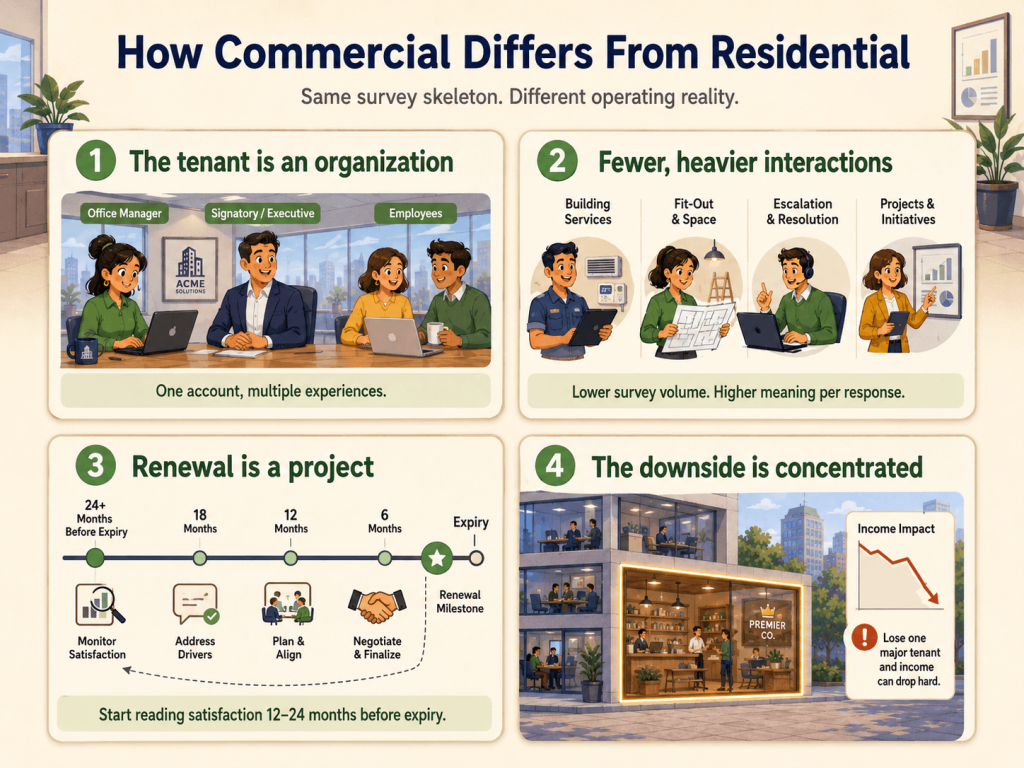
If you’ve read our residential tenant satisfaction guide, keep the skeleton (moments, metrics, close-the-loop) and change four organs.
The tenant is an organization. “How satisfied is Meridian Legal LLP?” isn’t one answer; it’s the office manager who files the work orders, the managing partner who signs the lease, and forty employees who experience the HVAC. Your survey program has to model that, which residential never asks of you.
Interactions are fewer and heavier. No pool gates or lease violations here. The relationship lives in building services, fit-outs, escalations, and the occasional capital project. Lower survey volume, higher meaning per response.
The renewal is a project, not a letter. Commercial renewals involve brokers, space planning, and board approvals, and they begin quietly 12 to 24 months out. Feedback collected during the renewal negotiation arrives after the verdict; feedback collected in year two of a five-year term is what actually shapes the outcome.
The downside is concentrated. Losing one resident costs a turn. Losing one major office tenant can drop a building’s income by double-digit percentages and trigger co-tenancy clauses in retail. The variance alone justifies instrumentation.
Who to Survey: The Multi-Contact Problem
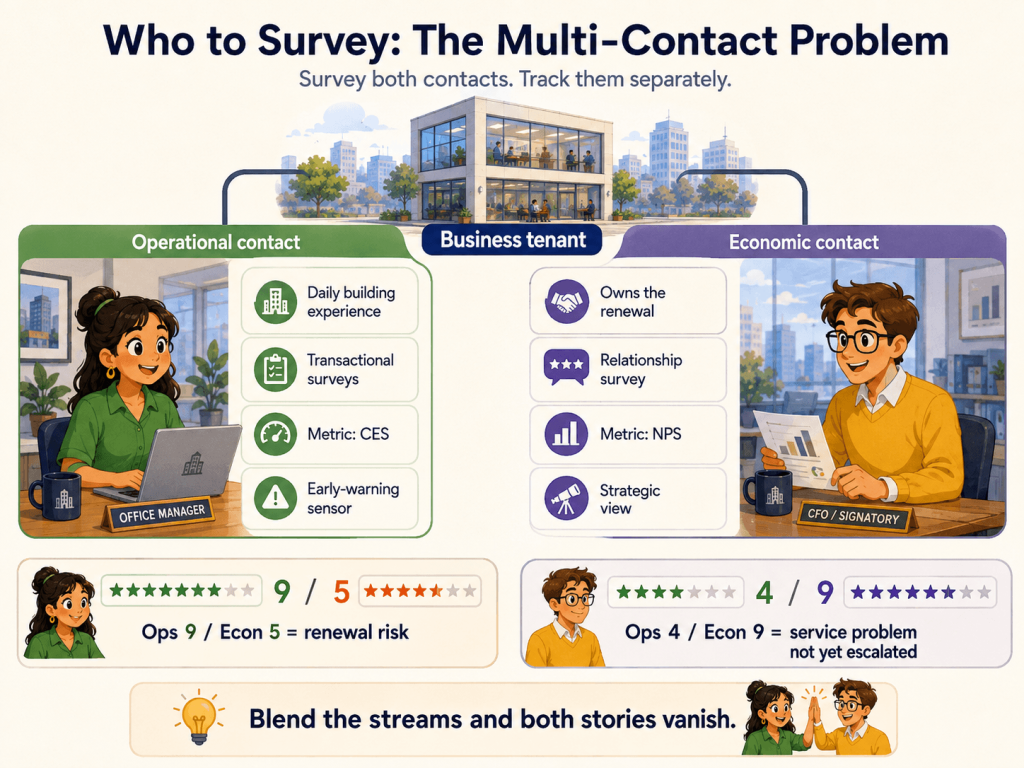
This is the question that decides whether your commercial program produces signal or noise, and it’s the same one B2B software companies face: survey the key contact, the users, or both? The answer here, as there, is both, tracked separately.
The operational contact (office manager, facilities lead) experiences your building daily: work order speed, cleaning quality, security, and communication. They complete your transactional surveys and are your early-warning sensor. Their frustration precedes the decision-maker’s by quarters.
The economic contact (signatory, CFO, managing partner) may visit the building twice a year, but they own the renewal. Their perception is assembled from the operational contact’s reports, the rent line, and how you handled the one escalation that reached their desk. They get the relationship survey less often, with an open question that invites a strategic answer.
Keep the streams separate in your reporting, per account. An office manager at 9 with a signatory at 5 is a renewal-risk profile; a signatory at 9 with an office manager at 4 is a service problem that hasn’t traveled upward yet. Blend them and both stories vanish. On Retently, this is per-audience campaigns with account-level tags, the same structure PM firms use to keep owners and residents separate.
The Commercial Survey Cadence
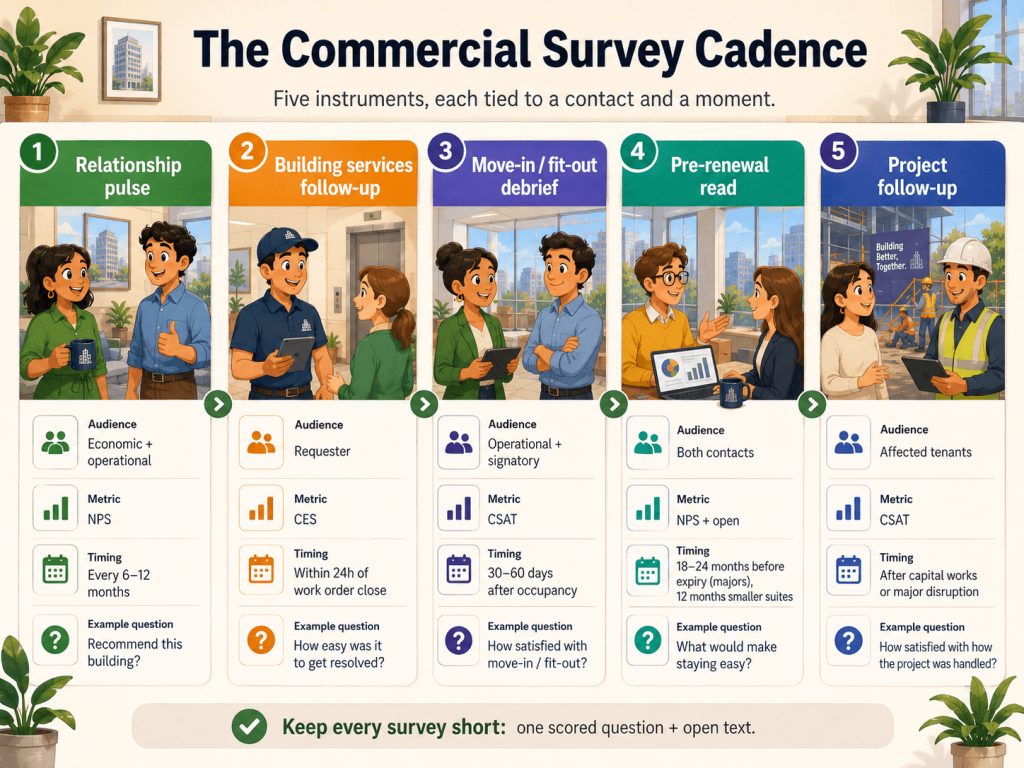
Those four differences translate into five distinct instruments, each aimed at a specific contact and moment rather than one generic satisfaction survey repeated on a schedule.
| Survey | Audience | Metric | Timing |
|---|---|---|---|
| Relationship pulse | Economic + operational contacts | NPS | Every 6-12 months, staggered per account |
| Building services follow-up | Whoever filed the request | CES | Within 24h of work order close |
| Move-in / fit-out debrief | Operational contact + signatory | CSAT | 30-60 days after occupancy |
| Pre-renewal read | Both contacts | NPS + open questions | 18-24 months before expiry (majors), 12 for smaller suites |
| Project follow-up | Affected tenants | CSAT | After capital works, restack, or major disruption |
Two cadence notes. The relationship NPS pulse runs annually or semiannually, not quarterly; commercial contacts are senior, busy, and fewer, so you protect their willingness to answer. And the pre-renewal read isn’t a separate instrument so much as a deliberately timed pulse whose results someone senior actually reviews against the lease expiry schedule, because that’s the window where a fixable grievance is still cheaper than a broker’s fee.
What to Ask at Each Touchpoint
The cadence table says when and who. What’s left is matching the question to the moment:
Relationship pulse: “How likely are you to recommend [building/management firm] to another business looking for space?” plus “What’s the main reason for your score?” For the economic contact, add one strategic open question: “As your lease planning develops, what would make staying here an easy decision?” You will be amazed what people tell a survey that they haven’t told your leasing team.
Building services (CES): “How easy was it to get your request resolved?” The effort framing fits commercial precisely because your operational contact’s own job performance depends on things getting fixed without chasing; make their life easy and you’ve made a Promoter. The mechanics mirror the maintenance survey playbook: triggered at ticket close, one question, metadata attached, vendor scorecards downstream.
Move-in/fit-out debrief: “How satisfied were you with the move-in and fit-out process?” plus an open question on what they’d change. Fit-outs are the most complex thing you’ll ever do together and the foundation of the relationship’s first year; debrief them like the projects they are.
Project follow-up: “How satisfied were you with how we managed [the capital project / restack / disruption]?” plus an open “what would have made this easier” question. Disruption is sometimes unavoidable – a restack, a lobby renovation, a system outage – but asking about it afterward is what keeps an inconvenient quarter from turning into a renewal-season grudge.
Delivery notes: email to named contacts is the channel; a survey link embedded in your tenant-portal announcements works as backup. Keep every survey to one scored question plus open text. Senior people answer short surveys and delete questionnaires.
The Anchor-Tenant Math
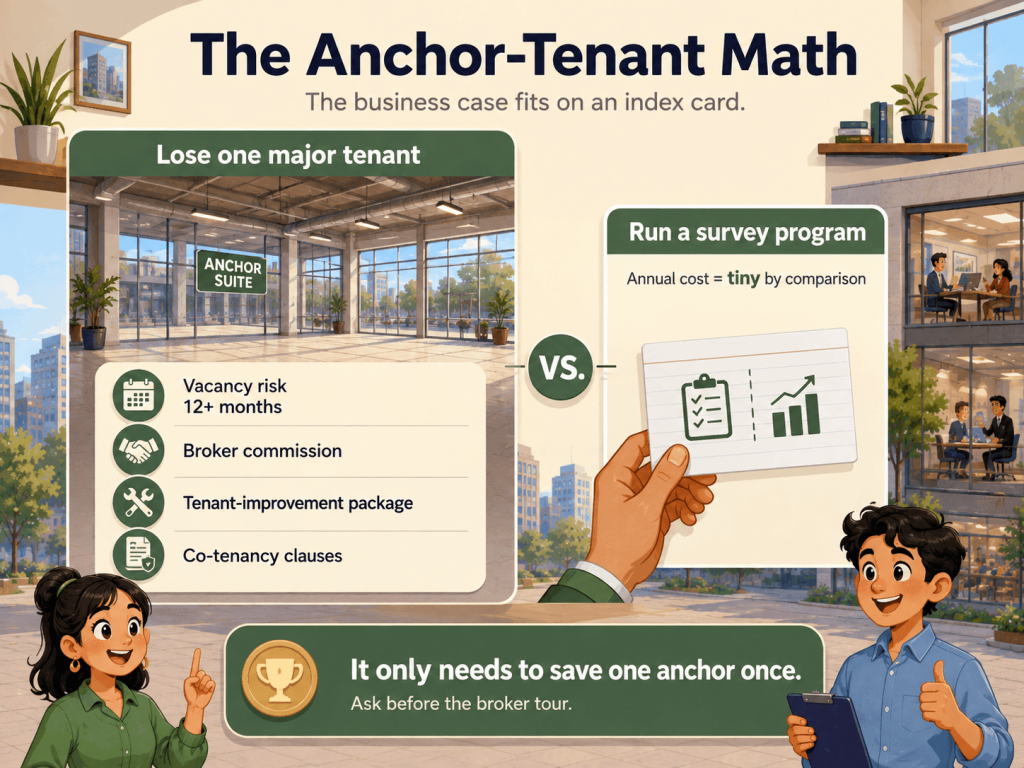
The business case for all of this fits on an index card.
Take a single 20,000-square-foot office tenancy at market rent. The revenue across a five-year term runs into seven figures. Losing it means 12-plus months of vacancy risk, a broker commission, a tenant-improvement package for the replacement, and, in retail, possible co-tenancy rent reductions cascading from other tenants’ leases. Against that: a survey program whose annual cost rounds to a rounding error, which exists to surface the fixable grievance two years before the broker tour.
It doesn’t need to save an anchor annually to be the best-yielding line in the operating budget. It needs to save one, once. Every other response it collects (the CES trend that caught a slipping vendor, the fit-out debrief that fixed your next fit-out) is margin on top.
Enterprise landlords already act on this logic through benchmarking programs like Kingsley’s, which grade commercial portfolios on tenant satisfaction at the institutional level. If you manage a portfolio below institutional scale, the same discipline is available with lighter tooling. What matters is that somebody is asking before the space planners visit on a quiet Tuesday.
Conclusion
Commercial tenancies end the way they endure: quietly. What keeps a tenant has nothing to do with the marble lobby and everything to do with work orders that close without chasing, a signatory who gets asked a real question once a year, and someone reading the answers against the expiry schedule. Everything in this playbook exists to make sure the eight-month head start belongs to you, not the broker.
Retently runs the commercial program alongside any residential one: per-contact campaigns, CES on service requests, account-level views, and alerts when a key contact’s score turns. Setup is two 30-minute calls. Start a free trial or book a demo before the next quiet Tuesday.
Frequently Asked Questions
What is a commercial tenant satisfaction survey? A structured feedback program for office, retail, or industrial tenants: a relationship NPS question sent to each tenant’s key contacts every 6 to 12 months, effort-score surveys after building service requests, and satisfaction checks after move-in and major projects, with results tracked per account and per contact type.
Who should receive a commercial tenant survey? Both the operational contact (office or facilities manager, who experiences daily service) and the economic contact (the lease signatory or finance lead, who decides the renewal). Track their scores separately: operational frustration is the early warning, and decision-maker sentiment is the renewal forecast.
How often should commercial tenants be surveyed? Relationship surveys every 6 to 12 months per contact, transactional effort surveys after every service request, and a deliberate pre-renewal read 18 to 24 months before expiry on major tenancies. Less frequent than residential surveying, because contacts are senior and fewer. Each response carries more weight.
Why measure commercial tenant satisfaction at all? Because commercial churn is silent and slow: renewal decisions form over quarters through brokers and boards, and surface long after they’re fixable. A single retained anchor tenancy, worth seven figures across a term, repays the survey program many times over.

 Christina Sol