



You’re on a check-in call with a customer whose usage has quietly halved since spring. You ask how things are going. There’s a pause, then: “It’s fine, I guess.”
That answer is a fork. Say “Great, glad to hear it” and you’ve learned nothing. Ask “What’s made it only fine?” and you might hear that their new ops lead hates the export, that two people stopped logging in after a reorg, and that they’ve already looked at a cheaper tool. Same customer, same minute. The only difference is the second question.
That second question is a probing question: the follow-up you ask after a first answer to get detail, a reason, or an example. This list covers customer-facing work only: interviews, survey follow-ups, support calls and usability sessions. Teaching, coaching and sales use probes too, but that’s a different job.
Key Takeaways
- A probing question only exists in response to an answer. Its job is to turn “it’s fine” or “it’s broken” into something specific enough to act on.
- Six purposes cover nearly every probe: clarify, example, reason, impact, compare and feeling. All 40 examples below are tagged with one.
- A survey can probe, but only in one round written in advance: write a different follow-up for Promoters, Passives and Detractors, and the respondent sees the one that matches their score.
- A Bureau of Labor Statistics pretest found that the last probe in a series got skipped most, so keep survey probes few and early.
- Let the survey probe find who to call, then probe live: two or three follow-ups per thread, then summarize back.
What makes a question a probing question
A probe is defined by its position, not its wording. “What happened?” is a probing question when a customer has just said their order arrived late. Asked cold, it’s just a question.
That’s the line between this list and a bank of open-ended questions. The first open question opens the topic. The probe comes second, when the answer comes back thin, vague, or full of words that mean something different to them than to you.
Probing vs clarifying questions
A clarifying question checks that you understood what was said: “So the report loads, but the numbers are wrong?” A probing question goes past it, toward why, how often, or what it cost. Clarify first, then probe.
Probing vs leading questions
A probe that carries its own answer stops being a probe. “Was it the price that put you off?” hands the customer a reason they may not have had, and plenty will take it because it’s easier than explaining. That’s a leading question. The neutral version is “What put you off?”
Six kinds of probes (and a starter for each)
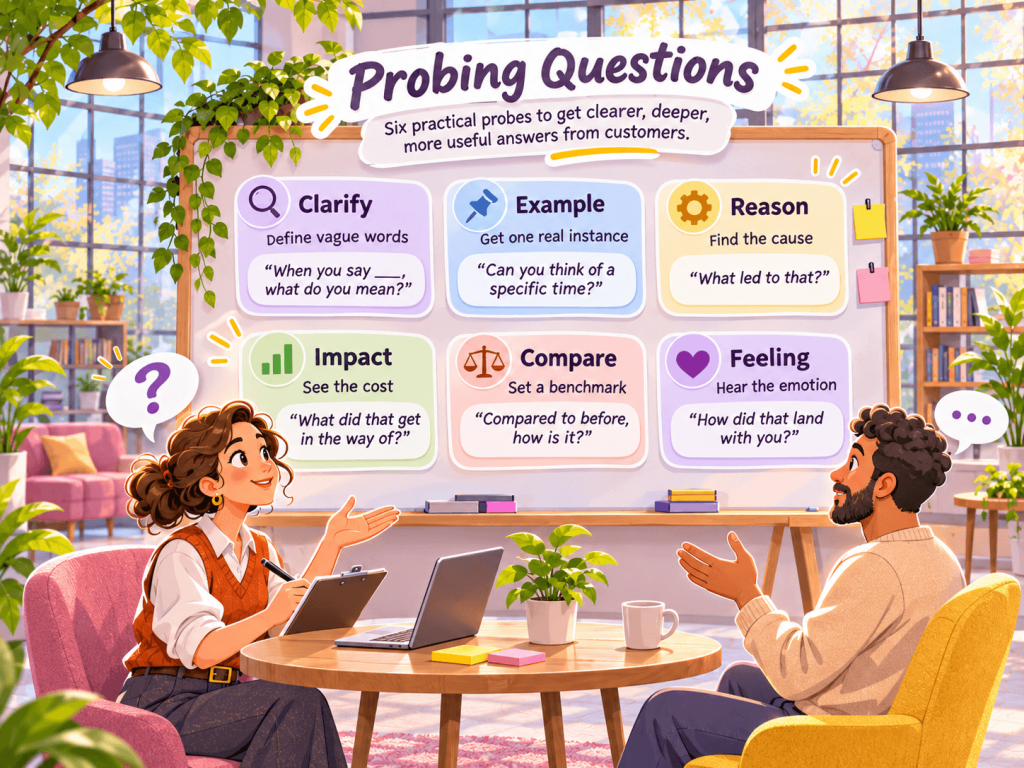
Lists of “5 types of probing questions” disagree on what the five are. We find it more useful to sort probes by what they get you, and every example below carries one of these six tags:
| Type | What it gets you | Starter |
|---|---|---|
| Clarify | What a vague word actually means to them | “When you say ___, what do you mean?” |
| Example | One real instance instead of a generalization | “Can you think of a specific time?” |
| Reason | The cause, without the defensiveness a bare “why” triggers | “What led to that?” |
| Impact | What the problem cost in time, money or trust | “What did that get in the way of?” |
| Compare | A benchmark or a priority | “Compared to what you had before, how is it?” |
| Feeling | The emotional weight, which predicts what they’ll do next | “How did that land with you?” |
Probing questions for customer interviews (1-10)
Discovery calls, churn interviews and win-loss reviews share one problem: customers summarize. They give you the conclusion and skip the story that would tell you what to fix.
- “Walk me through the last time that happened.” (Example) Rescues “It happens all the time”, which gives you frequency but no detail.
- “You said ‘clunky’. Which part felt clunky?” (Clarify) Turns a mood word into a screen, a step or a field.
- “What were you using before us?” (Compare) Rescues “It’s much better now” by giving you the baseline it’s better than.
- “What led to the decision to switch?” (Reason) Gets past “We just needed something better” to the trigger event.
- “What happened next?” (Example) For stories that stop at the problem and never reach the workaround.
- “If we didn’t exist, what would you be doing instead?” (Compare) Rescues “It’s really useful” by naming your real alternative.
- “Who else was involved in that?” (Clarify) “We decided” usually hides a buyer, a blocker and an end user.
- “What almost stopped you?” (Reason) Rescues “It was an easy decision”, which it rarely was.
- “What did that cost you, in hours or money?” (Impact) Turns “It was annoying” into something you can prioritize.
- “How did that land with you at the time?” (Feeling) For factual answers with the stakes missing.
Probing questions after an NPS, CSAT or CES score (11-20)
Most surveys end with one generic box after the score: “Any comments?” Answers are short, when they come at all. There are several reasons why NPS comments come back empty, and one of the easiest to fix is that a 10 and a 3 get asked the same thing.
Write one probe per score band
A Promoter, a Passive and a Detractor are telling you different things, so they need different second questions.
Promoters are worth probing for the specific thing worth repeating, in their words:
- “What’s the one thing you’d tell a colleague about us?” (Example) Rescues “Great product!” with a quotable specific.
- “What would you miss most if you switched tomorrow?” (Compare) Shows which feature is actually holding them.
- “When were you most glad you had us?” (Feeling) Gets a moment, which is far easier to act on than a compliment.
Passives are about the gap. They’re not unhappy; they’re unconvinced, so ask what’s missing:
- “What’s one thing that would make it a 10?” (Compare) The classic passive probe, because it asks for a single priority.
- “What’s holding your score back?” (Reason) Rescues a silent 7 that’s hiding a specific doubt.
- “Compared with what you expected at signup, how has it gone?” (Compare) Separates a product gap from an expectation gap.
- “What do you find yourself working around?” (Example) Passives often tolerate a workaround they’d never call a complaint.
Detractors are about the moment. Something happened, and you want to know what:
- “What happened?” (Example) Two words, and the most useful probe you can show a low score.
- “What did that get in the way of?” (Impact) Tells you whether this was an irritation or a blocked goal.
- “If we could fix one thing first, which should it be?” (Compare) Rescues a list of grievances by asking them to rank it.
Once the comments come in, the next job is to follow up with Detractors personally.
How this works in a survey tool
Here’s the honest version of “surveys can’t probe.” A survey can’t read an answer and react to it. It can ask a different follow-up depending on the score, so the probe has to be written in advance, once per band.
That’s how Retently surveys work. Each follow-up question can hold separate Promoter, Passive and Detractor versions, or one version marked the same for all, and the respondent sees the version that matches their score. It applies to NPS, CSAT, CES, star, emoji, thumbs and PMF-style ratings. The defaults already differ by band: Promoters get “What do you love about our product or service?”, Passives “What’s one thing we can do to make you more satisfied with us?” and Detractors “What was missing or disappointing in your experience with us?” Follow-up text can include personalization variables such as the person’s first name. The open-text step can also show an optional “I agree to be contacted for details” checkbox, and a multiple-choice “Other:” option can open its own comment field.
One probe, placed early
How many follow-ups should a survey carry? Fewer than you’d think. A Bureau of Labor Statistics pretesting study presented at FedCASIC in April 2026 (380 respondents, data collected in 2023, work in progress) tested up to seven open-ended web probes. Answers averaged about 108 characters, roughly 16 to 21 words. The final probe drew the most missing answers, and the authors’ advice was to limit open-ended probes and put the important ones near the beginning or middle.
Two more findings are worth borrowing. A one-line note telling people why their answer mattered lengthened replies by about four words on average, and by 48 characters on the first probe. And people with a mobility impairment wrote longer answers to the mobility probe, so relevance counts. It was a pretest on one panel, so treat it as directional: one relevant probe, early, with a reason to answer.
The cost side points the same way. In a randomized experiment, Hadler (2025, Sociological Methods & Research) found that embedding open-ended probes in a web survey raised break-off and backtracking, while mostly leaving answers to the closed questions unchanged. For what goes around the probe, see our guides to qualitative survey questions and the wider types of survey questions.
Probing questions for support calls and live chat (21-30)
“It just doesn’t work” is the support version of “It’s fine, I guess.” True, and useless until someone narrows it down. The order roughly follows a real call: timeline, context, symptoms, stakes.
- “When did you first notice it?” (Clarify) Rescues “It’s been broken for ages”, which might mean an hour.
- “What were you doing right before it happened?” (Example) Often the fastest route to the cause.
- “What have you tried so far?” (Example) Saves you from suggesting the three fixes they already ran.
- “What do you see on your screen right now?” (Clarify) Swaps “It’s weird” for an error message you can search.
- “What were you expecting to happen?” (Compare) Separates a bug from a misunderstanding of how the feature works.
- “Has this happened before, or is this the first time?” (Compare) A repeat tells you the last fix didn’t hold.
- “What’s this holding up for you today?” (Impact) Tells you whether it’s an annoyance or an outage on their side.
- “Is anything else acting oddly since then?” (Impact) Catches the second symptom they didn’t think was related.
- “What would a good outcome from this conversation look like?” (Compare) Rescues a vague complaint by asking for the finish line.
- “How are you feeling about it at this point?” (Feeling) Worth asking on a second or third contact, when “fine” usually isn’t.
In chat, send these one at a time. If you’re writing canned replies, slot them into your live chat scripts as follow-ups, not openers.
Probing questions for user research and usability sessions (31-40)
Usability work has its own trap: people narrate what they think you want to hear, and stay polite about what confuses them.
- “What are you looking for right now?” (Clarify) Rescues aimless clicking by naming the goal.
- “What did you expect to happen when you clicked that?” (Compare) The gap between expectation and result is the usability finding.
- “You paused there. What were you thinking?” (Reason) Hesitation is data, and most people won’t mention it unprompted.
- “Can you show me how you did this last time, for real?” (Example) Swaps a hypothetical walkthrough for actual behavior.
- “What would you call this?” (Clarify) Their label tells you whether yours makes sense.
- “Where would you look for it?” (Example) Rescues “I couldn’t find it” with a map of where it should be.
- “What, if anything, feels confusing here?” (Feeling) “If anything” lets them say nothing, which keeps it neutral.
- “If this screen disappeared tomorrow, what would you lose?” (Impact) Shows whether a feature is load-bearing or decorative.
- “What would you change first?” (Compare) Forces a priority out of a list of small complaints.
- “Tell me more about that.” (Example) The most flexible probe there is, and the hardest to overuse.
After asking, wait. A few seconds of silence feels long to you and normal to them, and people often fill it with the thing they were editing out.
From survey comment to conversation: the handoff
A survey probe gets you one good sentence. That’s enough to tell you who’s worth a call, but rarely enough to tell you what to change.
So treat the comment as the start. A Detractor who writes “The new billing page is a mess” and ticks the box agreeing to be contacted has handed you a 15-minute interview. Open with probe 1, and the real problem usually surfaces fast. No checkbox? A reply from the account owner asking for a call works too. The survey finds the person, the human probe finds the reason, and that’s what lets you close the feedback loop with a fix rather than an apology.
How to ask probing questions without leading or interrogating
Good probes can still go wrong in delivery.
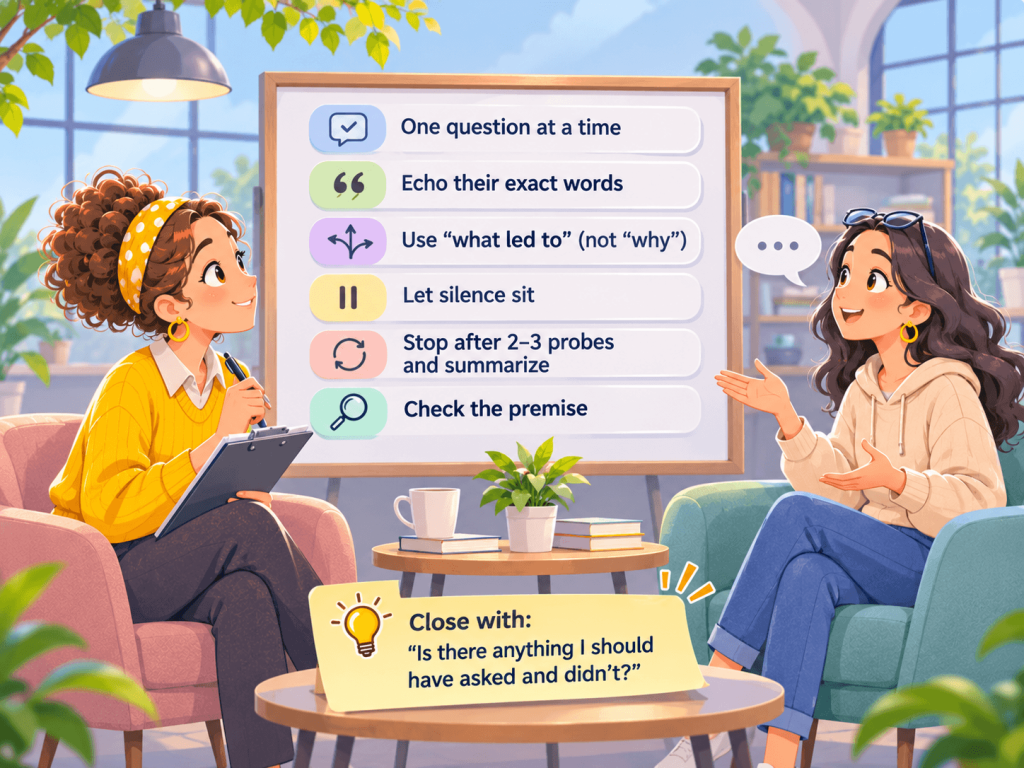
- One question at a time. Stack three, and you get an answer to the easiest one.
- Echo their exact words. Example 2 works because “clunky” is theirs. Swapping in your own word (“So the interface is slow?”) quietly steers them.
- Swap “why” for “what led to”. Example 4 asks for a cause without asking them to defend a choice.
- Let silence sit. The pause is where the edited-out answer lives.
- Know when to stop. Two or three probes per thread, then summarize back: “So the export breaks on large files, and that’s why two people stopped using it?” It shows you listened and lets them correct you.
- Check the premise. “What made the pricing feel high?” assumes they thought it was. Example 18 assumes nothing.
To close an interview, ask: “Is there anything I should have asked and didn’t?” It sounds like a formality. It often isn’t.
The second question is where the learning is
Most customer conversations already have a decent first question. What’s missing is the follow-up: a probe chosen for its purpose, asked once, in the customer’s own words. Pick two or three per context from the 40 above and keep the ones that open people up.
If your survey still asks every score the same thing, start there. In Retently, you can write a separate follow-up for each score band and add the contact checkbox so the best answers turn into calls. Start a free trial or book a demo to set it up.
Frequently Asked Questions
What is a probing question? A probing question is a follow-up you ask after someone’s first answer to get more detail, a reason or a concrete example. It’s defined by its position in the conversation rather than its wording: “What happened next?” is a probe when it follows a customer’s story about a failed delivery. Probes turn vague answers like “it’s fine” into something you can act on.
What are the types of probing questions? Most lists name five types, but they rarely agree on which five. We sort probes into six purposes: clarify (what a word means), example (one real instance), reason (what led to it), impact (what it cost), compare (a benchmark or a priority) and feeling (how it landed). Knowing the purpose helps you pick the right probe instead of defaulting to “why?”
What’s the difference between probing and clarifying questions? A clarifying question checks that you understood what was said: “So the report loads, but the numbers are wrong?” A probing question goes beyond what was said, toward causes, examples or consequences: “What were you using those numbers for?” Clarify first when you’re unsure what you heard, then probe once you’re sure.
Can you ask probing questions in a survey? Yes, in one round, written in advance. A survey can’t react to the content of an answer the way an interviewer can. It can show a different follow-up depending on the score, so Promoters, Passives, and Detractors each get a probe written for them. Keep it early and personally relevant, then use a contact-permission checkbox to move the best answers into a live conversation.
How many probing questions should you ask? In a survey, as few as possible. A Bureau of Labor Statistics pretest found that the last of several open-ended probes drew the most missing answers, and the authors recommended limiting probes and placing the important ones early. In a live conversation, two or three follow-ups per thread are usually enough. After that, summarize what you heard and let the customer correct you.

 Alex Bitca


 Christina Sol