



You’ve abandoned a survey halfway through – everyone has. It’s rarely the topic that loses you, it’s something about how the question was put to you. Multiply that moment across a thousand recipients and most of your data was never collected at all.
So a “good” survey question isn’t a matter of style. It’s the thing standing between a signal you can act on and a silence you can’t read.
This guide is about writing that question. Not which format to pick – our types of survey questions catalog covers that – but how to word it so a busy customer answers honestly and fast. We’ll walk through the five things that make a question good, how many to ask, the order, and more than thirty rendered examples sorted by the moment they fire in.
Key Takeaways
- A good question is clear: it asks one thing, the person can answer it, it’s specific and time-bound, and its options are balanced and exhaustive.
- Question count is a response-rate lever, not a preference. Every question has to map to an action you’ll take, or you cut it.
- Order matters. Open easy, keep sensitive and demographic questions last, and put your one open-ended question near the end.
- Organize by the moment you’re asking in (post-purchase, onboarding, support, renewal), not just by type.
- Attention is scarce, so every word has to earn the reply.
What makes a survey question “good”?
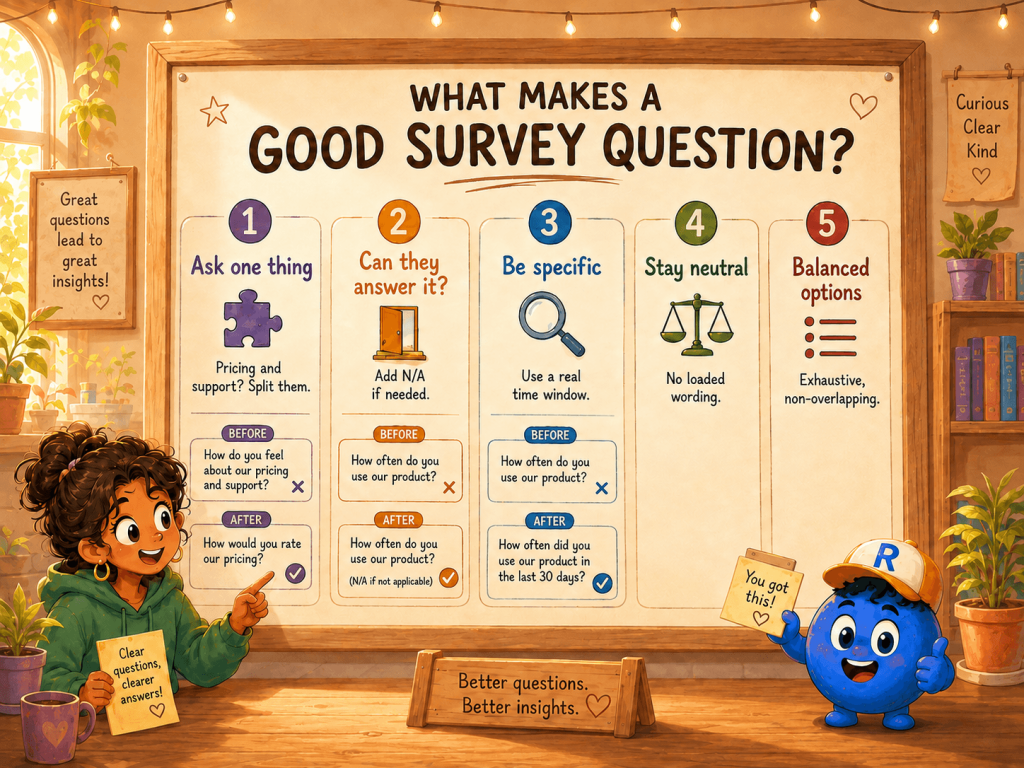
Strip away the tips lists and it comes down to five properties. Get these right and the wording mostly writes itself; miss one and even a well-chosen format returns muddy data. Here’s each with a before-and-after.
It asks one thing
The fastest way to ruin an answer is to bundle two questions into one. “How satisfied are you with our pricing and support?” can’t be answered cleanly, because someone might love the price and resent the support. When they pick a middle number, you have no idea which half they meant.
Before: How would you rate our pricing and support? After: How would you rate our pricing? (ask support separately)
One idea per question, every time. This is the most common wording mistake there is, and it hides inside answer options too. The full catalog of what to avoid lives in common bad survey questions.
The person can actually answer it
A question is only good if the respondent has the information to answer it. Ask a customer to rate a feature they’ve never opened, and you get a guess, not data. Same with recall: “How many times did you contact support last quarter?” asks for a number almost nobody tracks.
Two fixes: ask about what the person genuinely knows or just experienced, and add an honest escape hatch (“N/A” or “Haven’t used it”) so people who can’t answer don’t invent one. A forced answer is worse than a blank.
It’s specific and time-bound
Vague words invite vague answers. “Do you contact us often?” means something different to every reader; “often” could be weekly or once a year. Pin it down.
Before: Do you use the reports often? After: How many times have you opened the reports in the last 30 days?
A concrete referent and a time window turn a mood into a measurement. Whenever you catch a “recently”, “regularly”, or “usually”, swap in an actual period.
It’s neutrally worded
A question tilts the moment its wording, or its answer scale, nudges people toward a reply. “How much did you love the new checkout?” assumes the answer. So does a scale running from “Good” to “Amazing” with nowhere to land if the truth is “Bad.” Keep the phrasing plain and the scale balanced, so a happy customer and an unhappy one can both answer honestly.
Keep the scale direction consistent too – always low-to-high, never flipped between questions in the same survey, or respondents will answer the opposite of what they mean. The deep mechanics of loaded phrasing sit in avoid leading questions, and the wider tilt (who you ask, when, how) in minimize survey bias.
Its options are balanced and exhaustive
For closed questions, the answer choices carry as much weight as the question. They should be mutually exclusive (no overlapping buckets), cover the realistic range, and offer an “Other” when your list might miss the real answer. Four upbeat options and one negative one is a leading scale in disguise. Match the format to the decision: for closed formats, see well-built multiple choice, and reach up to the types of survey questions catalog when you’re unsure which fits.
How many questions should a survey have?
Every question you add is paid for out of a budget you don’t control: the customer’s patience. Across our own sends, that budget is thin. The typical account gets about 5% of its survey emails answered, and barely half of recipients open the email at all. Attention this scarce isn’t something to spend on a question nobody will act on.
So the honest answer to “how many questions should a survey have” isn’t a number. The rules you’ll read elsewhere, completion drops after ten questions, keep it under ten minutes, are repeated everywhere and measured almost nowhere. Treat them as folklore, not findings. The rule that holds up: every question has to map to an action you’ll take. If nobody owns the follow-up, the question comes out.
That splits surveys into two shapes. A transactional survey fires after a single event, a delivery, a support ticket, a finished onboarding step, and usually needs one question: the metric, plus at most one open box for the reason. A relationship survey, your periodic NPS or account health check, can carry a small handful, because the reader has more context. Neither shape gains anything from padding. And single-question closed formats, the one-tap NPS (Net Promoter Score), CSAT (Customer Satisfaction Score), or CES (Customer Effort Score), reliably see the highest completion of anything you can send, so reach for them when a number is all you need.
Response rates also differ by segment. Ecommerce buyers answer at a higher rate than B2B (a 6.7% median versus 4.8%, with a much fatter top quartile at 17.7% versus 10.3%). That’s worth knowing when you read your own numbers against the right baseline. It’s not a license to ask more; the decision rule holds either way.
There’s a second lever on response rate that has nothing to do with question count: whether you close the loop. Customers who’ve seen their last answer lead to a real change are more willing to answer the next one – even a one-line “you told us X, so we changed Y” does real work.
The order you ask them in
Sequence changes answers, so it’s worth a minute of thought. Open with something easy and low-effort. When the metric is the reason you’re surveying, ask it first, before any other question can prime it, so three friendly questions don’t warm a Detractor into a higher score first. Same objectivity concern as neutral wording, applied to position.
From there, work from general to specific and from easy to sensitive. Group questions by topic so the respondent isn’t jumping between subjects. Save one open-ended question for near the end, where it catches the “why” behind the numbers without slowing people down early. For a ready bank, see our open-ended examples. Keep screening and demographic questions last and optional, since that’s where an unanswered one costs you the least. And tell people up front how long it’ll take. A one-line “Two quick questions, about 30 seconds” sets an expectation people are far more willing to meet.
Order inside the survey is only half of it – when you send matters just as much. Fire close enough to the moment that it’s still fresh, but not so close that the experience isn’t finished yet: a delivery survey sent before the package arrives, or a renewal survey sent the day it renews, asks the right question at the wrong time.
30+ good survey question examples by moment
Most example banks sort questions by type or by research goal. That’s not how you deploy them. You fire a survey at a moment, right after a delivery, mid-onboarding, when a plan comes up for renewal, and the moment decides what’s worth asking. Below are more than thirty questions grouped by that moment, rendered the way the customer sees them. Keep each survey short: pick one or two per moment, not the whole list.
Post-purchase and delivery (ecommerce)
This is the moment ecommerce answers best, which is why it’s worth getting the questions tight.
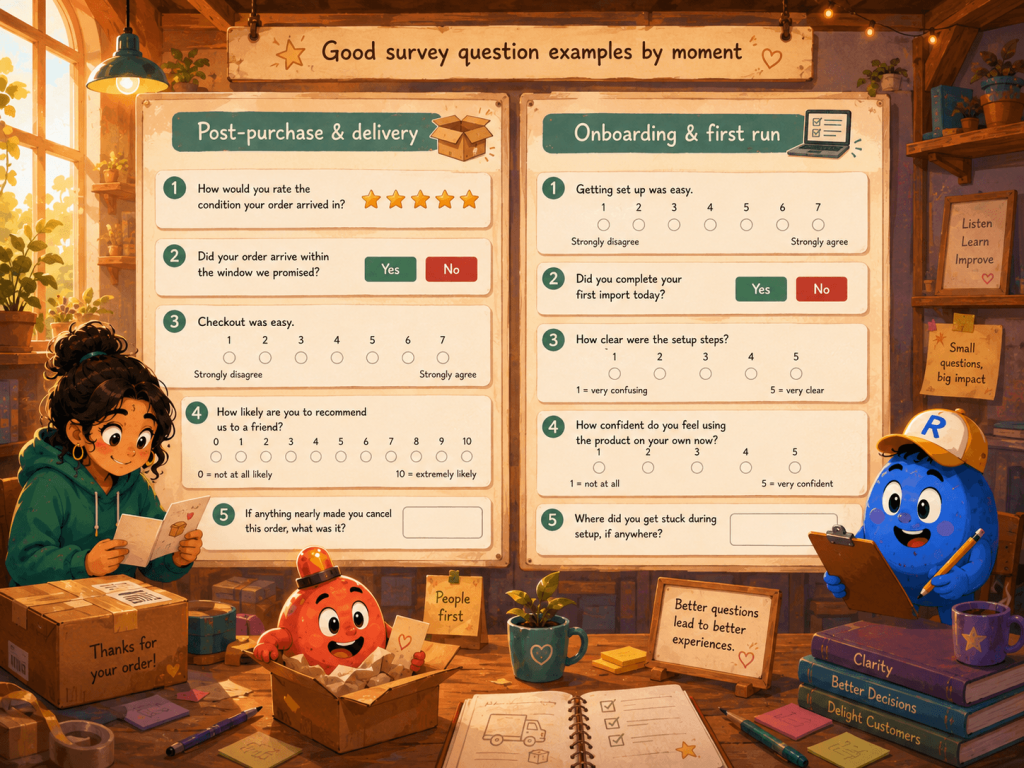
How would you rate the condition your order arrived in? ★ ★ ★ ★ ★
Did your order arrive within the window we promised? ◯ Yes ◯ No
Checkout was easy. Strongly disagree · 1 2 3 4 5 6 7 · Strongly agree
How likely are you to recommend us to a friend? 0 1 2 3 4 5 6 7 8 9 10 (0 = not at all likely, 10 = extremely likely)
If anything nearly made you cancel this order, what was it? [ your answer ]
Each ties to a decision (fix packaging, delivery windows, a checkout snag), and the open question surfaces objections your team never listed.
Onboarding and first run
Early experience predicts retention, so ask about effort and clarity while it’s fresh.
Getting set up was easy. Strongly disagree · 1 2 3 4 5 6 7 · Strongly agree
Did you complete your first import today? ◯ Yes ◯ No
How clear were the setup steps? 1 · 2 · 3 · 4 · 5 (1 = very confusing, 5 = very clear)
How confident do you feel using the product on your own now? 1 · 2 · 3 · 4 · 5 (1 = not at all, 5 = very confident)
Did the product do what you expected so far? ◯ Yes ◯ No ◯ Too early to tell
Where did you get stuck during setup, if anywhere? [ your answer ]
For the full lifecycle set, see onboarding survey questions.
After a support interaction
Effort is the sharpest signal right after a ticket closes, so lead with it.
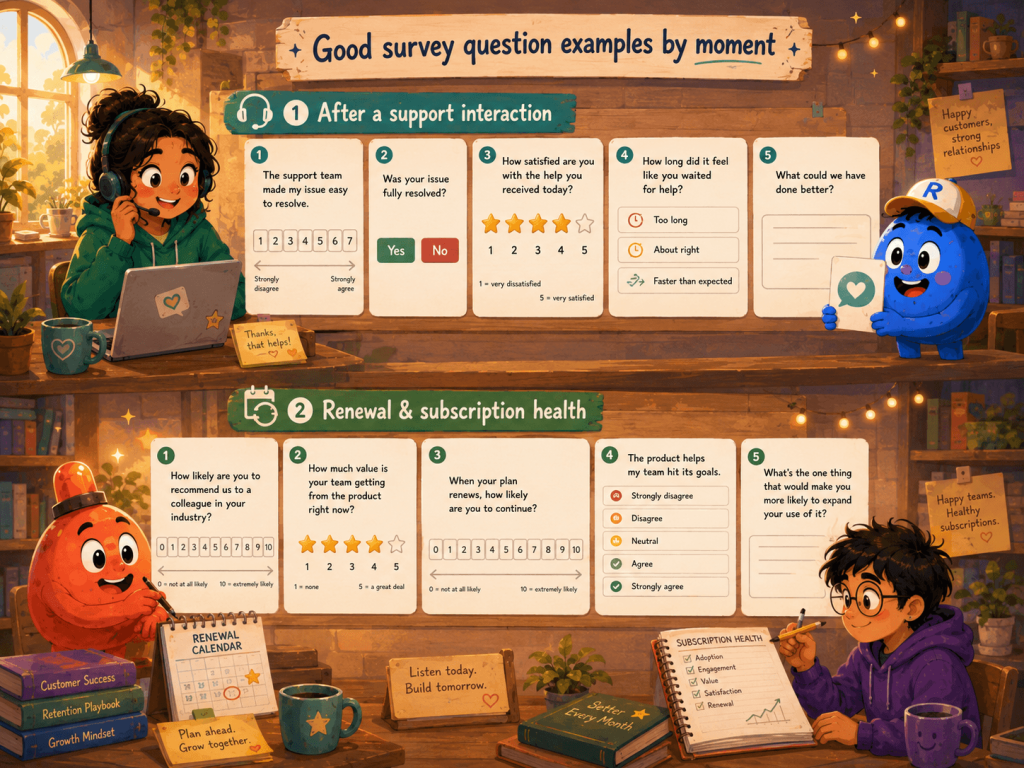
The support team made my issue easy to resolve. Strongly disagree · 1 2 3 4 5 6 7 · Strongly agree
Was your issue fully resolved? ◯ Yes ◯ No
How satisfied are you with the help you received today? 1 · 2 · 3 · 4 · 5 (1 = very dissatisfied, 5 = very satisfied)
How long did it feel like you waited for help? ◯ Too long ◯ About right ◯ Faster than expected
How many times did you have to explain your issue? ◯ Once ◯ Twice ◯ More than twice
What could we have done better? [ your answer ]
The resolution yes/no is the one to watch: a satisfied score with an unresolved issue is a warning, not a win. For the full set, see our CSAT question examples.
Renewal and subscription health (B2B SaaS)
Ask ahead of the renewal, not at it, and keep it neutral so you measure intent, not manufacture it.
How likely are you to recommend us to a colleague in your industry? 0 1 2 3 4 5 6 7 8 9 10 (0 = not at all likely, 10 = extremely likely)
How much value is your team getting from the product right now? 1 · 2 · 3 · 4 · 5 (1 = none, 5 = a great deal)
When your plan renews, how likely are you to continue? 0 1 2 3 4 5 6 7 8 9 10
The product helps my team hit its goals. Strongly disagree · Disagree · Neutral · Agree · Strongly agree
What’s the one thing that would make you more likely to expand your use of it? [ your answer ]
Note the renewal question: “how likely are you to continue” not “you’ll be renewing, right?” One measures a decision, the other leans on it.
Product and feature feedback
Tie feature questions to actual usage, and always leave room for the gap you didn’t anticipate.
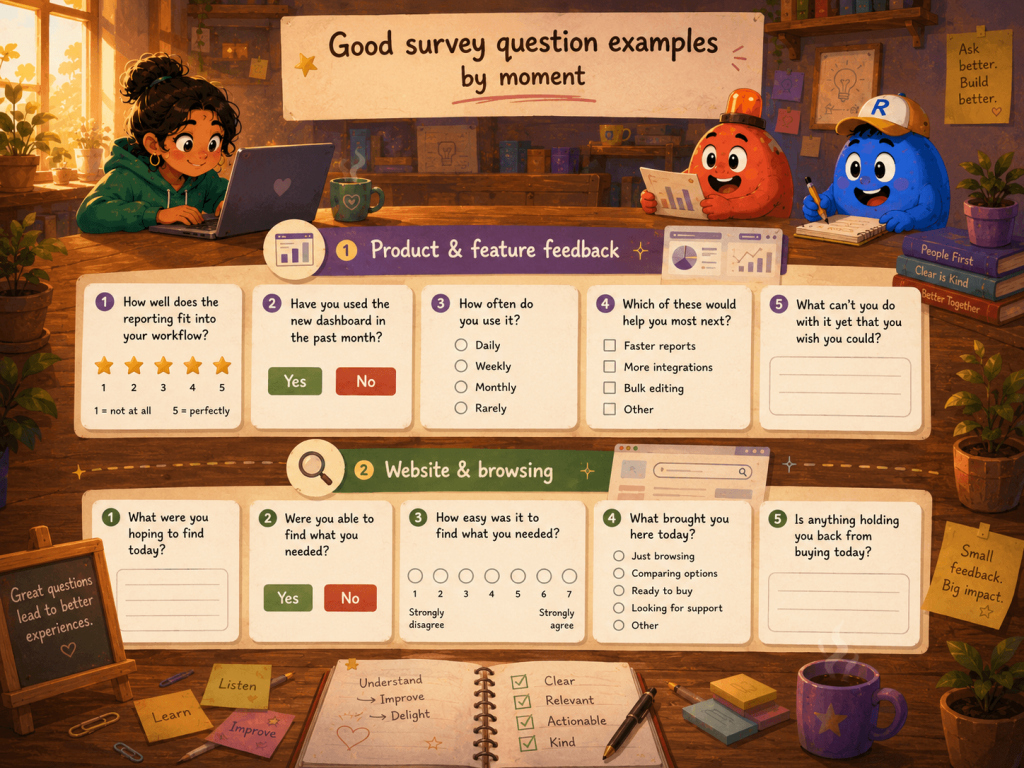
How well does the reporting fit into your workflow? 1 · 2 · 3 · 4 · 5 (1 = not at all, 5 = perfectly)
Have you used the new dashboard in the past month? ◯ Yes ◯ No
How often do you use it? ◯ Daily ◯ Weekly ◯ Monthly ◯ Rarely
Which of these would help you most next? ◯ Faster reports ◯ More integrations ◯ Bulk editing ◯ Other
What can’t you do with it yet that you wish you could? [ your answer ]
For a deeper bank aimed at product teams, see product feedback survey questions.
Website and browsing (pre-purchase intent)
On-site surveys catch people mid-decision, so learn what’s blocking the next step.
What were you hoping to find today? [ your answer ]
Were you able to find what you needed? ◯ Yes ◯ No
How easy was it to find what you needed? Strongly disagree · 1 2 3 4 5 6 7 · Strongly agree
What brought you here today? ◯ Just browsing ◯ Comparing options ◯ Ready to buy ◯ Looking for support ◯ Other
Is anything holding you back from buying today? [ your answer ]
When you’re ready to build a full survey rather than borrow one question, our set of 35 questionnaire questions gives you a starting template you can trim to fit.
A quick pre-send check
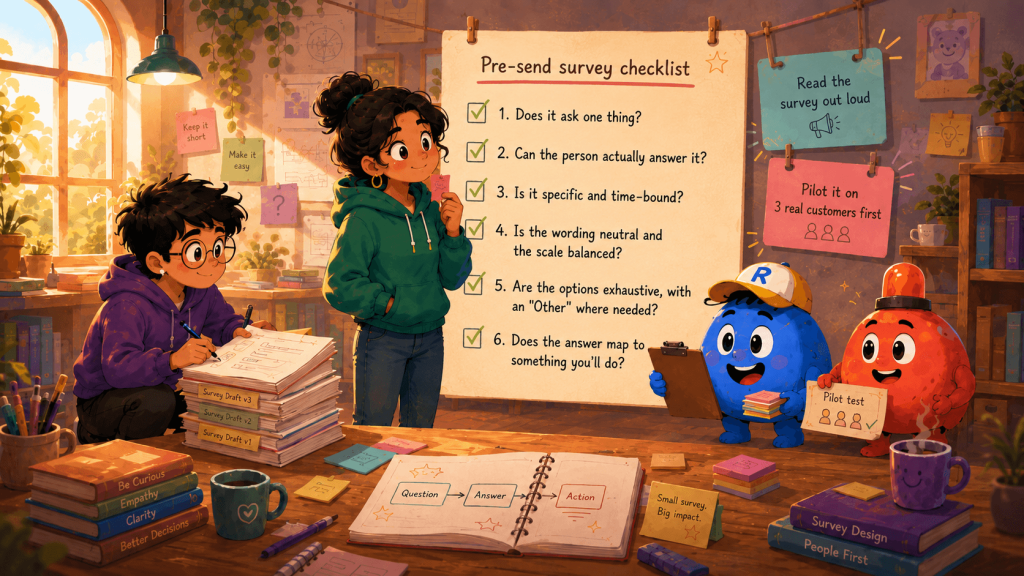
Before you hit send, run each question past six questions of your own. Every “no” is a rewrite.
- Does it ask one thing?
- Can the person actually answer it?
- Is it specific and time-bound?
- Is the wording neutral and the scale balanced?
- Are the options exhaustive, with an “Other” where needed?
- Does the answer map to something you’ll do?
Two habits catch what the list misses: read the survey out loud (clumsy phrasing is obvious to the ear), and pilot it on three real customers first. We do this across Retently campaigns, and it reliably turns up a question that reads fine on the page but confuses everyone who answers it.
Every question has to earn its answer
A good question earns the reply. Write fewer, keep each to one idea, keep the wording neutral, and the ones who answer will give you something you can act on instead of a pile of noise. Format and timing get easier once the question is right.
Retently renders NPS, CSAT, and CES as neutral, single-tap question types across every moment above, so the question reaches the customer the way it should and the score comes back comparable. Start a free trial to send one to your own list.
Frequently Asked Questions
What makes a good survey question? A good survey question asks one thing at a time, is worded neutrally so it doesn’t nudge the answer, and can actually be answered by the person you’re asking. It’s specific and time-bound rather than vague, and for closed questions the answer options are balanced and cover the realistic range.
How do you write good survey questions? Work in four steps. First, decide the action you’ll take with the answer, if there isn’t one, don’t ask. Second, pick the format that fits that decision (the types of survey questions guide is the map). Third, write it in plain, neutral language, one idea per question. Fourth, pilot it on a few real customers before sending it wide.
How many questions should a survey have? As few as answer the question you’re actually asking. There’s no measured magic number, the “under ten questions” rules floating around are folk wisdom, not data. The reliable rule is that every question must map to an action you’ll take. A transactional survey (post-support, post-delivery) usually needs just one; a periodic relationship survey can carry a small handful.
How long should a survey take? Short enough that people finish it. Attention is genuinely scarce. A single-tap question takes seconds and converts best; a longer survey competes with everything else in the inbox. Tell respondents the length up front.
What are 5 good survey questions to ask customers? One per moment: “How likely are you to recommend us to a friend?” (loyalty), “How satisfied are you with the help you received today?” (post-support), “The product made my issue easy to resolve” (effort), “How clear were the setup steps?” (onboarding), and “What can’t you do yet that you wish you could?” (open-ended). Each one earns its place because the answer points to a specific fix.

 Christina Sol





 Greg Raileanu