



What does a new property owner actually know about you on the day they sign the management agreement? Almost nothing. They know your sales pitch, your fee, and whatever three Google reviews they skimmed. Everything they’ll come to believe about your competence gets written in the next 90 days, mostly by small things: whether the first statement makes sense, whether the first question gets answered the same day, whether the first maintenance bill arrives explained or as a surprise.
PM firms pour energy into winning doors and then hand the new owner to an inbox. It’s a strange place to go quiet, because the early relationship is when owners are paying the closest attention they will ever pay, and when their expectations are still soft enough to set. Get the first quarter right, and you’ve banked trust that survives the occasional rough month for years. Get it wrong, and you’ve booked a termination that will execute itself sometime in year one or two, as we covered in the property owner retention playbook.
What follows is a property management onboarding checklist for the first 90 days and why each line is on it.
Key Takeaways
- New owners churn over expectation gaps, not service failures: statement confusion, communication cadence mismatches, and first-bill shock are the big three, and all are preventable in week one.
- Onboarding is a designed sequence, not a welcome email: an expectation-setting call, a first-statement walkthrough, and proactive updates before the owner has to ask.
- Measure it with a day-30 CSAT survey, and treat any score below the top boxes as a same-week phone call, because early grievances calcify fast.
- Close the first quarter with a 90-day review call that shows the owner their numbers and asks for their assessment, then feed them into the recurring NPS cadence every owner should be on.
Why Year-One Owners Churn
Talk to firms about the owners they’ve lost in the first year and the same three stories come up, wearing different addresses.
The statement mystery. The owner opens their first monthly statement and can’t tell what they earned, what they paid, or why. They feel stupid, then they feel suspicious. Nobody walks them through it, because to your team, the statement is self-explanatory; they see a hundred a month. The owner sees one, for the first time, with their money in it.
The cadence mismatch. The owner expected to hear from you when anything happened; you contact the owners when something needs approval. Neither expectation is wrong, but nobody surfaced them, so your normal operating silence reads as neglect. By month four, they’re describing you to a friend as “fine, but you have to chase them.”
The first-bill shock. A $600 maintenance invoice lands without warning or context. The work was necessary and fairly priced, but the owner’s first financial surprise from you is a cost, unexplained. First impressions built on surprise bills don’t recover cheaply. The psychology is the same one we describe in making a strong first impression on every customer, with more zeros attached.

Notice what’s missing from the list: bad service. Year-one churn is mostly an expectations problem, which is excellent news, because expectations can be set on purpose, in week one, for free.
Days 0-7: The Expectation-Setting Week
The single most valuable hour in the whole relationship is a structured kickoff call in the first week. Not a sales call; the deal is closed. A working session that covers, explicitly:
- How money flows. When rent arrives, when disbursements go out, what will the statement look like? Share a sample statement and annotate it live. Thirty minutes here prevents twelve months of quiet confusion.
- How communication works. What you proactively report and when, what response time to expect on questions, who their named contact is, and what counts as an emergency. Say the quiet part: “if you haven’t heard from us, it means rent is in, and nothing needs you.”
- How maintenance decisions get made. The approval threshold, how estimates are handled, and what happens after hours. Agree on the number above, which they get a call first. This single agreement prevents the first-bill shock outright.
- What success looks like at 90 days. Occupancy target, timeline for leasing the unit, and the date of their 90-day review call. You’re scheduling the onboarding finish line in advance.
Follow the call with a one-page written recap. Not a 40-page owner manual nobody reads: one page, the promises you just made, in plain language.

Days 8-30: First Proof
Expectations set, the next three weeks are about demonstrating that the machine works without being asked.
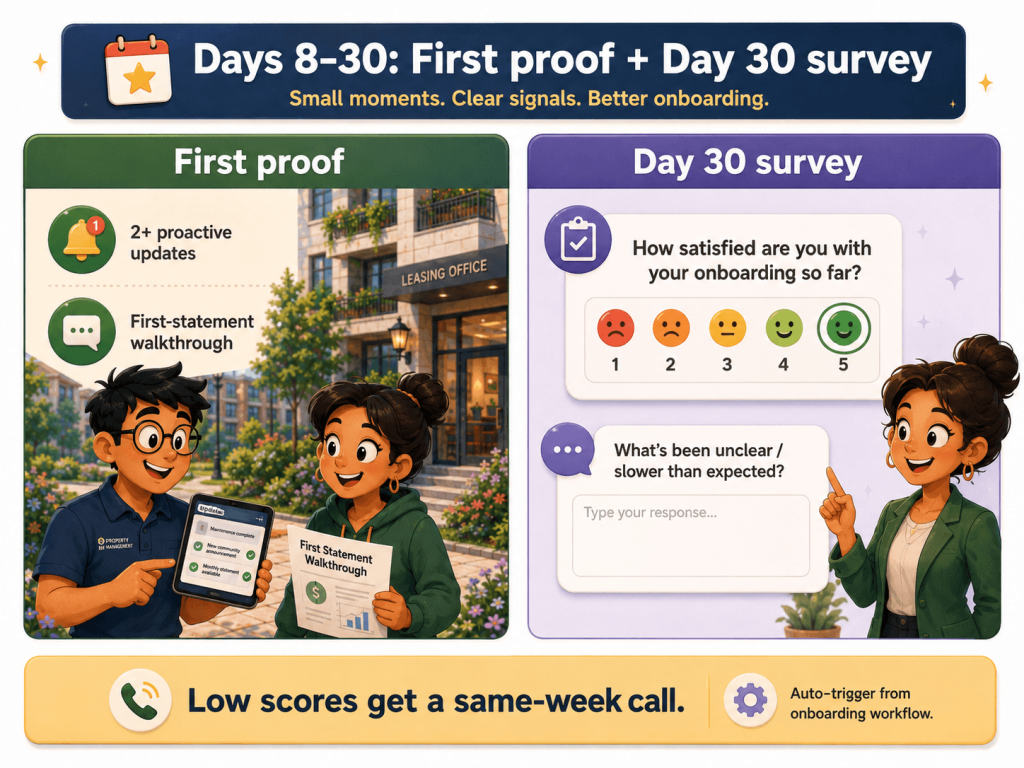
Send at least two proactive updates in the first month, even if nothing dramatic is happening: “lease-up marketing is live, 14 inquiries, 3 showings booked” or “inspection complete, photos attached, no issues.” Proactive contact in month one recalibrates the owner’s baseline. They learn that silence from you is rare, so the normal quiet months that follow read as calm rather than absence.
Then walk the first statement. When it goes out, a short note or a five-minute call: “your first statement just landed; here’s the one line people usually ask about.” The owners who least need the walkthrough will decline it warmly. The ones who need it were the ones about to churn silently.
Day 30: The Onboarding Survey
Now measure. Around day 30, send a short CSAT survey: “How satisfied are you with your onboarding experience so far?” on a 1-5 scale, plus one open question, “What’s been unclear/ slower than you expected?”
Three design notes:
- Day 30, not day 90. You want the wobble while it’s fresh and fixable. A frustrated owner discovered at day 90 has been rehearsing the frustration for two months.
- The open comment is the payload. Score 4 with “all good, though the statement took me a while to decode” is an instruction manual for your next fix.
- Low scores get a call that week. Same rule as every feedback loop worth running: the survey is the smoke detector, the human is the response. Anything in the bottom boxes means their account manager calls within days, leads with the owner’s own words, and leaves with a specific commitment.
Fire it automatically from your onboarding workflow (a webhook or Zapier step when the account hits day 30), so it never depends on memory. This is the first entry in the measurement rhythm that continues for the life of the account. Colorado Realty surveys owners from sales and onboarding onward as part of its lifecycle program, which is what a mature version of this looks like.
Days 31-90: Rhythm and the First Review
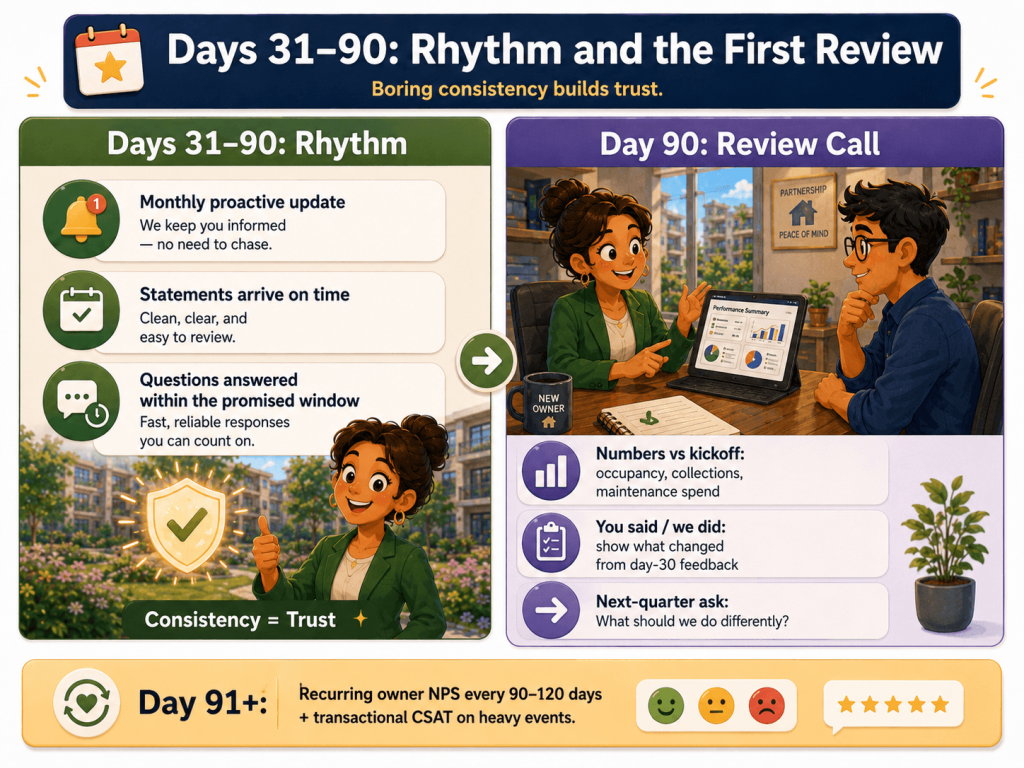
The back half of onboarding is repetition: statements that arrive on time, questions answered inside the promised window, and one more proactive update each month. Boring is the goal. Boring is what trust is made of.
Then close the quarter with the 90-day review call you scheduled on day one. Fifteen to thirty minutes with:
- Their numbers: occupancy, collections, any maintenance spend, versus what you said at kickoff.
- What changed based on their day-30 feedback, stated explicitly. “You said the statement was confusing, so we now include the one-page summary” is the outer half of closing the feedback loop, and it lands harder with a client three months in than any marketing you’ll ever run.
- Their assessment: “What should we do differently in the next quarter?”
After the review, the owner graduates into your standing program: recurring relationship NPS every 90-120 days and transactional CSAT on heavy events. Onboarding ends, listening doesn’t.
The Onboarding Checklist
Here’s the whole system on one screen:
| When | Action |
|---|---|
| Day 0 | Agreement signed; welcome note with named contact and kickoff invite |
| Days 1-7 | Kickoff call: money flow, communication cadence, maintenance thresholds, 90-day targets. One-page recap sent |
| Days 8-30 | 2+ proactive updates; first-statement walkthrough |
| Day 30 | Onboarding CSAT survey (auto-triggered); same-week call on any low score |
| Days 31-89 | Monthly proactive update; promises kept on cadence |
| Day 90 | Review call: numbers vs kickoff, “you said / we did”, next-quarter asks |
| Day 91+ | Recurring owner NPS every 90-120 days; transactional CSAT on heavy events |
Conclusion
Owner retention gets decided earlier than anyone thinks: not at renewal, not at the first crisis, but in the ninety days when a new client is quietly deciding what kind of firm they hired. An hour of expectation-setting, a monthly rhythm of unprompted proof, one survey, and one review call. None of it is hard; all of it compounds.
Retently handles the measurement layer: the day-30 onboarding CSAT triggered automatically, alerts when a new owner’s score needs a call, and the recurring NPS program every owner graduates into. Start a free trial or book a demo and give your next new owner a first quarter worth five years.
Frequently Asked Questions
What should a property management onboarding checklist include? A structured kickoff call in week one covering how money flows, communication cadence, maintenance approval thresholds, and 90-day success targets; a walkthrough of the first statement; at least two proactive updates in month one; a day-30 satisfaction survey; and a 90-day review call against the kickoff commitments.
Why do new property management clients leave in the first year? Mostly expectation gaps rather than service failures: confusing statements, communication cadence mismatches, and surprise maintenance bills. Each is preventable through explicit expectation-setting in the first week and proactive early communication, which is why onboarding quality predicts year-one retention so strongly.
When should you survey a new property owner? Send a short CSAT survey around day 30 (“How satisfied are you with your onboarding so far?” plus an open question about what’s been unclear), then a 90-day review conversation. After onboarding, move the owner onto a recurring NPS pulse every 90 to 120 days for the life of the account.

 Christina Sol