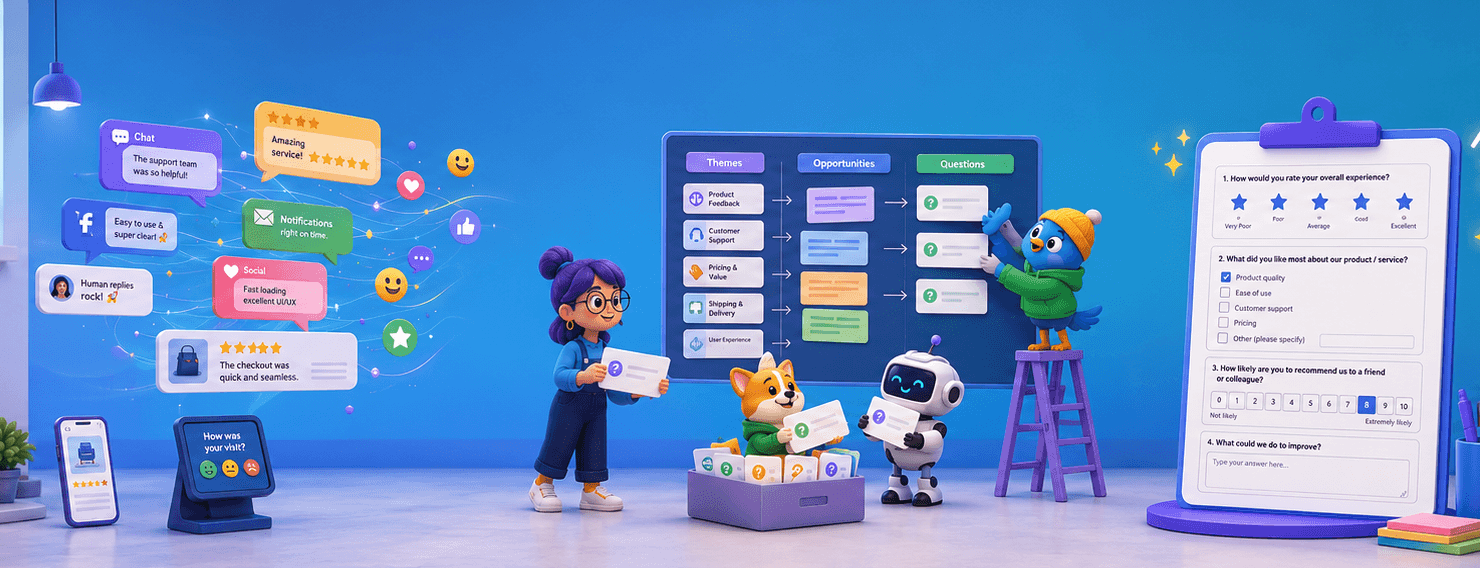



“How satisfied were you with your delivery? Rate it 1 to 5” scores something that already happened. “What did you expect from us that you didn’t get?” hands you the customer’s own expectation, in their words, while there’s still time to act on it. Both are survey questions. Only the second one is a voice of the customer question.
That gap is the whole article. A VoC question is engineered to surface what the customer expects, values, and would change, so the answer feeds a decision you haven’t made yet. This page is the bank, organized by the decision each set feeds rather than by topic, plus a template you can lift. It’s the question layer of a broader voice of the customer program; the strategy for running that program lives there.
Key Takeaways
- A voice of the customer question surfaces expectations and priorities before the next experience, so the answer feeds a decision. CSAT scores a moment that has already passed. That difference is the whole game.
- Don’t sort your VoC questions by topic. Sort them by the decision each set feeds: keeping the customer, diagnosing churn, prioritizing what to build, or finding where the journey breaks.
- Ask the anchor metric first, keep the survey to five or six questions with one open box, and put the verbatim “voice” question near the end.
- The template most guides skip is a flow, not a list: intro, anchor metric, one or two decision questions, the open question, and optional segmentation.
What makes a question a VoC question (and not a CSAT one)
Start with what CSAT does well. It scores a delivered experience: a support ticket, a shipment, an onboarding step. It’s reactive on purpose, and that’s fine, because most of the time you just need to know whether that one moment landed.
A VoC question works the other direction. It’s built to surface what the customer expects, values, and would change before the next experience is delivered, so you can act ahead of the score instead of explaining it afterward. That proactive, in-their-words quality is what “returning the voice” actually means.
In practice, it shows up as four things: verbatim (a real sentence, not a number), forced trade-offs (rank these, you can’t have all of them), the gap between what they expected and what they got, and their real priorities instead of yours.
Two nearby jobs are not this, and it’s worth routing them out before you build anything. If all you need is a satisfaction score after a touchpoint, that’s a CSAT survey question, and there’s a full bank for it. If you want a general, all-purpose feedback form, use the 35-question feedback questionnaire. VoC is the narrower, sharper tool: questions pointed at a decision, in the customer’s own voice.
Organize VoC questions by the decision, not the topic
Most question banks sort by topic. Loyalty here, product there, support in its own pile. You end up with a menu, not a survey. Sorting by topic tells you what you could ask; it never tells you which handful of questions belong in the same three-minute survey.
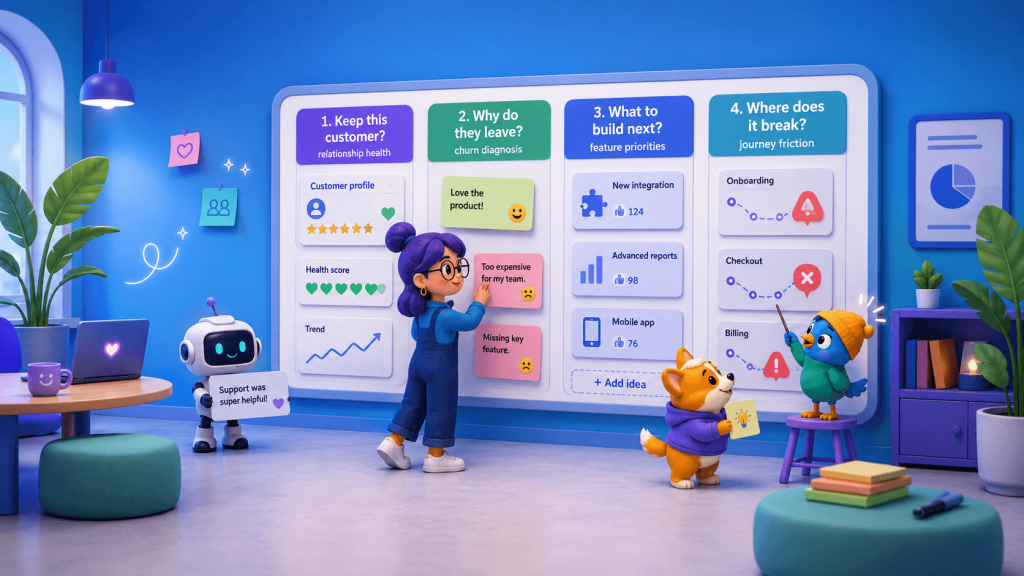
Sort by the decision instead. Four decisions cover most VoC programs:
- Are we keeping this customer? (relationship health)
- Why do customers leave, and what would have kept them? (churn diagnosis)
- What should we build or fix next? (feature and roadmap priorities)
- Where does the experience break? (journey friction)
Each decision pulls a different set of questions and, usually, a different question type. The four sections below are those four sets, rendered the way the customer sees them. Pick the decision you’re facing this quarter, take that set, and leave the rest.
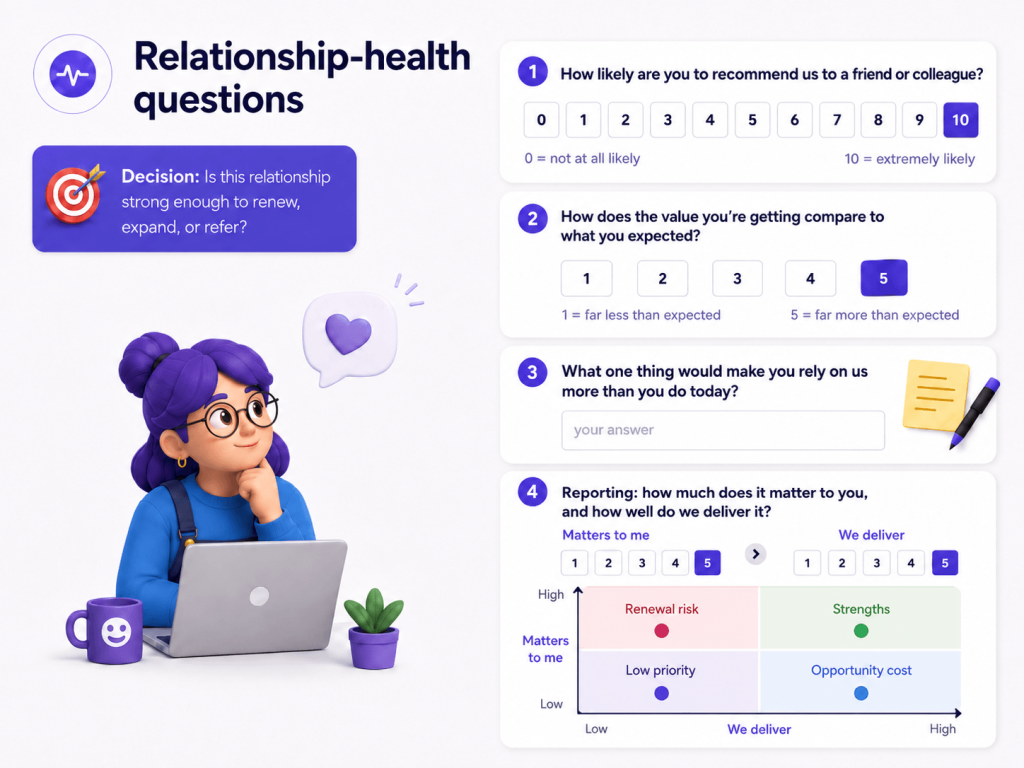
Relationship-health questions
The decision: is this relationship strong enough to renew, expand, or refer, and what would make it stronger?
These run at the relationship level, not after a single transaction. You want the overall loyalty read, the reason behind it, and the one lever that would deepen the account.
- How likely are you to recommend us to a friend or colleague? 0 1 2 3 4 5 6 7 8 9 10 (0 = not at all likely, 10 = extremely likely)
The score tracks loyalty; the follow-up is where the voice comes in. Pair it with an expectation-anchored value read, not a plain satisfaction rating.
- How does the value you’re getting compare to what you expected? 1 · 2 · 3 · 4 · 5 (1 = far less than expected, 5 = far more than expected)
Then hand them the lever question, open, because you cannot list an answer you don’t already know.
- What one thing would make you rely on us more than you do today? [ your answer ]
For key accounts, a paired importance-and-performance read shows where to spend effort: the areas that matter a lot and score low are your renewal risks.
- Reporting: how much does it matter to you, and how well do we deliver it? Matters to me: 1 · 2 · 3 · 4 · 5 We deliver: 1 · 2 · 3 · 4 · 5
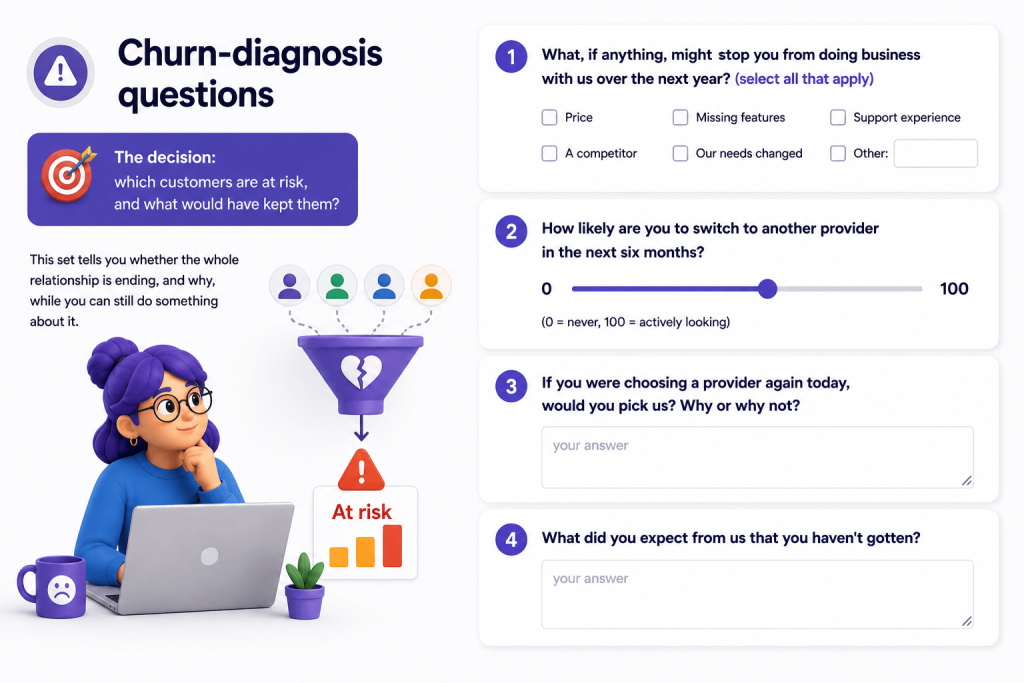
Churn-diagnosis questions
The decision: which customers are at risk, and what would have kept them?
A per-touchpoint CSAT score tells you a moment went badly. This set tells you whether the whole relationship is ending, and why, while you can still do something about it. The trick is to ask for the real reason in the customer’s language, not to make them pick from your list of excuses.
- What, if anything, might stop you from doing business with us over the next year? (select all that apply) ☐ Price ☐ Missing features ☐ Support experience ☐ A competitor ☐ Our needs changed ☐ Other: [ ]
The multi-select surfaces the shape of the risk; the slider quantifies how close it is.
- How likely are you to switch to another provider in the next six months? (0 = never, 100 = actively looking)
The two questions that move a save are open, and the counterfactual is the sharpest.
- If you were choosing a provider again today, would you pick us? Why or why not? [ your answer ]
- What did you expect from us that you haven’t gotten? [ your answer ]
Picture a subscription box brand running the counterfactual at the first sign of a downgrade. The answers rarely match what the team assumed: canceling almost never means the product is bad, usually, an expectation went quietly unmet a few orders ago.
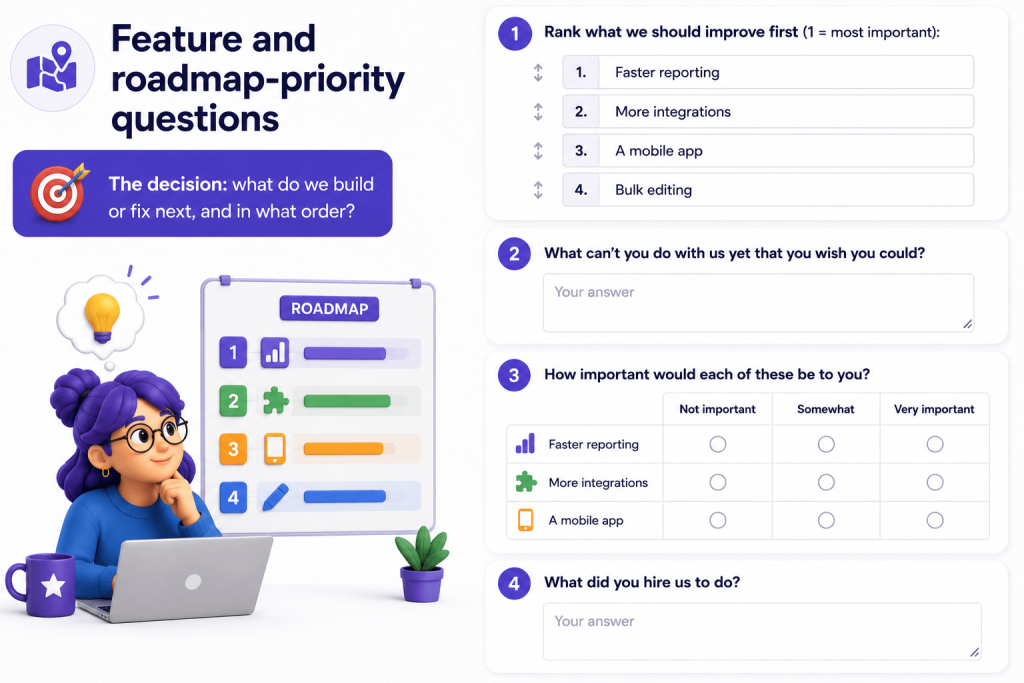
Feature and roadmap-priority questions
The decision: what do we build or fix next, and in what order?
Not “rate feature X.” This set asks what matters most, what’s missing, and what the customer actually hired you to do, so the roadmap follows their priorities instead of the loudest voice in the room. Ranking earns its place here: it forces the trade-off a checkbox lets people dodge.
- Rank what we should improve first (1 = most important): ⇅ 1. Faster reporting ⇅ 2. More integrations ⇅ 3. A mobile app ⇅ 4. Bulk editing
A ranking tells you the order among the options you already know. The open question finds the ones you don’t.
- What can’t you do with us yet that you wish you could? [ your answer ]
When you’re validating a shortlist, a compact importance grid reads fast and segments cleanly.
- How important would each of these be to you?
| Not important | Somewhat | Very important | |
|---|---|---|---|
| Faster reporting | ◯ | ◯ | ◯ |
| More integrations | ◯ | ◯ | ◯ |
| A mobile app | ◯ | ◯ | ◯ |
Close with the jobs-to-be-done question, the one that reframes every feature request as an outcome.
- What did you hire us to do? [ your answer ]
The open answers here hold the real roadmap signal, and reading them well is its own skill, covered in our guide to qualitative questions.
Journey-friction questions
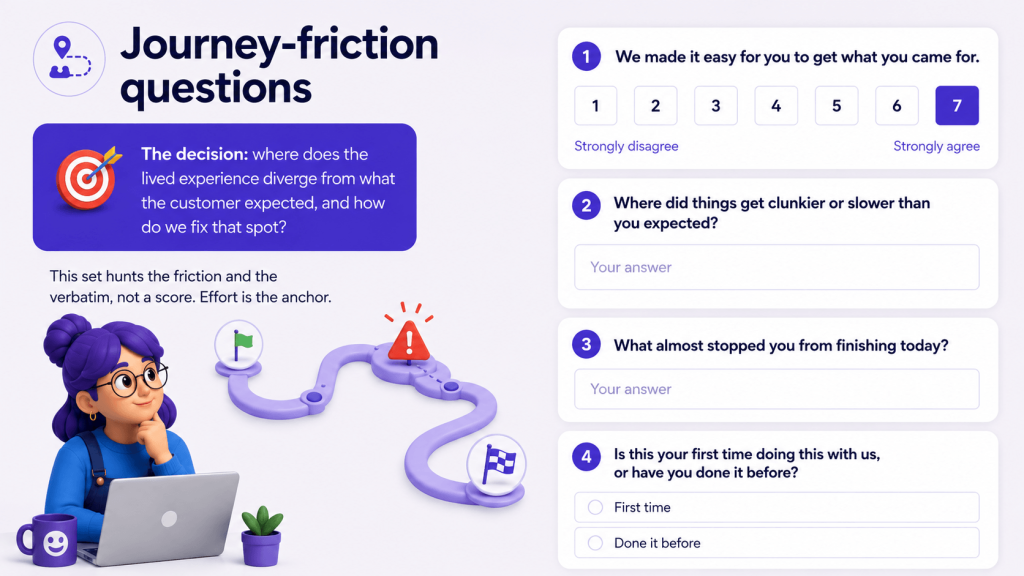
The decision: where does the lived experience diverge from what the customer expected, and how do we fix that spot?
This set hunts the friction and the verbatim, not a score. It looks across the journey for the exact place where effort spiked or an expectation broke, chasing the gap rather than the rating. Effort is the anchor.
- We made it easy for you to get what you came for. Strongly disagree · 1 2 3 4 5 6 7 · Strongly agree
A low effort score flags that something dragged. The open question tells you where.
- Where did things get clunkier or slower than you expected? [ your answer ]
A near-miss variant (“What almost stopped you from finishing today?”) pulls out the objection the customer pushed through this time and might not next. And because first-timers and returning customers break in different places, a single-select gate lets you split them.
- Is this your first time doing this with us, or have you done it before? ◯ First time ◯ Done it before
A voice of the customer survey template
Here’s the part almost no ranking page ships: not a list of questions, but the order they go in. A voice of the customer survey is really five slots.
- Intro line: One sentence naming the decision + how long it takes.
- Anchor metric: Ask it FIRST. NPS for a relationship pulse, CES for a transactional one.
- Decision Qs: One or two questions from the set that match your decision.
- Open question: The verbatim “voice” question. One box, near the end.
- Segmentation: Plan, tenure, or role. Last, and optional.
Filled in for a relationship pulse, it renders like this:
Two quick questions on how we’re doing, plus one open one. About 60 seconds.
- How likely are you to recommend us to a friend or colleague? 0 1 2 3 4 5 6 7 8 9 10
- What one thing would make you rely on us more than you do today? [ your answer ]
- How long have you been a customer? ◯ Under 6 months ◯ 6-12 months ◯ 1-2 years ◯ 2+ years
Keep the whole thing to five or six questions and a single open box; attention is scarce and a bloated VoC survey gets abandoned like any other. Ask the anchor metric first, before any other question can prime it. Run it across the channels your customers actually use instead of one annual email blast. And close the loop afterward, because people stop answering surveys that seem to vanish into a void.
Best practices for VoC survey questions
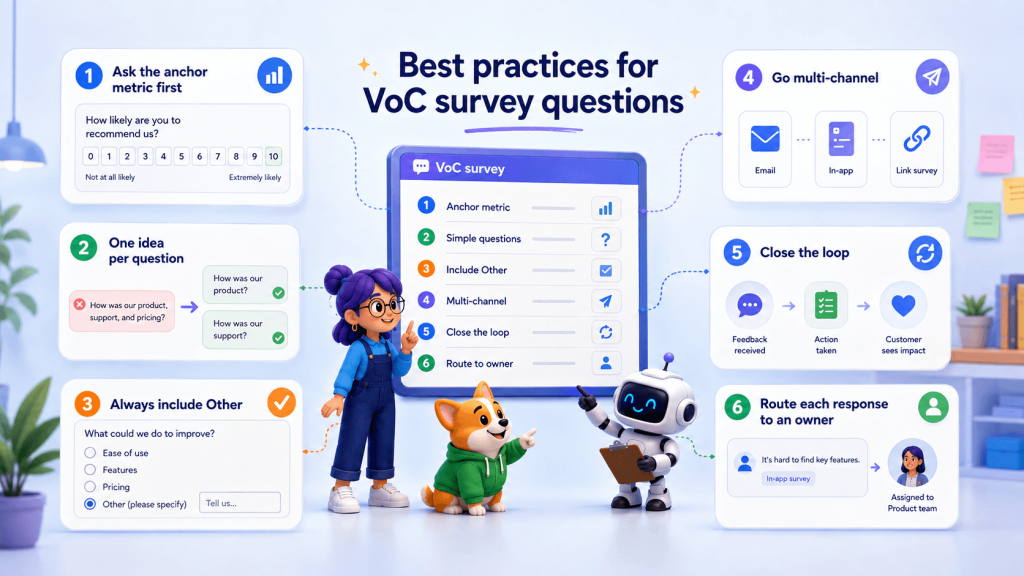
Most of the craft of wording these well lives in our guide to writing effective survey questions. A handful of rules matter enough to repeat for VoC specifically:
- Ask the anchor metric first. NPS or CES goes at the top, before any question can nudge the answer.
- One idea per question. “Fast and helpful support” bundles two things a customer might rate differently. Split them.
- Always leave an “Other” box. The most useful churn reason is usually the one you forgot to list.
- Go multi-channel, not one blast. Email, in-app, and a link survey each reach people the others miss.
- Close the loop. Show respondents that their input changed something, or the next survey’s response rate pays for it.
- Pick a tool that routes each response to an owner. Feedback only becomes action when it lands on someone’s desk. Our roundup of VoC tools covers the options.
From a question bank to a VoC program
The questions are only half the job. A voice of the customer survey earns its keep when the answers reach the person who can act on them, which means asking the anchor metric first, keeping the survey short, running it where your customers already are, and closing the loop.
Retently renders NPS, CSAT, and CES as neutral, single-tap question types and routes every response to an owner, so your VoC runs as a program across channels instead of one annual blast. Start a free trial and send one of the sets above to your own customers.
Frequently Asked Questions
What is a voice of the customer survey? A voice of the customer survey is a short set of questions designed to capture what customers expect, value, and would change, in their own words, so the answers guide a business decision. Unlike a satisfaction survey that scores a past interaction, a VoC survey is forward-looking: it surfaces priorities and expectations you can act on before the next experience.
How is a VoC survey different from a CSAT survey? CSAT measures how satisfied someone was with a specific experience that already happened, usually on a 1 to 5 scale. A VoC survey is proactive: it asks about expectations, priorities, and what would improve the relationship, often through open and trade-off questions. CSAT tells you a moment’s score; VoC tells you what the customer wants next.
How many questions should a VoC survey have? Keep it to roughly five or six questions with a single open-text box. A VoC survey should lead with one anchor metric, add one or two questions tied to the decision you’re making, and end with an open “voice” question. Longer surveys lower completion, and the extra questions rarely earn their place.
What questions should a voice of the customer survey ask? Start with an anchor metric (NPS for relationship health, CES for a transactional pulse), then add questions matched to your decision: what would deepen the relationship, why they might leave, what to build next, or where the experience broke. Always include one open question that asks for the answer in the customer’s own words.
How often should you run a voice of the customer survey? Match the cadence to the decision. Relationship-level VoC surveys fit a quarterly or twice-a-year rhythm, while journey-friction and transactional questions run continuously, triggered right after the moment they ask about. Running one short survey per touchpoint beats one long annual survey that tries to cover everything at once.

 Christina Sol