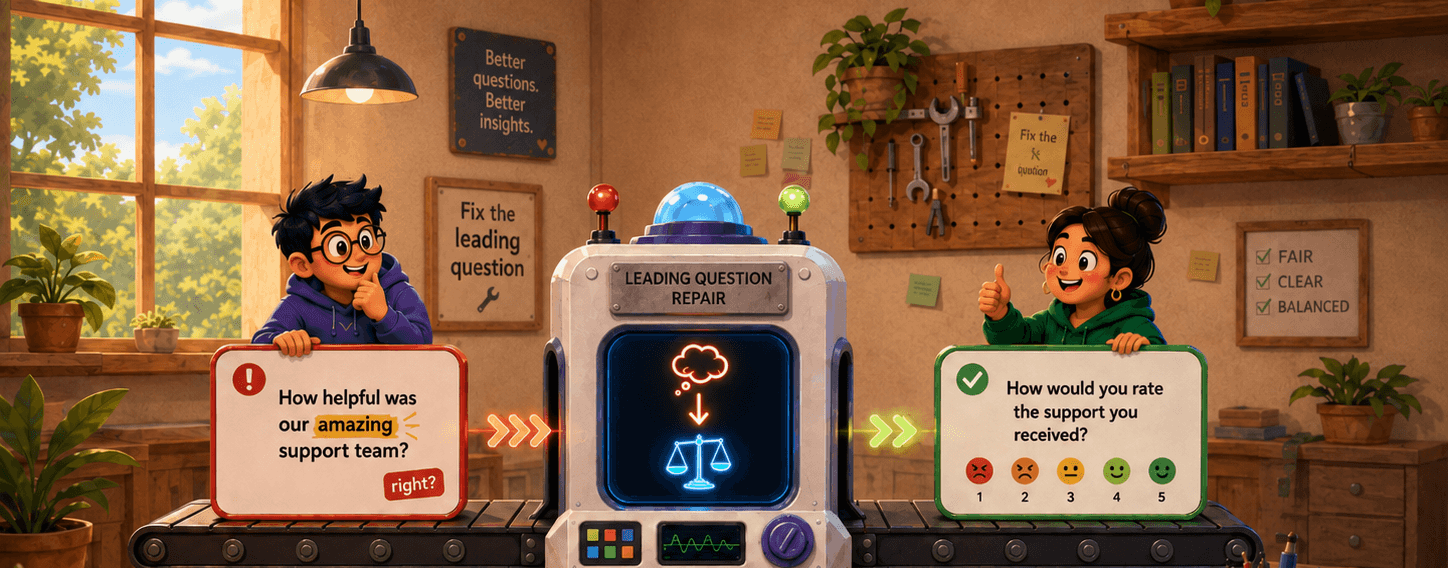



Your latest post-purchase survey reads 4.8 out of 5. The support queue says otherwise: returns are climbing, and a chunk of this week’s tickets are about an item that arrived damaged. Look at what the survey asked: “How much did you love your new order?” A lukewarm customer still has to pick a number that sits under the word love, so the score drifts up and the real signal gets buried.
That’s a leading question, and it’s a data-quality bug, not a matter of taste. One word can move the number by several points. This piece covers the definition, 20 leading-to-neutral rewrites for real ecommerce and SaaS surveys, the six mechanisms behind them, and a checklist to catch them before you hit send.
Key Takeaways
- A leading question is worded to push respondents toward a particular answer, which turns your survey into a data-quality bug instead of a measurement.
- One word can move the number: in a classic 1974 study, swapping “hit” for “smashed” changed people’s speed estimates by nearly 7 mph.
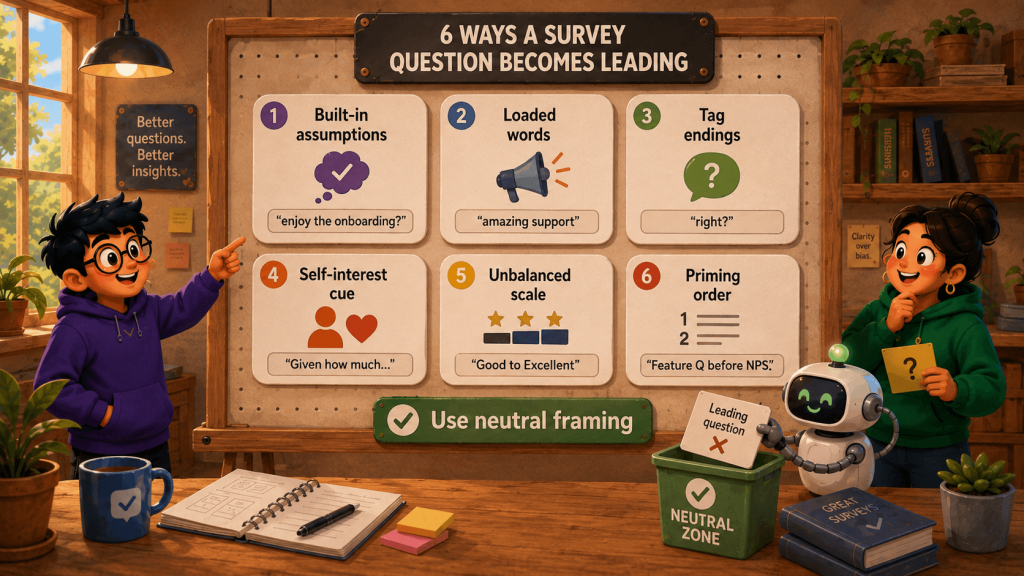
- Six mechanisms cause it: built-in assumptions, loaded adjectives, tag endings, self-interested preambles, unbalanced scales or options, and question order.
- The fix is neutral framing plus balanced scales and answer options. The quickest test: could a happy customer and an unhappy customer both answer honestly?
What is a leading question?
A leading question is one worded to nudge the respondent toward a particular answer. It plants an assumption, an evaluation, or an implied “right” response inside the question, so people agree with the frame instead of reporting what they think. The result skews toward whatever the survey author expected to hear. In a courtroom, that’s deliberate; in a survey, it’s usually an accident that corrupts the data you’re paying to collect.
Here’s the gap in one line. “How helpful was our support team?” has already decided that support was helpful, so the customer only picks how helpful. “How would you rate the support you received?” leaves room for “not very.” Same topic, different data.
Leading questions are one of several types of survey questions that go wrong, and they slip through more than most because they read as friendly.
Leading vs loaded questions (and where “biased” fits)
The two labels get used interchangeably, but they fail in slightly different ways.
A leading question steers you toward a preferred answer through framing or a built-in assumption: “Our checkout is quick and secure, wouldn’t you agree?” The wording points at “yes.”
A loaded question goes further. It buries an assumption the respondent never agreed to, so any answer confirms it. The textbook case is “Have you stopped abusing your dog?” – answer either way, and you’ve conceded the abuse. A softer CX version: “What made you leave when things were going so well?” takes for granted that things were going well.
Both are forms of wording bias, and wording is only one way a survey tilts. Sampling, nonresponse, and who replies matter just as much, but those are separate problems. This article stays on wording.
6 ways a question ends up leading
Naming the mechanism behind a leading question is what lets you catch it in your own draft. Six show up again and again.
Built-in assumptions (presupposition)
The question takes something for granted before the customer speaks. “How much did you enjoy the onboarding?” assumes enjoyment happened. The tell: pull out the loaded verb. If “enjoy” is carrying the question, you’re leading.
Loaded or emotive adjectives
Praise hiding inside the question. “How fast was our lightning-quick delivery?” and “our amazing support team” grade themselves before the customer gets a turn. The tell: an adjective that flatters your own product has no place in the question stem.
Agreement and tag questions
Endings like “wouldn’t you agree?”, “right?” and “won’t you?” fish for a nod. That’s acquiescence bias, the documented tendency to agree rather than argue, and it’s stronger when the respondent is rushing. The tell: if you can answer “yes” without really reading the question, cut the tag.
Tying the question to your own interest
A flattering preamble or a social-proof cue that primes the answer: “Given how much our tool has improved your workflow, how likely are you to recommend us?” People read the room and answer to match. The tell: delete everything before the actual question and see if the meaning changes.
Unbalanced scales and one-sided answer options
Bias hides in the answers, not just the wording. A scale that runs “Good to Excellent” gives an unhappy customer nowhere to stand, and options that only trend positive do the same. The tell: read your poles and options out loud, and if a frustrated customer can’t find themselves on them, the scale is leading.
Question order and priming
What comes before a question colors its answer. Put an enthusiastic feature question right above your NPS item, and the score inflates, because you’ve just reminded everyone what they like. The tell: whatever sits immediately above your key metric is priming it.
The fix for all six is neutral framing, and each of the 20 examples below is tagged with its mechanism so the pattern sticks.
20 leading question examples (with neutral rewrites)
Each entry follows the same shape: the leading version, the mechanism that makes it lead, and a neutral rewrite you can paste straight into a survey. These are drawn from the survey moments we see most across Retently accounts.
Ecommerce surveys
- “How much did you love your new order?” Presupposition: assumes love before the customer weighs in. Rewrite: “How would you describe your experience with your recent order?”
- “How fast was our lightning-quick delivery?” Loaded adjective: it grades the delivery inside the question. Rewrite: “How would you rate the delivery time for your order?”
- “Our returns are super simple. How easy was your return?” Loaded adjective: primes “easy” before the customer answers. Rewrite: “How easy or difficult was it to return your item?”
- “What did you like most about our high-quality products?” Presupposition: bakes in both the quality and the liking. Rewrite: “What, if anything, stood out about the product you received?”
- “Our checkout is quick and secure, wouldn’t you agree?” Tag question: the ending invites a yes. Rewrite: “How would you rate the checkout process?”
- “If you loved your order, will you shop with us again?” Presupposition: conditions the whole question on love. Rewrite: “How likely are you to purchase from us again?” (0 = not at all likely, 10 = extremely likely)
- “You’ll be renewing your subscription, won’t you?” Tag question: pressures the customer toward a yes. Rewrite: “How likely are you to renew your subscription?”
- “Do you agree our pricing is fair for everything you get?” Agreement bias: asks them to agree with “fair,” not to judge it. Rewrite: “How would you rate the value you get for the price you pay?”
SaaS and B2B surveys
- “How helpful was our effortless onboarding?” Loaded adjective: “effortless” decides the verdict for them. Rewrite: “How would you describe your onboarding experience?”
- “How much time does our powerful automation save you?” Presupposition: assumes the automation saves time at all. Rewrite: “Has the automation changed how long your tasks take? If so, how?”
- “Did our friendly support team resolve your issue quickly?” Agreement bias, and double-barreled: “friendly” and “quickly” lead, and it asks two things at once. Rewrite: Split it. “Was your issue resolved?” then “How would you rate the support you received?”
- “Given how much our tool has improved your workflow, how likely are you to recommend us?” Self-interested preamble: the flattery does the persuading. Rewrite: “How likely are you to recommend us to a colleague?” (0-10)
- “Most of our customers love dark mode. How important is it to you?” Social-proof priming: the bandwagon cue nudges a higher answer. Rewrite: “How important is dark mode to you?”
- “What made you leave when things were going so well?” Loaded presupposition: assumes things were going well, which is exactly what’s in dispute. Rewrite: “What’s the main reason you’re canceling?”
Scales, answer options and order
- “On a scale of Good to Excellent, how was our service?” Unbalanced scale: there’s no way to say it was poor. Rewrite: “On a scale of 1 (poor) to 5 (excellent), how would you rate our service?”
- Options that read “Satisfied / Very satisfied / Extremely satisfied.” One-sided answer options: every choice is a compliment. Rewrite: Give the full range: “Very dissatisfied / Dissatisfied / Neutral / Satisfied / Very satisfied.”
- Asking “How much do you value our new AI features?” on the screen right before your NPS question. Question order: the enthusiasm primer inflates the score that follows. Rewrite: Ask the NPS question first, and keep any enthusiasm questions after your key metric.
- “What did you enjoy most about working with our amazing team?” Loaded adjective, open-ended: “amazing” and “enjoy” fence in the reply. Rewrite: “What’s the main reason for your score?” – one of many open-ended alternatives that invite an honest reason instead of a compliment.
- “Wouldn’t you say setup was easier than you expected?” Agreement bias: the double negative quietly nudges a yes. Rewrite: “How did the setup compare to what you expected?”
- “How much better is our new dashboard than the old one?” Presupposition: assumes the new one is better. Rewrite: “How does the new dashboard compare to the previous version?”
Why leading questions wreck your data
Two well-known studies show how far a single word can move an answer.
In 1974, psychologists Elizabeth Loftus and John Palmer showed people the same film of a car crash, then asked how fast the cars were going. Asked when the cars “smashed” into each other, people estimated 40.8 mph on average. Asked when the cars “hit,” the estimate dropped to 34.0 mph. Same footage, one verb, nearly 7 mph of difference. A week later, the “smashed” group was more than twice as likely to falsely remember broken glass that was never in the film (32% versus 14%).
Decades earlier, in 1941, Donald Rugg found the same effect in plain survey wording. When Americans were asked whether the U.S. should “allow” public speeches against democracy, 25% came down on the side of allowing them. When a matched group was asked whether the U.S. should “forbid” those speeches, 46% refused to forbid, logically the same stance, a 21-point swing on nothing but the verb.
Now put that in CX terms. A leading question that pushes your CSAT from a true 3.9 to a reported 4.4 makes you act on a mirage: you deprioritize the fix, miss the churn signal, and teach customers the survey isn’t really listening. Biased phrasing is a known way biased NPS wording throws a score off, and it’s rarely the only bias in the room. The broader mechanics, from sampling to nonresponse, live in our guide to survey bias.
How to catch and fix leading questions before you send
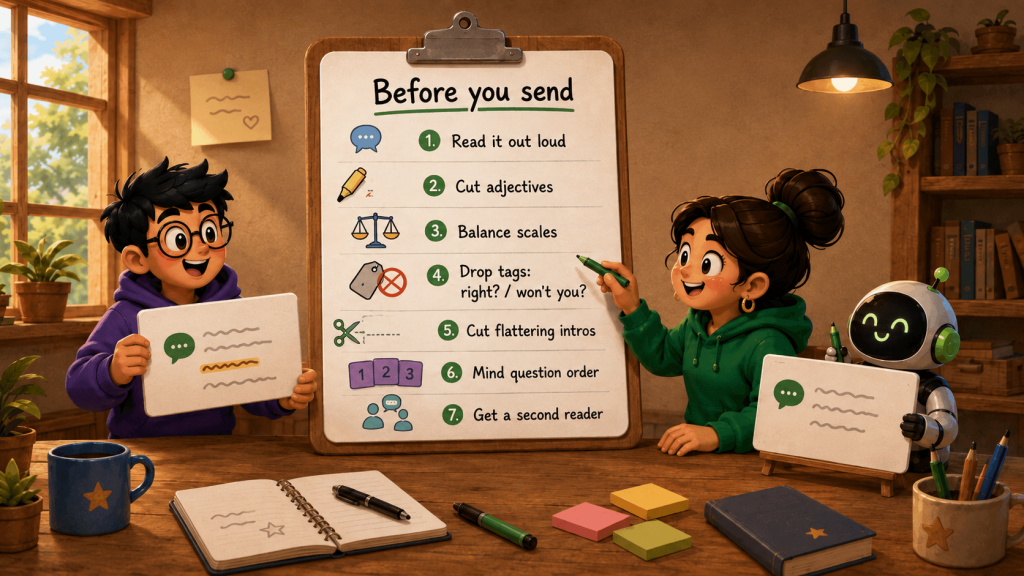
Run through this before you schedule anything.
- Read each question out loud. If a happy customer and an unhappy customer wouldn’t both feel free to answer it honestly, it’s leading.
- Strip the evaluative adjectives. “Fast,” “friendly,” “easy,” and “powerful” belong in the answer, never the question.
- Balance the scale and the options. Every scale needs a real negative pole, and every option list needs the unhappy choices spelled out.
- Drop the tag endings: “right?”, “won’t you?”, “wouldn’t you agree?”.
- Cut flattering preambles and social-proof cues. Start at the actual question.
- Mind the order. Keep enthusiasm questions after your key metric, not in front of it.
- Pilot on a few real customers, then get a second reader. The person who wrote a question is the worst judge of whether it leads.
Leading questions are one entry on a longer list of common bad survey questions, alongside double-barreled, vague, absolute, and jargon-heavy ones, so once the wording is neutral, it’s worth a sweep for those too. For the full craft of building questions that hold up, the guide on how to write neutral survey questions goes deeper than a pre-send checklist can here.
Neutral questions tell you what’s actually wrong
You run surveys to find the problems you can’t already see. A leading question guarantees you won’t: it answers itself before the customer does. Fix the wording, balance the scales, watch the order, and the number that comes back means something you can act on.
Retently’s NPS, CSAT, and CES templates are written to stay neutral from the start, so your first survey isn’t quietly grading itself. Start a free trial or book a demo to see how they read.
Frequently Asked Questions
What is a leading question? A leading question is one worded to nudge the respondent toward a particular answer, usually by planting an assumption or an evaluation inside the question. Instead of measuring what someone thinks, it measures how readily they accept the frame you handed them. In a survey, that quietly distorts your result.
What is an example of a leading question in a survey? “How fast was our lightning-quick delivery?” is leading: it praises the delivery inside the question, so a customer whose parcel arrived late still feels steered toward a positive answer. The neutral version asks “How would you rate the delivery time for your order?” and lets the real experience come through.
What is the difference between a leading and a loaded question? A leading question steers you toward a preferred answer through framing, like a “wouldn’t you agree?” ending. A loaded question goes further and buries an assumption you never agreed to, so any answer confirms it. “What made you leave when things were going so well?” assumes things were going well. Loaded questions are a sharper subset of leading ones.
Are leading questions always bad? In surveys and research, yes: they corrupt the data you set out to collect. The one place they’re used on purpose is cross-examination in court, where an attorney is allowed to lead a witness. For measuring customer sentiment, though, a leading question is always a defect.
Is a closed-ended question automatically leading? No. Closed-ended just means the answer choices are fixed, like a 0-10 scale or a set of options. A closed question is only leading if its wording or its options push toward one answer. “How likely are you to recommend us? (0-10)” is closed and neutral; “You’d recommend us, wouldn’t you?” is closed and leading.

 Alex Bitca


 Christina Sol